
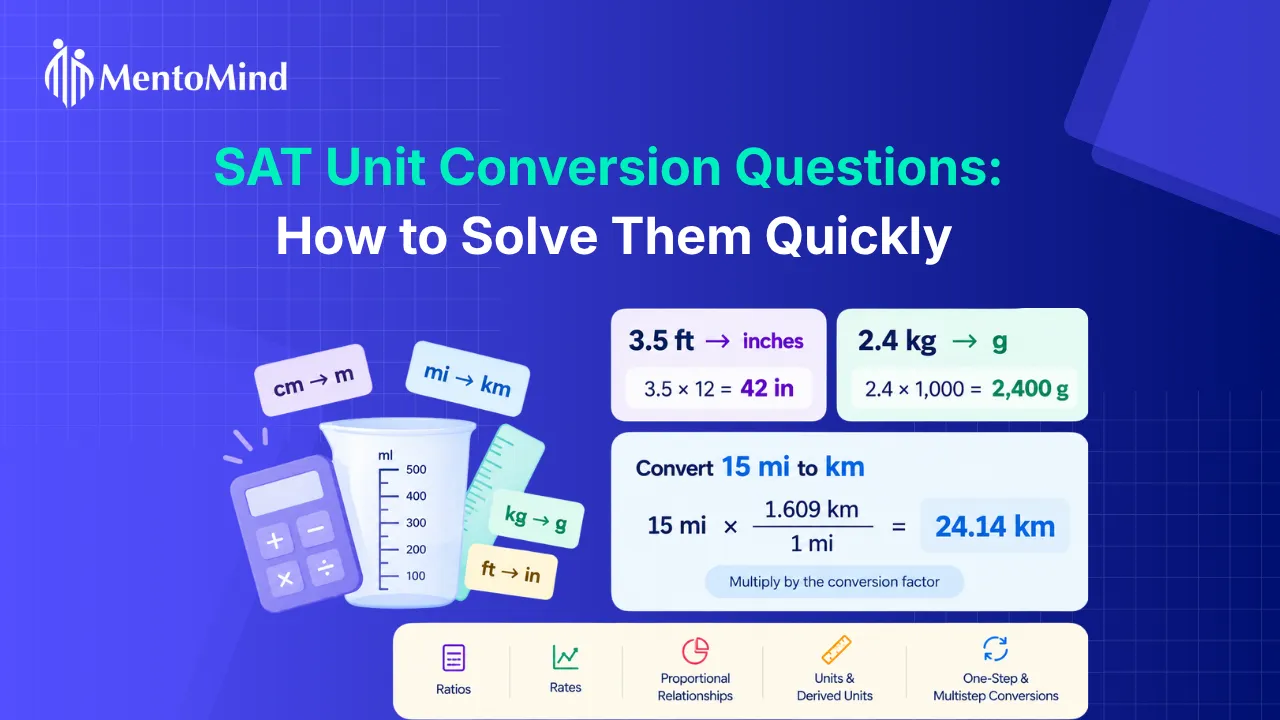
One scenario that we’ve found to play out in test centers every single testing day is: a student nails a tricky quadratic, breezes through a systems-of-equations question, and then loses points on something that looks almost embarrassingly simple: converting minutes to hours, or feet per second to miles per hour. Not because the math is hard, but because the setup is rushed. It’s exactly the kind of question a student blows past when they’re moving fast, and exactly the kind of miss a parent remembers long after the practice test is graded.
SAT unit conversion questions are some of the “freest” points on the entire Math section, once you know the one method that solves nearly all of them. No worries, we will teach you how to approach conversion questions in your next SAT, so you’re never guessing which way a conversion factor goes on test day.
What Exactly Are SAT Unit Conversion Questions?
Unit conversion questions ask you to move a quantity from one unit of measurement to another, usually as one step inside a larger word problem.
- Same-system conversions: inches to feet, ounces to pounds, minutes to hours.
- Compound or rate conversions: feet per second to miles per hour, dollars per ounce to dollars per pound, miles per gallon comparisons.
- Embedded conversions: the unit switch is slipped inside a longer question about proportional relationships, scale drawings, or data analysis
Often that third category is the one that catches students off guard because the question never says the word ‘convert.’ It just quietly changes units between the given information and the answer choices.
Why You’re Expected to “Know This”
Unit conversion falls under what College Board calls the Problem-Solving and Data Analysis domain, which tests your ability to reason through ratios, rates, and proportional relationships. It accounts for 5 to 7 of the 44 questions on the Math section, just a relatively small slice of the test, which is why losing points here stings more. Moreover, since about 30% of Math questions are set in real-world contexts, conversion steps also hide inside questions from other domains. Before you even start the real math, you’ll find yourself converting units.
What actually happens is students read the question fast and start working before they understand which unit the answer needs to be in or which direction a conversion factor goes. It’s not a conceptual error, but a pattern you can fix. All you need is to hit the weak spot in your Digital SAT Math practice plan.
The One Method That Solves Almost Every SAT Unit Conversion Question
Dimensional analysis or unit cancellation is the most reliable approach. Write every conversion factor as a fraction and arrange it so the unit you want to get rid of sits opposite itself and cancels out, leaving only the unit you want.
The general template
Given quantity (in Unit A) × (Unit B ÷ Unit A) = Answer (in Unit B)
Put the unit you’re starting with on the bottom of the conversion fraction, and the unit you want on top. When you multiply, Unit A cancels diagonally, and you’re left holding exactly the unit the question asked for.
For the full, authoritative list of standard conversion factors, the National Institute of Standards and Technology (NIST) publishes the official U.S. reference guide. It is the same one used across science, engineering, and education. You can bookmark it if you ever want to double-check an exact factor.
tip: Whenever you’re unsure which way a conversion fraction should flip, write both units out in full next to your numbers. If a unit doesn’t cancel, the fraction is upside down. Flip it and try again.
Step-by-Step SAT Unit Conversion Examples
Example 1: Single-step conversion
Question: A lab experiment must run for 150 minutes. How many hours is that?
Step 1: Set up the conversion fraction with the unit you want (hours) on top and the unit you have (minutes) on the bottom: 1 hour ÷ 60 minutes.
Step 2: Multiply: 150 minutes × (1 hour ÷ 60 minutes) = 150 ÷ 60 = 2.5 hours.
Step 3: Check the unit. Minutes cancel; hours remain.
Answer: 2.5 hours.
Example 2: Multi-step rate conversion
Question: A drone flies at 88 feet per second. What is its speed in miles per hour?
Step 1: Convert feet to miles: 88 feet/second × (1 mile ÷ 5,280 feet).
Step 2: Convert seconds to hours: multiply by (3,600 seconds ÷ 1 hour), since you’re removing seconds from the denominator, so the time conversion factor goes on top.
Step 3: Combine: 88 × (1 ÷ 5,280) × 3,600 = 88 × 3,600 ÷ 5,280 = 60 miles per hour.
Answer: 60 miles per hour.
Remember: In rate conversions, you’re converting two units at once, one in the numerator, one in the denominator. Handle them as two separate multiplication steps rather than trying to do it in one leap.
Example 3: Compound (squared) units
Question: One gallon of paint covers 350 square feet. A wall measures 42 square yards. How many gallons of paint are needed, rounded to the nearest whole gallon?
Step 1: Convert square yards to square feet. Since 1 yard = 3 feet, 1 square yard = 3² = 9 square feet.
Whenever a conversion involves area (square units) or volume (cubic units), square or cube the linear conversion factor before you use it.
Step 2: 42 square yards × 9 square feet/square yard = 378 square feet.
Step 3: Divide by coverage rate: 378 ÷ 350 ≈ 1.08, which rounds up to 2 gallons (you always round up when buying enough material to cover a full area).
Answer: 2 gallons
Common Mistakes on SAT Unit Conversion Questions
This is a well-known weak spot, flagged as one of the most common SAT Math tips and traps test-takers run into, because the mistakes are small, but the point loss is real. Watch for these:
- Flipping the conversion fraction upside down, so units multiply instead of canceling.
- Forgetting to square or cube the conversion factor when the units involve area or volume.
- Solving for the right number but the wrong unit — the SAT frequently includes a trap answer that matches your work but not the requested unit.
- Rounding in the middle of a multi-step conversion instead of at the very end, which compounds small errors.
- Mixing up compound units, like confusing miles per hour with hours per mile in a rate setup.
So, the fix is: write the unit next to every number, every step. If the units don’t visibly cancel on your scratch paper, the setup is wrong, and you’ll catch it.
Quick-Reference Table: Common SAT Unit Conversions
These are the conversions that come up most often on the Digital SAT. Values are drawn from NIST’s official general tables of units of measurement, the standard reference used in U.S. science and education.
| Category | Conversion | Factor |
|---|---|---|
Length |
1 foot |
12 inches |
Length |
1 yard |
3 feet |
Length |
1 mile |
5,280 feet |
Time |
1 minute |
60 seconds |
Time |
1 hour |
60 minutes |
Time |
1 day |
24 hours |
Weight/Mass |
1 pound |
16 ounces |
Weight/Mass |
1 ton |
2,000 pounds |
Volume |
1 cup |
8 fluid ounces |
Volume |
1 gallon |
4 quarts |
Area |
1 square yard |
9 square feet |
Some of these are easy to mix up under pressure. Quarts and gallons trip people up because the number (4) feels almost too small to be right. And square-yard-to-square-foot conversions get missed constantly because students multiply by 3 instead of squaring it to get 9; more on that below.
The 60-Second Trick: Dimensional Analysis
Spend one short session memorizing the list above cold. But to remember it, over your next three practice sessions, deliberately flag every conversion or rate question you find and solve it using the full unit-cancellation method. By the fourth session, it should feel automatic, not deliberate.
Write your starting quantity as a fraction, then multiply by the conversion factor arranged so the unit you want to eliminate is on the bottom, canceling against the unit you’re starting with. Whatever’s left on top is your answer’s unit.
Example 1: Simple conversion
Question: A runner holds a pace of 6 minutes per mile. What is that pace in miles per hour?
Since pace is minutes per mile and you want miles per hour, flip it: 1 mile per 6 minutes. Now, convert minutes to hours. 1 mile ÷ 6 minutes × 60 minutes ÷ 1 hour = 60 ÷ 6 = 10 miles per hour.
Example 2: With squared units
Question: If a rug covers 8 square yards, how many square feet is that?
1 yard = 3 feet. So, 1 square yard = 3² = 9 square feet
8 square yards × 9 square feet per square yard = 72 square feet
Remember: Linear conversions get squared for area and cubed for volume.
How to Practice SAT Unit Conversion Questions the Smart Way
Reading about a method is not the same as being fast under a 35-minute module clock. To actually build speed and accuracy on unit conversion:
- Drill the dimensional analysis (full unit-cancellation) method until it’s automatic.
- Practice compound and multi-step conversions specifically
- Review your mistakes by category to find whether the error was conceptual or a rushed unit slip.
- Time yourself. Most unit conversion questions should take well under a minute once the method clicks.
MentoMind’s adaptive SAT practice tests mirror the real Digital SAT, with detailed performance reports that break your results down by topic including Problem-Solving and Data Analysis. Give them a try and see where unit conversion is costing you points, and fix it before test day.
Frequently Asked Questions
SAT unit conversion questions ask you to change a measurement from one unit to another, such as minutes to hours, feet to miles, or ounces to pounds, usually as one step inside a larger word problem.
Dimensional analysis is the most reliable method. Write each conversion as a fraction with the unit you want on top and the unit you’re removing on the bottom, then multiply so the unwanted units cancel and whatever remains on top is your answer.
Yes. On the digital SAT, a calculator is permitted throughout the entire Math section, including questions involving unit conversion. However, the challenge is rarely the arithmetic; it’s setting up the conversion correctly.
No. The built-in Digital SAT reference sheet, available in Bluebook throughout the Math section, covers geometry formulas like area, volume, and special right triangles. It does not include conversions such as feet-to-miles or minutes-to-hours, so you need to memorize those factors before test day.