Students who search for SAT prep courses usually want to see a real change in their score report, not just a few extra points. A gain of around 150 points is a useful example, and for many students it is reasonable, though the right goal depends on the starting score, the time available, and how the preparation is organized.
Many students put in weeks of practice and still see little movement. Often the difference lies in how that practice is directed rather than in how many hours are logged.
This guide explains what a score increase looks like in practice, offers a way to evaluate any SAT prep course, and describes why MentoMind is a strong SAT prep option for students aiming for meaningful score gains. It ends with a weekly routine you can adapt to your own schedule.
Why a Meaningful Score Increase Is Realistic but Hard With the Wrong Approach
A meaningful score gain is realistic, but it is not automatic. It tends to happen when preparation targets the right skills and to stall when it does not. The sections below explain what a gain of this size looks like and where preparation most often goes off track.
What a 150-point increase on the SAT actually means
The SAT is scored from 400 to 1600, so a 150-point increase represents a meaningful improvement in the total score. This gain could come from different combinations of improvements in Math and Reading & Writing, depending on the student’s starting scores and progress in each section. Because SAT scores are scaled, a 150-point increase does not correspond to a fixed number of additional correct answers.
A gain like this rarely requires learning an entirely new body of material. It usually comes from turning questions that are missed for repeating reasons into correct answers. The cause might be a shaky grasp of one algebra skill, a habit of misreading evidence-based questions, or running short of time near the end of a section. These recoverable points tend to sit in a limited number of weaknesses rather than across the whole test, which is why a gain of this size is reachable for many students. The same logic applies to smaller or larger targets.
Your starting point shapes the target
A student who begins in the middle of the scoring range generally has more recoverable points than one who already scores near the top, so the same goal can be modest for one student and ambitious for another. A target that fits your starting score keeps the plan realistic and makes progress easier to judge.
Random practice rarely moves the score
Working through hundreds of questions can feel productive, but unfocused practice may reinforce skills you already know while leaving weaker areas unaddressed. To make practice more effective, prioritize the skills where you consistently lose points.
A test without review only measures
An SAT practice test shows your current performance, but improvement depends on how you use the results. Review incorrect answers and questions you answered correctly by guessing. Identify whether each mistake came from a content gap, a careless error, or time pressure, then use that information to guide your next practice sessions.
Time pressure can hide what you know
Some missed questions reflect timing rather than knowledge. A student may understand the material and still run out of minutes. Without realistic timed practice, this cost stays hidden until test day, when it is hardest to correct.
Unresolved mistakes compound over time
Each question left unresolved lets a misunderstanding settle in more firmly. When help arrives only days later, the same error can repeat many times before it is corrected, which makes it harder to undo.
What an SAT Prep Course Must Deliver to Support a Meaningful Score Gain
Whatever the price or format, the six questions below help clarify whether a course can support a gain of this size.
| Evaluation Question | Why It Matters |
|---|---|
Does it show exactly which skills are costing you points? |
Prevents wasting time on skills you already know |
Does practice adjust as you improve? |
Keeps work challenging without becoming frustrating |
Are the questions written by experts? |
Matches the real SAT’s difficulty and style |
Are there enough full-length tests? |
Lets you measure real progress more than once |
Can you get help the moment you are stuck? |
Stops small mistakes from becoming habits |
Does it show progress in a form you can act on? |
Helps you know what to fix next |
Few courses will answer yes to every question, and that is not necessarily a flaw. Each gap does mark a place where you may need an additional resource or more self-directed effort. When you compare the best SAT prep courses on these terms, the trade-offs become visible before you commit.
How MentoMind Is Structured to Help Students Make Large Score Improvements
MentoMind is an adaptive test prep platform, and its SAT course is organized around the same six questions. Here is how its main features connect to them.
Expert-created questions
The course includes 3,500+ questions, each written and reviewed by experts. A bank of this size lets a student return to a weak skill several times and at different levels of difficulty. How useful it is depends on which questions are chosen, which is where the features below come in.
Adaptive practice and full-length tests
Practice adjusts to how you perform. The course also includes 11 adaptive full-length tests, which work as checkpoints under realistic conditions. Each SAT practice test shows whether your recent work has changed your results.
Diagnostic tests and personalized pathways
A diagnostic test shows your strengths and weaknesses before studying begins. Personalized learning pathways then turn those results into a sequence of work.
Real-time skill tracking
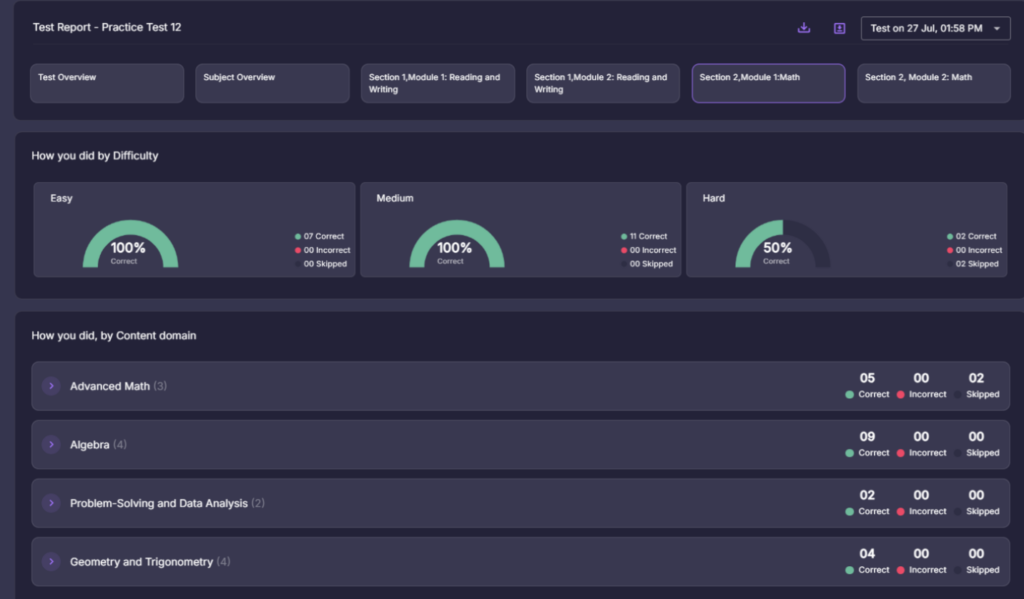
MentoMind records your performance for each individual skill rather than as a single overall score, and it updates that record as you complete practice. Progress reports then organize the results by topic. A student opening a report might see, for example, that one area of math is improving steadily while a particular reading and writing skill is still producing errors. That view shows which weak spots are closing and which still need attention.
Interactive study companion
The interactive study companion is available 24/7 while you work through questions. It provides step-by-step hints and explanations when students get stuck, helping them understand the reasoning behind a question. After a practice session, a summary recaps what to revisit.
Video solutions
For SAT Math questions, students can also open a short, narrated video solution powered by Think10x.ai. These videos walk through the problem step by step, showing the full reasoning rather than just the final answer. The feature is currently available only for SAT Math.
Vocabulary and a learning library
The vocabulary section includes flashcards and practice that help students learn words, along with tracking so they can see how many words they have mastered. The learning library offers study guides, worked examples, and strategy resources for both Math and Reading & Writing, so students can review a concept when needed and then return to practice.
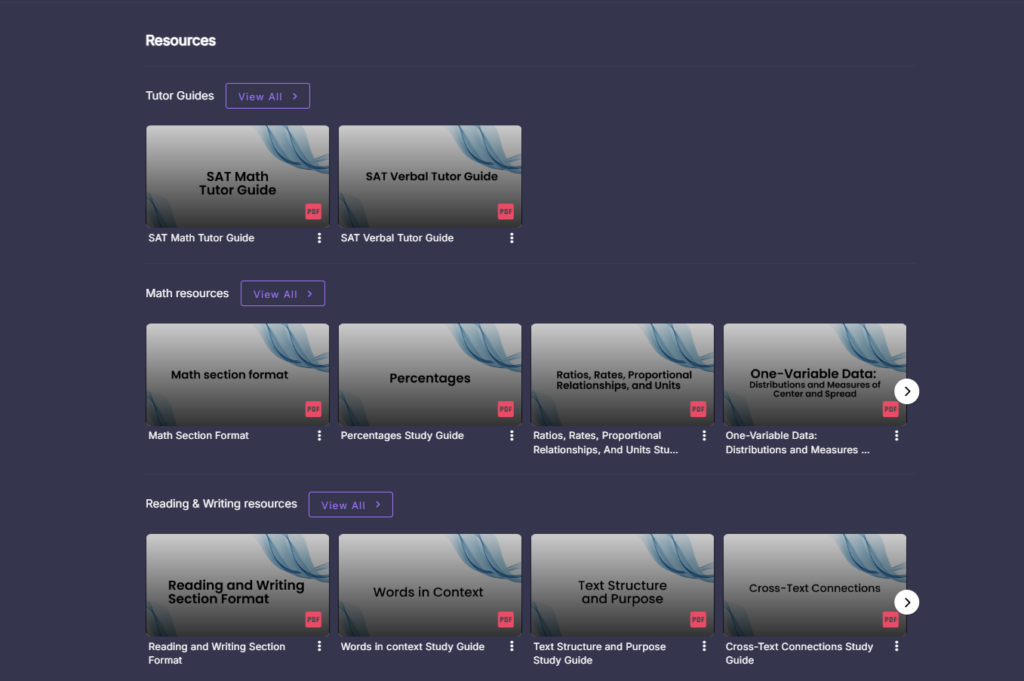
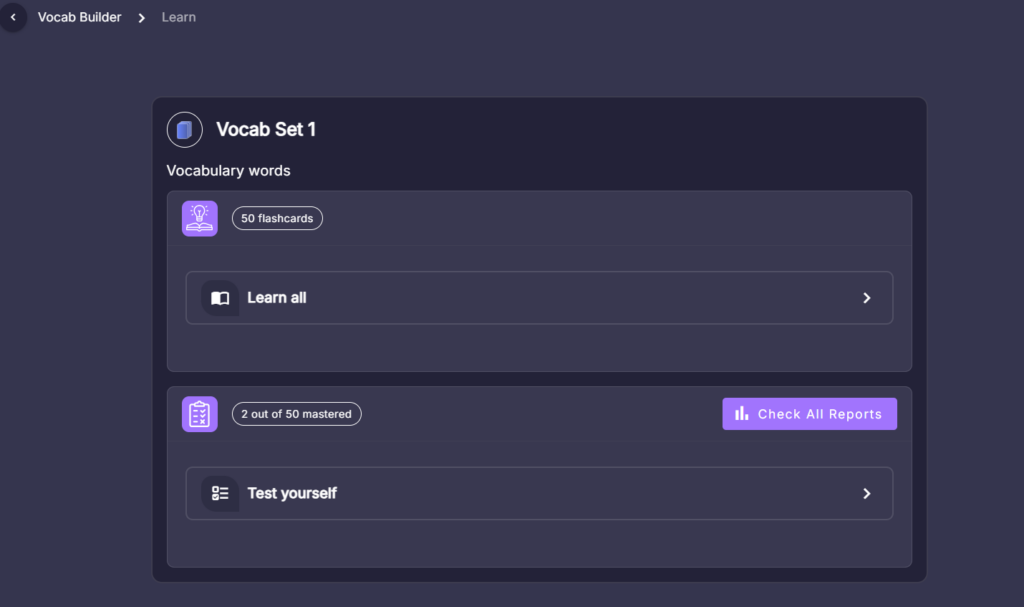
MentoMind’s vocabulary flashcards, mastery tracking, and learning library help students review SAT Math and Reading & Writing concepts.
The Role of Diagnostics, Targeted Practice, Adaptive Tests, and Ongoing Help
These features work best as part of one study process. A diagnostic test identifies weaker skills, targeted practice helps students address them, and hints provide guidance when questions become difficult. Later, an adaptive full-length test helps students assess their progress under timed conditions. Its results can then guide the next round of practice.
This approach makes a question bank more useful because students can focus on specific weaknesses, evaluate their progress, and adjust their study plans based on their results.
A Practical Weekly Routine for a Score Jump Such as 150 Points
Knowing how to study for SAT improvement matters as much as choosing among SAT prep courses. Gains like 150 points build over several weeks, since each fix needs to be practiced, tested, and confirmed. The outline below spans eight weeks as an example and can be adjusted to your exam date.
| Phase | Focus | What You Do |
|---|---|---|
Week 1 |
Baseline |
Take a diagnostic test, read the results by skill, and choose one or two weak skills to start with |
Weeks 2 to 3 |
First targets |
Practice the chosen skills in short, regular sessions and use hints when a question stops making sense |
Week 4 |
First checkpoint |
Take a full-length test, review every miss, and log the cause of each error |
Weeks 5 to 6 |
Second targets |
Move to the next weak skills, along with any skills that did not improve at the checkpoint |
Week 7 |
Second checkpoint |
Take another full-length test and compare the results with the first one |
Week 8 |
Consolidation |
Lighten the workload, review your log, and rest before test day |
Make each checkpoint count
A checkpoint is only as useful as the review that follows it. Sort each error into a content gap, a careless slip, or a timing problem, since each calls for a different fix, and note the skill, the cause, and the correction for anything that repeats. This error log then guides the next block of weeks, because it shows which skills to practice and whether the last round of fixes held. Comparing the second checkpoint with the first is what shows how much has actually changed.
Add vocabulary a little at a time
Short vocabulary sessions add up over several weeks. Practicing words in context keeps them useful when they appear in an unfamiliar passage.
Key Takeaway – Treat every full-length SAT practice test as a checkpoint rather than a study method. Reviewing mistakes afterward is where meaningful improvement begins.
Who Benefits Most from This Approach
Students whose scores have plateaued
A student who has practiced extensively and stopped improving often has one or two specific weaknesses that general practice never reaches. Diagnostics and targeted work are well suited to that situation.
Students with several weeks before the exam
Skill-by-skill improvement takes time, so this approach suits students who have room for at least a few cycles of practice, testing, and review. Students retaking the SAT often fit this description, since an earlier score report already points to where points were lost.
Students who prefer to study independently
Fixed class times are hard to fit around school, sports, and family commitments. A self-paced platform lets students study when it suits them and still keep a steady weekly rhythm.
What to keep in mind
Results vary from student to student. A student who already scores near the top of the range has fewer points left to recover, so the gain will usually be smaller, and a student with only a few weeks has room for fewer rounds of practice and review. No course can promise a specific score. What a course can provide is structure, practice, and feedback, and the studying itself still depends on the student.
Conclusion
Choosing among SAT prep courses starts with finding a program that identifies your weaknesses, provides focused practice, and helps you measure progress over time. A score increase of around 150 points may be a reasonable goal for some students, but results depend on the starting score, preparation time, and consistency of study. Diagnostics, targeted practice, and regular test review can help you build a more structured preparation plan.
Ready to see where you stand? Take a diagnostic test at MentoMind and start building your study plan today.
Frequently Asked Questions
For many students it is a reasonable goal, although the result depends on the starting score, the number of weeks available, and how consistently the student practices and reviews. Students who begin in the middle of the scoring range usually have more recoverable points than those who already score near the top.
A course should show which skills are costing you points, adjust practice as you improve, use expert-written questions, and offer several full-length tests so progress can be measured more than once. It should also provide help while you study and present progress in a form you can act on.
MentoMind combines diagnostic tests, personalized learning pathways, adaptive practice, skill tracking, and an interactive study companion, along with 3,500+ expert-created questions and 11 adaptive full-length tests. It does not guarantee a score increase. It provides a structured way to find gaps and work on them.
The number depends on the time available, but each SAT practice test works best as a checkpoint placed a few weeks after the previous one. The time between tests should go to practicing the skills that the review identified, so that each test measures real change.
Yes. MentoMind works for tutoring businesses as well as independent students, and white-label options are available for programs that prefer to run it under their own brand.
With a diagnostic test. Its results show which skills are costing the most points, and every later decision about practice, testing, and review depends on that starting picture.