Every student knows the feeling. You work through a problem set, check the answer key, and see that you got it wrong. The key shows a number, but it does not show where your thinking went off track.
That gap is what sends students looking for online math platforms . What they really want is not another answer. It is a clear path from the first line of a problem to the last, with the reasoning explained along the way.
This matters most in Advanced Placement Calculus AB and AP Calculus BC, where one question can need a limit, a derivative, and an integral in the right order. A wrong setup costs points even when the arithmetic is perfect.
MentoMind is an adaptive test prep platform built around this need. This guide shows what good step-by-step support looks like, how MentoMind provides it, and how it fits each course.
Why Many Students Struggle With AP Math
Most exam questions are not hard because of one formula. They are hard because they take several steps, and one early slip travels through every line that follows.
Here are the most common reasons students lose points:
Multi-step problems hide the real gap
Picture a student who understands the chain rule perfectly and still loses points, because the setup was wrong from the start. Without seeing each step, it is hard to tell whether the problem was the concept, the setup, or the algebra.
There is no formula sheet on exam day
The College Board does not provide an official formula sheet for the AB or BC exam. You need to know the key formulas and, just as important, know when to use each one.
Calculator and no-calculator sections change the approach
The AB exam includes 45 multiple-choice questions in 1 hour 45 minutes and 6 free-response questions in 1 hour 30 minutes. Each section is worth 50 percent of the score.
Part A of the multiple-choice section has 30 questions in 60 minutes and does not allow a calculator. Students need practice both with and without one.
Answer keys skip the reasoning
A final answer tells you whether you were right. It does not tell you why. Free-response questions award credit for setup and reasoning, so the path matters as much as the result.
What Makes Step-by-Step Support Effective for AP Calculus
A walkthrough only helps if you can learn from it. Clear, step-by-step support explains the reasoning behind each move, helping you understand why it works and apply the same approach to the next problem.
Think about three common errors in AP Calculus –
- Chain rule. Students differentiate the outer function and forget to multiply by the derivative of the inner function.
- Related rates. Students differentiate too early. The strong approach is to write the relationship between the variables first, differentiate with respect to time, and substitute known values afterward.
- Displacement and total distance. The integral of velocity gives displacement. For total distance, you must check where velocity changes sign.
A good explanation catches each of these at the exact step where they happen.
What strong step-by-step support does
- Names the concept behind the question.
- Shows how to set up the problem before any calculation.
- Explains the reason for each step in plain language.
- Flags the mistake students most often make on that question type.
- Points you toward more practice on the same skill.
Why this matters for AP Calculus
AP Calculus AB and BC both cover infinite series, with BC going further into the topic. For many students, series is one of the more challenging areas of the course.
When solving a series question, the first step is to identify what type of series you’re dealing with. Once you recognize the series, you can determine which convergence test is appropriate. Helping students understand this process is more valuable than simply showing them the final answer.
Key Takeaway -> Step-by-step help is only useful when it shows the reasoning, not justthe result.
How MentoMind Supports Students Step by Step
MentoMind follows a simple cycle. You find the gap, practice it with targeted questions, and check your progress as you improve. Each feature below supports one part of that cycle.
Diagnostic tests find your gaps
Diagnostic tests identify topic-level and skill-level gaps. Instead of guessing what to study, you start with a clear picture of where points are being lost.
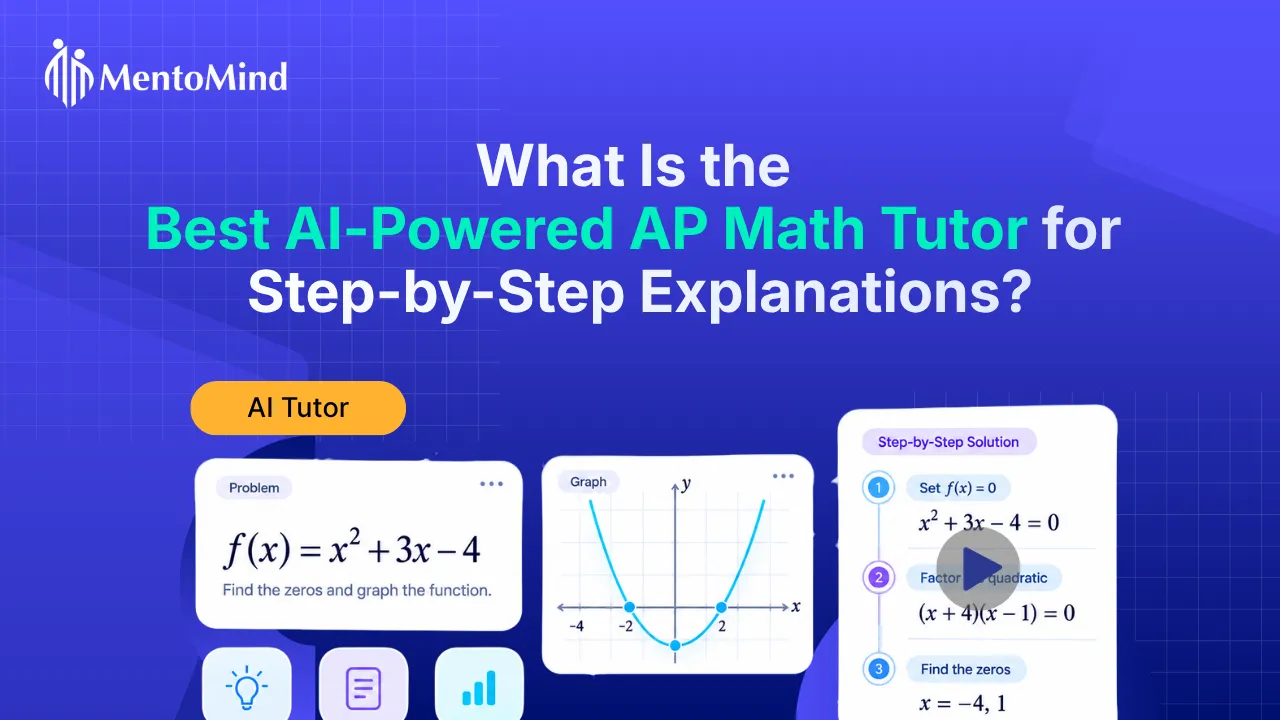
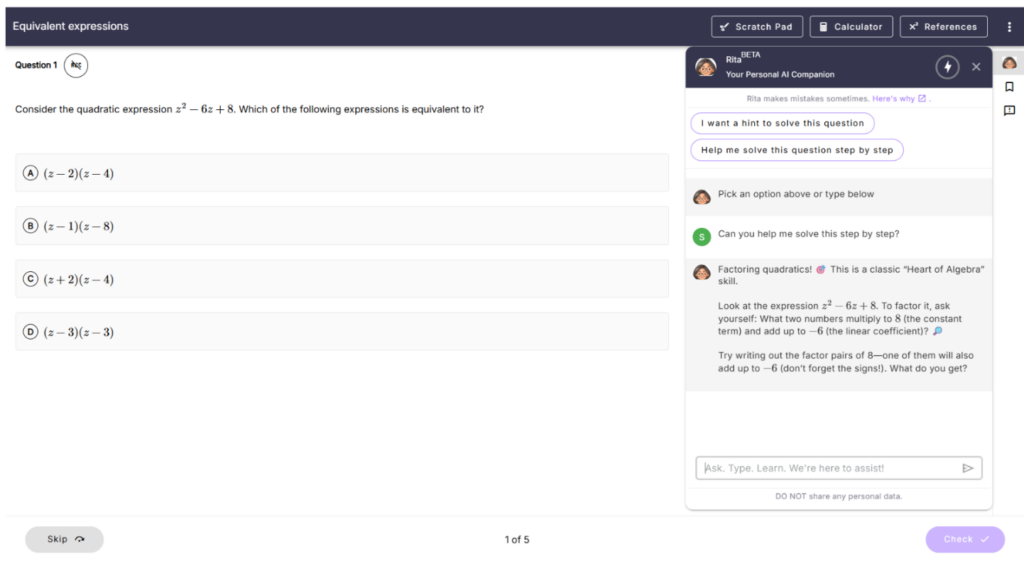
Mento, an interactive study companion gives 24/7 interactive step-by-step explanations
When you are stuck, Mento walks through the problem with you. These interactive explanations are available 24/7, so help is there during late-night problem sets and early-morning review.
Step-by-step video solutions
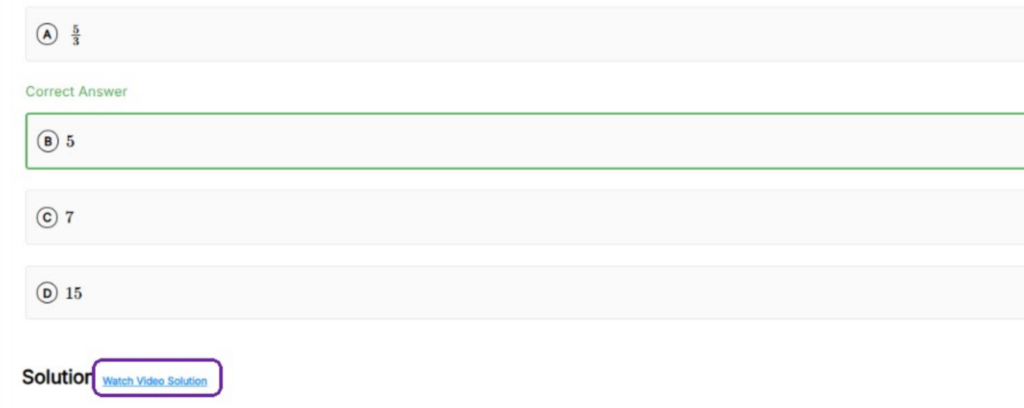
Powered by Think10x.ai, MentoMind provides short, narrated video solutions that walk students through questions step by step. For eligible questions, a “Watch Video Solution” link appears next to the Solution heading. Clicking it opens the video in an overlay on the same screen, so students can follow the explanation without losing their place.
Each video focuses on the reasoning behind the solution, helping students understand how to approach the problem, not just what the final answer is.
The feature is currently available for Math in SAT and ACT, and for all subjects in other courses.
The first time a question’s video is requested, there may be a brief preparation step. Once generated, the video is saved and will load almost instantly the next time it is viewed.
Use a video solution when you want to see the complete solution explained step by step. When you want to ask questions or explore the problem as you work through it, use Mento. Together, they provide both guided explanations and interactive support.
Targeted drills for MCQ and FRQ
Practice is not one-size-fits-all. MentoMind offers targeted drills for both multiple-choice and free-response questions, so you can work on the format that costs you the most points.
The course also includes the following.
- Calculator and no-calculator practice
- Real-world application problems
- Timed practice exams that simulate real AP exam conditions
Difficulty that builds over time
Practice moves from Beginner to Intermediate to Advanced to Mastery. You build confidence on the basics before taking on the hardest questions.
Progress tracking by unit, topic, and skill
Progress tracking shows mastery by unit, topic, and skill. You can see which areas are strong and which still need work, so each study session has a purpose.
Expert-created and exam-aligned
The content is expert-created and aligned with the latest College Board Course and Exam Description. Practice stays close to what the exam actually tests.
How MentoMind Prepares You for AP Calculus AB and AP Calculus BC
MentoMind’s AP Calculus AB course includes 2,500+ comprehensive practice questions and 4 full-length tests. That gives students enough material to practice every unit and still measure progress along the way.
Advanced Placement Calculus AB rewards students who can connect limits, derivatives, and integrals within a single problem. A large question bank lets you practice each skill on its own first and then bring them together in full-length tests.
The BC exam has the same format as AB. The difference is content. BC adds Unit 9 on parametric equations, vector-valued functions, and polar functions, and Unit 10 on infinite sequences and series.
Unit 10 accounts for 17 to 18 percent of the BC multiple-choice section. It includes geometric series, convergence tests, Taylor polynomials, error bounds, and power series.
MentoMind’s AP Math courses cover Calculus BC alongside Precalculus, Calculus AB, and Statistics. Across all four, students get 6,800+ expert-curated questions and 20 full-length tests.
The same features apply here, and they matter most on series, parametric, and polar questions where setup decides the result. Use a diagnostic test to see which BC topics need attention. Then use Mento to see why a particular convergence test fits a particular series.
Pro Tip -> On BC series questions, say out loud what kind of series you are looking at before choosing a test. Naming the series first prevents most wrong-test errors.
Review mistakes, not only scores
After each test, look at why you missed each question. Wrong answers, repeated errors, timing problems, and lucky guesses all point to something specific to fix. Then use targeted practice before taking another full test.
How MentoMind Compares With Free Video Resources Like Khan Academy
Free learning resources like Khan Academy are valuable for building a foundation and learning concepts through structured lessons and videos. MentoMind takes a different approach, focusing on what students need when they are preparing for a specific exam and trying to improve their scores.
- Khan Academy provides lessons and videos that help students learn and review concepts.
- MentoMind combines practice, skill-level insights, targeted assignments, and interactive support to help students identify and work on the areas where they are losing points.
With Mento (an interactive study companion), students can ask follow-up questions while working through a problem and get help without leaving the platform. MentoMind can also use performance data to identify specific skill gaps and target practice toward those areas.
A video lesson can be a great starting point when you are learning a concept for the first time. But when you understand the basics and are still missing questions, the bigger challenge is knowing what to work on next and why you are getting it wrong.
That is where MentoMind is designed to help. Instead of simply giving students more content to watch, it connects practice, diagnosis, personalized assignments, and interactive support to help them focus on the skills that matter most for their exam.
Why MentoMind Stands Out for Structured, Exam-Aligned Prep
Many tools can explain a single problem. Far fewer are built around the AP exam from the first diagnostic to the last timed test. When you weigh your options for the online math platforms, the useful question is what happens after the explanation.
At MentoMind, the explanation is one stage in a plan. Your gaps are identified, practice is aimed at them, and your progress shows where you stand, all within expert-created content aligned to the latest College Board Course and Exam Description.
Conclusion
Effective AP Math prep is about more than getting the right answer. Students need to understand the reasoning behind each solution, identify the skills they need to improve, and get targeted practice that helps those skills stick.
MentoMind brings these pieces together across AP Math, with structured, exam-aligned practice, skill-based insights, step-by-step solutions, and support when students get stuck.
If you’re preparing for an AP Math exam and want a clearer picture of where you stand, take a free diagnostic test on MentoMind and use the results to guide your preparation.
Frequently Asked Questions
Yes. Mento provides 24/7 interactive step-by-step explanations. Think10x.ai powers step-by-step video solutions on eligible Math questions, currently in SAT and ACT practice with more subjects planned.
MentoMind covers Precalculus, Calculus AB, Calculus BC, and Statistics.
Yes. MentoMind includes calculator and no-calculator practice, which matters because Part A of the AP Calculus multiple-choice section does not allow a calculator.
Diagnostic tests identify topic-level and skill-level gaps, and progress tracking shows mastery by unit, topic, and skill.
MentoMind’s practice-test guide suggests 3 to 5 full-length tests. Take a diagnostic early, one or two during preparation, and one or two close to the exam, with time between tests to review mistakes.