An AP (Advanced Placement) course is a college-level curriculum taught at the high school level, culminating in a standardized exam scored 1-5. AP courses allow students to earn college credit, strengthen college applications, and demonstrate academic rigor. For tutors, AP courses provide year-round teaching opportunities beyond seasonal test prep.
What Are AP Courses and Why Do Students Take Them?
AP courses are college-level classes offered in high school that help students earn potential college credit, demonstrate academic rigor for admissions, and prepare for college-level coursework through standardized exams scored 1-5.
AP (Advanced Placement) courses are college-level classes offered in high schools through the College Board. Students take AP courses to:
- Earn potential college credit (policies vary by institution)
- Boost weighted GPA (weighting policies vary by school)
- Demonstrate academic rigor on college applications
- Prepare for college-level coursework
- Potentially save on college tuition through early credits
AP Exam Scoring:
- Score of 5: Extremely well qualified
- Score of 4: Well qualified
- Score of 3: Qualified
- Score of 2-1: Not recommended for college credit
Competitive colleges often expect students to take multiple AP courses if available at their school, though specific admissions requirements vary by institution.
Complete List of AP Courses: Most Popular AP Subjects for Tutors
The College Board offers 40 AP courses across Mathematics, Sciences, History, English, Computer Science, World Languages, and Arts. Mathematics courses (Precalculus, Calculus AB/BC, Statistics) have the highest tutor demand.
The College Board currently offers 40 AP courses across seven subject areas. Mathematics courses (Precalculus, Calculus AB/BC, Statistics) consistently rank among the most popular AP subjects to teach due to high student demand, clear skill progression, and overlap with SAT/ACT content. Science courses (Physics, Chemistry, Biology) and humanities courses (English, History, Psychology) also maintain strong enrollment.
Complete Table: All 40 AP Courses by Subject Area
| Subject Area | AP Courses |
|---|---|
AP Capstone Program |
AP Seminar, AP Research |
Arts |
AP 2-D Art and Design, AP 3-D Art and Design, AP Drawing, AP Art History, AP Music Theory |
English |
AP English Language and Composition, AP English Literature and Composition |
History & Social Sciences |
AP African American Studies, AP Comparative Government and Politics, AP European History, AP Human Geography, AP Macroeconomics, AP Microeconomics, AP Psychology, AP United States Government and Politics, AP United States History, AP World History: Modern |
Math & Computer Science |
AP Calculus AB, AP Calculus BC, AP Computer Science A, AP Computer Science Principles, AP Precalculus, AP Statistics |
Sciences |
AP Biology, AP Chemistry, AP Environmental Science, AP Physics 1: Algebra-Based, AP Physics 2: Algebra-Based, AP Physics C: Electricity and Magnetism, AP Physics C: Mechanics |
World Languages & Cultures |
AP Chinese Language and Culture, AP French Language and Culture, AP German Language and Culture, AP Italian Language and Culture, AP Japanese Language and Culture, AP Latin, AP Spanish Language and Culture, AP Spanish Literature and Culture |
AP Mathematics Courses (Highest Tutor Demand)
Core AP Math Courses:
- AP Precalculus (introduced 2023)
- AP Calculus AB
- AP Calculus BC
- AP Statistics
These four mathematics courses represent the highest demand in AP tutoring because:
- They’re required for STEM college majors
- They have clear skill progression (Precalculus → Calculus AB → Calculus BC)
- They overlap with SAT/ACT Math content
- They’re consistently among the most-taken AP exams
Note: AP Precalculus enrollment grew significantly in its first two years (2023-2024, 2024-2025) as schools adopted the new course.
AP Science Courses
Physics:
- AP Physics 1: Algebra-Based
- AP Physics 2: Algebra-Based
- AP Physics C: Mechanics
- AP Physics C: Electricity and Magnetism
Life Sciences:
- AP Biology
- AP Environmental Science
Chemistry:
- AP Chemistry
High demand courses: AP Physics 1, AP Chemistry, and AP Biology consistently have strong enrollment from STEM-focused students.
AP History and Social Sciences
History:
- AP United States History (APUSH)
- AP World History: Modern
- AP European History
- AP Art History
Social Sciences:
- AP Psychology
- AP Human Geography
- AP United States Government and Politics
- AP Comparative Government and Politics
- AP Macroeconomics
- AP Microeconomics
High enrollment courses: AP Psychology, APUSH, and AP World History: Modern have the largest student populations.
AP English Courses
- AP English Language and Composition
- AP English Literature and Composition
Both courses have high enrollment and significant overlap with SAT Reading and Writing sections, making them natural pairings for test prep tutors.
AP Computer Science Courses
- AP Computer Science Principles
- AP Computer Science A (Java programming)
Enrollment in both courses continues to grow as computer science becomes more integrated into high school curricula.
AP World Languages and Cultures
- AP Spanish Language and Culture
- AP Spanish Literature and Culture
- AP French Language and Culture
- AP German Language and Culture
- AP Italian Language and Culture
- AP Latin
- AP Chinese Language and Culture
- AP Japanese Language and Culture
AP Arts Courses
- AP Music Theory
- AP 2D Art and Design
- AP 3D Art and Design
- AP Drawing
Note: Arts courses have smaller enrollment but serve students building portfolios for art school applications.
Best AP Math Courses to Teach: High-Demand Options
AP Calculus AB, AP Statistics, AP Precalculus, and AP Calculus BC are the best AP math courses for tutors to teach, offering consistent student demand, clear skill progression, and natural overlap with SAT/ACT Math content.
AP Mathematics courses provide the strongest foundation for tutors starting AP offerings. These four courses (Precalculus, Calculus AB, Calculus BC, Statistics) have consistent year-round demand from STEM students, clear prerequisite pathways, and natural overlap with standardized test prep content. Math APs also allow tutors to build comprehensive course sequences.
AP Precalculus (Newest Addition)
Course Content:
- Polynomial and rational functions
- Exponential and logarithmic functions
- Trigonometric and polar functions
- Functions involving parameters, vectors, and matrices
Why It Matters: AP Precalculus, introduced in fall 2023, filled a gap between Algebra 2 and AP Calculus. Schools are rapidly adopting it as a standard pathway course.
Best For:
- 10th-11th grade students preparing for calculus
- Students strengthening algebra and function skills
- Bridge course between Algebra 2 and Calculus
AP Calculus AB
Course Content:
- Limits and continuity
- Differentiation: definition and basic rules
- Differentiation: composite, implicit, and inverse functions
- Contextual applications of differentiation
- Analytical applications of differentiation
- Integration and accumulation of change
- Differential equations
- Applications of integration
Why It Matters: AP Calculus AB is one of the most-taken AP exams and serves as the standard introduction to college calculus. Strong performance can earn credit for Calculus I at most universities.
Best For:
- 11th-12th grade students in STEM pathways
- Students who completed Precalculus
- Engineering and science majors
AP Calculus BC
Course Content:
- All AP Calculus AB topics
- Parametric equations, polar coordinates, and vector-valued functions
- Additional integration techniques
- Infinite sequences and series
- Taylor and Maclaurin series
Why It Matters: AP Calculus BC covers approximately 1.5 college semesters of calculus (Calculus I and II). It’s faster-paced than AB and provides more college credit.
Best For:
- Advanced 11th-12th grade math students
- Students who excelled in Precalculus
- Engineering, physics, and mathematics majors
AB Subscore: BC exam includes an AB subscore, so students earn credit for both if they pass.
AP Statistics
Course Content:
- Exploring categorical and quantitative data
- Sampling and experimentation
- Probability and sampling distributions
- Statistical inference: confidence intervals
- Statistical inference: significance tests
- Statistical inference: chi-square and slope
Why It Matters: AP Statistics has become increasingly popular as data science grows in importance. Unlike Calculus, Statistics doesn’t require advanced algebra, making it accessible to more students.
Best For:
- Students in any major (not just STEM)
- Students interested in social sciences, business, or medicine
- Students seeking college-level math without calculus
- Can be taken alongside or instead of Calculus
Top 5 AP Courses Tutors Should Offer in 2026
The top 5 AP courses for tutors to offer are AP Calculus AB, AP English Language and Composition, AP Statistics, AP Psychology, and AP US History due to high enrollment, broad appeal, and strong overlap with test prep skills.
Based on student enrollment trends, tutor demand, and teaching feasibility, these five AP courses provide the strongest starting point:
AP Calculus AB
- Highest demand among STEM students
- Required for engineering and science majors
- Strong overlap with SAT/ACT Math
- Clear prerequisite pathway from Precalculus
AP English Language and Composition
- Extremely high national enrollment
- Nearly identical skills to SAT Reading & Writing
- Appeals to students across all majors
- Easier to teach online than Literature
AP Statistics
- Growing rapidly with data science popularity
- Accessible to non-STEM students
- No calculus prerequisite required
- Practical applications across majors
AP Psychology
- Consistently top-3 in national enrollment
- Engaging content for students
- Moderate difficulty level
- Popular for social science majors
AP US History (APUSH)
- High enrollment nationwide
- Required or strongly recommended at many schools
- Builds critical reading and writing skills
- Strong student interest in subject matter
These five courses cover diverse student interests (STEM, humanities, social sciences) while maintaining manageable teaching requirements and strong year-round demand.
Which AP Courses Should Tutors Offer First: Selection Strategy
Tutors should start with 2-4 AP courses matching their expertise and local student demand, prioritizing mathematics (Calculus, Statistics), sciences, or English courses that overlap with existing SAT/ACT offerings.
Tutors should start with 2-4 AP courses where they have strong content expertise and student demand exists. Mathematics (especially Calculus and Statistics), sciences, and English courses typically provide the best starting point. Quality instruction in fewer subjects produces better outcomes than superficial coverage of many courses.
Start with courses meeting these criteria:
1. High Student Demand: Mathematics (Precalculus, Calculus AB/BC, Satistics), Sciences (Physics 1, Chemistry, Biology), English (Language and Literature), History (APUSH, World History), and Psychology have the largest enrollments.
2. Alignment with Existing Expertise:
- Test prep tutors → Math, English, Psychology
- STEM tutors → Calculus, Statistics, Sciences
- Humanities tutors → History, English, Social Sciences
3. Year-Round Viability: AP courses run August-May, with exam season in May. This provides 8-9 months of consistent teaching.
Recommended Starter Courses for Most Tutors:
Comparison: Most Popular AP Courses for Tutors to Offer
| Course | Student Demand | SAT/ACT Overlap | Difficulty to Teach | Best For |
|---|---|---|---|---|
AP Calculus AB |
Very High |
High (Math) |
Moderate |
STEM tutors |
AP Statistics |
High |
Moderate (Math) |
Moderate |
All tutors |
AP Precalculus |
Growing |
High (Math) |
Moderate |
Math tutors |
AP English Language |
Very High |
Very High (R&W) |
Low |
Test prep tutors |
AP Psychology |
High |
Low |
Low |
Social science tutors |
Starter Course Combinations:
- Option 1 (Math Focus): AP Calculus AB, AP Statistics, AP Precalculus
- Option 2 (Test Prep Expansion): AP Calculus AB, AP English Language, AP Statistics
- Option 3 (Full Math Pathway): AP Precalculus, AP Calculus AB, AP Calculus BC, AP Statistics
How to Structure an Effective AP Course?
Effective AP courses combine weekly concept instruction, regular practice sets, unit assessments every 2-3 weeks, 2-3 full-length practice exams, and a 4-6 week intensive exam prep period using authentic College Board formats.
Effective AP tutoring follows a systematic structure aligned with College Board curricula, combining concept instruction, regular practice, assessments, and exam preparation.
Core Teaching Cycle:
- Weekly Concept Instruction: Clear explanations, worked examples, guided practice
- Regular Practice Sets: 15-25 topic-specific questions progressing from basic to advanced
- Unit Assessments (Every 2-3 Weeks): MCQ and FRQ in authentic AP format with rubric-based grading
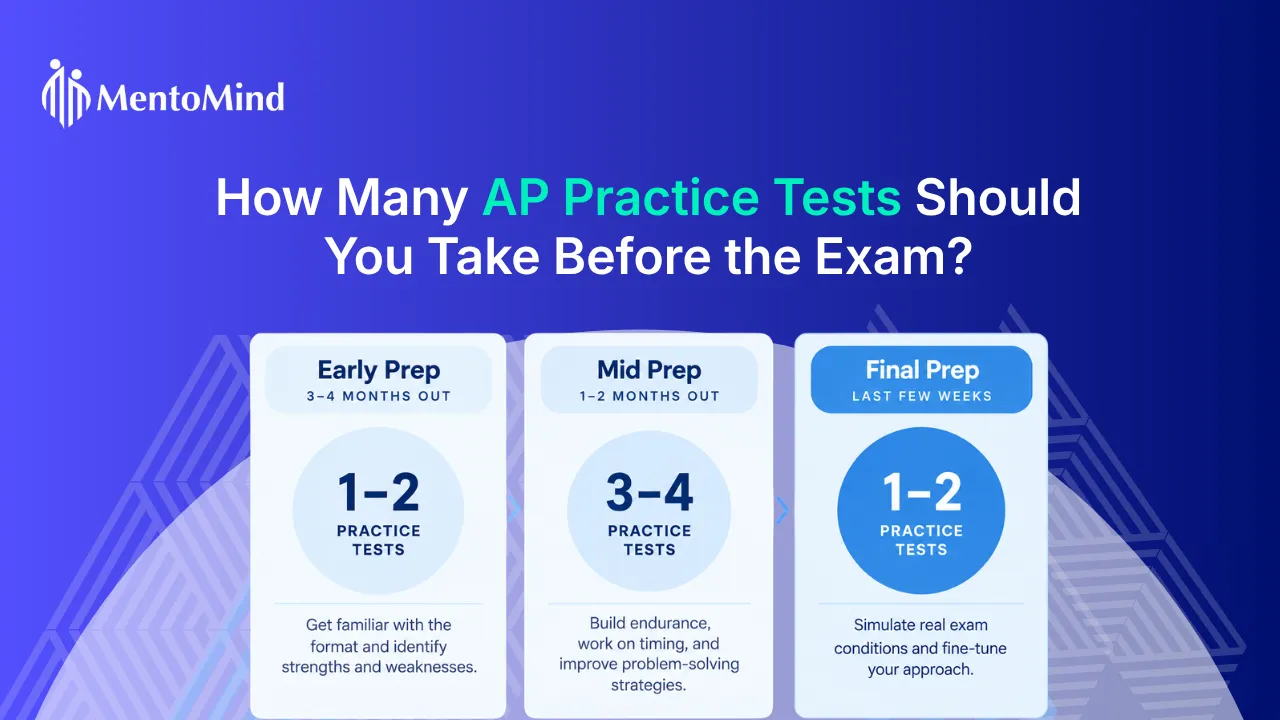
- Full-Length Practice Exams (2-3 Times): Complete timed exams in December/January and March/April
- Exam Preparation (Final 4-6 Weeks): Comprehensive review focusing on weak areas, timed practice, test strategies
How MentoMind Supports AP Course Delivery
MentoMind provides infrastructure for building and delivering AP courses: upload materials (PDFs, worksheets, videos), convert to auto-graded assignments, organize by unit, create custom problem sets, assign homework, track student progress, and generate performance reports. Supports both self-paced and instructor-led delivery.
Platform tools: How to Turn PDFs Into Auto-Graded Assignments | How to Create and Sell Online Courses
AP Course Business Considerations for Tutors
Pricing AP Tutoring
Typical AP Tutoring Rates (vary significantly by region, experience, and local market):
- Private 1-on-1: $60-150 per hour
- Small group (3-6 students): $30-60 per student per hour
- Large group classes: $400-800 per student for full course
- Self-paced digital course: $200-500 per course
Timeline and Scheduling
AP Course Timeline:
- August-September: Course start, foundational units
- October-December: Core content instruction
- January-March: Advanced topics, first practice exams
- April: Intensive review and practice
- Early May: AP exam week
Most students enroll in August-September, though mid-year students may join for targeted support.
Year-Round Business Model
Combining AP courses with SAT/ACT prep creates year-round revenue:
- August-May: AP course instruction
- Year-round: SAT/ACT test prep
- Summer: SAT/ACT intensive prep or AP summer bridge courses
This model reduces seasonal income fluctuations common in test prep businesses.
AP Course Glossary
AP (Advanced Placement): College Board program offering college-level courses and exams to high school students.
AP Exam: Standardized test scored 1-5 administered in May, with scores of 3-5 typically earning college credit.
FRQ (Free-Response Question): Open-ended problems requiring detailed written solutions, scored with rubrics by trained readers.
MCQ (Multiple-Choice Question): Selected-response questions with four or five answer choices, common in Section I of most AP exams.
Unit: Major content division in AP courses, typically covering 2-3 weeks of instruction.
College Credit: Academic credits awarded by colleges for qualifying AP exam scores, allowing students to skip introductory courses.
Weighted GPA: Grading system where AP courses receive additional points (typically +0.5 to +1.0) to reflect increased difficulty.
AB Subscore: Score reported for AP Calculus BC exam representing performance on Calculus AB content only.
Start Teaching AP Courses
AP courses provide tutors with year-round teaching opportunities, higher rates due to subject specialization, and the ability to support students beyond test prep. Mathematics courses (Precalculus, Calculus AB/BC, Statistics) offer the strongest starting point for most tutors due to consistent demand and clear skill progression.
Success in AP tutoring requires strong content knowledge, structured curriculum delivery, regular assessment, and familiarity with College Board exam formats. MentoMind provides tools to build, deliver, and track AP courses while handling administrative tasks like grading and progress monitoring.
Whether teaching 1-on-1, in small groups, or through self-paced courses, AP instruction helps students earn college credit, strengthen applications, and prepare for college-level academic work.
Frequently Asked Questions
AP Calculus AB, AP Statistics, AP Psychology, and AP English Language work well online because they have structured content, predictable exam patterns, and don’t require specialized lab equipment.
According to College Board data, the most-taken AP exams include AP English Language, AP US History, AP Psychology, AP Calculus AB, and AP World History: Modern.
Start with 2-4 courses where you have strong content expertise. Quality instruction in fewer subjects is more effective than superficial coverage of many courses.
Students following the full course should begin in August or September. For targeted exam prep only, starting 3-4 months before the May exam (January-February) provides adequate review time.
Yes. Live courses need weekly lesson plans and interactive activities. Self-paced courses need shorter video modules (10-15 minutes), downloadable worksheets, and auto-graded quizzes for independent learning.
BC covers all AB content plus parametric equations, polar coordinates, sequences and series, and advanced integration techniques. BC is faster-paced and covers approximately 1.5 college semesters versus AB’s 1 semester.
Yes. Many students take both simultaneously as they cover different mathematical content. Statistics focuses on data analysis while Calculus focuses on functions and rates of change.
Many colleges grant credit for AP scores of 3 or higher, though competitive universities often require 4 or 5. Credit policies vary significantly by institution and even by department within universities. Students should check their target schools’ specific AP credit policies, as some schools may not award credit for certain subjects regardless of score.
Not required but recommended. Students can take AP Calculus AB after completing regular Precalculus. AP Precalculus provides stronger preparation and is becoming the standard pathway at many schools.
Full course preparation takes 8-9 months (August-May). Intensive exam review for students who completed coursework takes 6-8 weeks. Crash course preparation for students self-studying typically requires 2-3 months minimum.