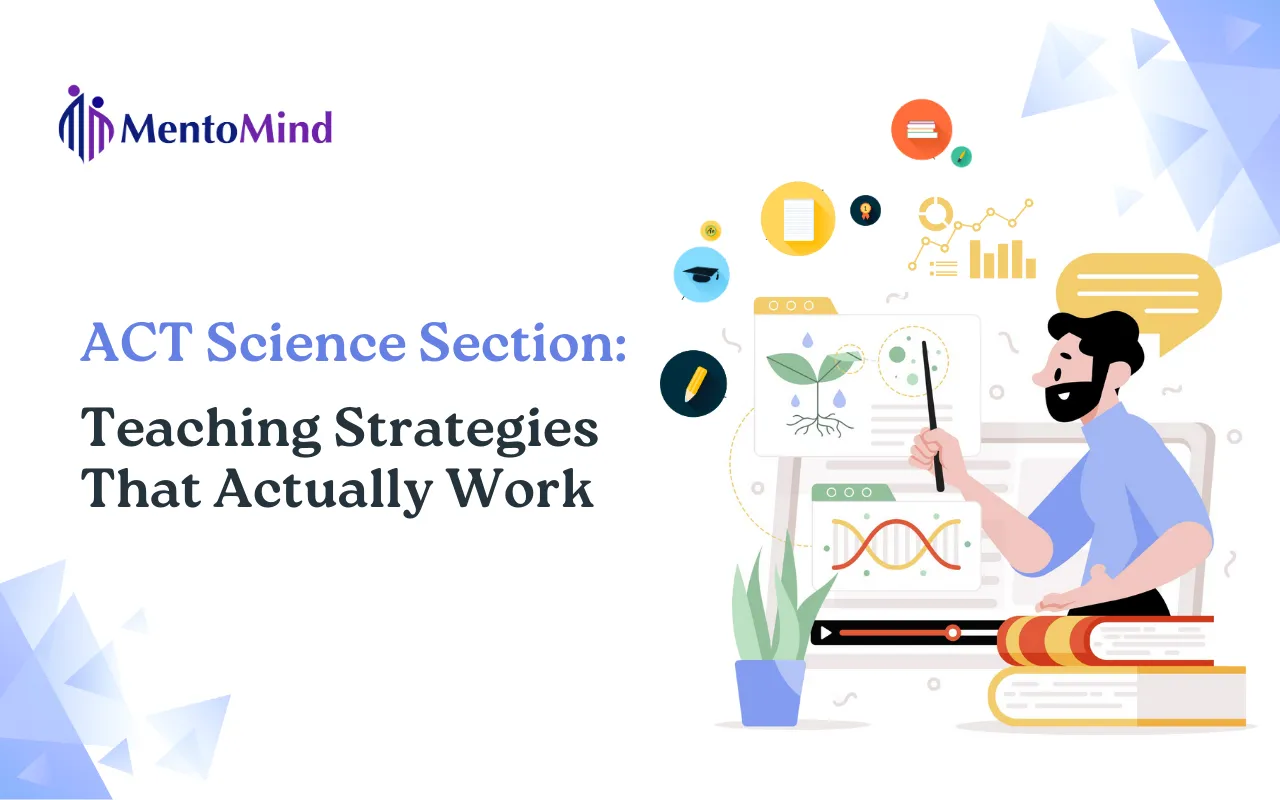
What Makes ACT Science Difficult and How to Teach It?
The ACT Science section is challenging due to time pressure and data-heavy passages, not advanced science content. Students answer 40 questions in 40 minutes, requiring efficient interpretation of charts, tables, and experiments. Advanced biology, chemistry, or physics knowledge is not required, though introductory science background may be helpful.
The three skills that improve scores fastest:
- Graph and table reading: Many questions can be answered by directly interpreting charts, tables, and figures rather than relying on outside science knowledge.
- Passage-type recognition: Each of the three passage formats (discussed in detail below) requires a different approach
- Timing discipline: With under 1 minute per question, pacing is the main barrier to completion each section
ℹ️ Note: On many digital ACT administrations under the enhanced format, the Science section is optional and scored separately. Because policies vary by test type and administration, this guide focuses on teaching strategies for students who need or choose to take the Science section.
3 ACT Science Passage Types (and How to Approach Each)
Every ACT Science section includes three passage formats: Data Representation, Research Summaries, and Conflicting Viewpoints. Teaching students to quickly recognize each type and adjust their strategy accordingly is one of the fastest ways to improve scores.
1. Data Representation (2-3 passages, about 30% of questions)
Passages built around charts, graphs, and tables with minimal explanatory text. Students answer questions by interpreting visual data rather than relying on advanced science knowledge.
🎯 How to teach it?
- Train students to skip most of the text and focus immediately on the visuals
- Teach a 10-second scan to identify axes, units, and what each graph or table measures
- Practice matching question keywords to the correct graph or table
- Emphasize reading exact values instead of estimating
✅ Why this works?
Data Representation questions are designed to test data interpretation. The necessary information is almost always contained in the visuals themselves. By skipping unnecessary text and focusing directly on graphs and tables, students reduce cognitive load, save time, and answer questions more accurately.
2. Research Summaries (2-3 passages, about 50% of questions)
These passages describe one or more experiments, usually labeled Experiment 1, Experiment 2, and so on. They include explanatory text outlining procedures along with visuals that display results.
🎯 How to teach it?
- Train students to identify the independent variable (what changed) and dependent variable (what is measured) for each experiment
- Practice summarizing each experiment in one sentence: “This experiment tested [X] by measuring [Y]”
- Teach students to answer questions using only the experiment referenced in the question
- Emphasize comparing experiments only when the question explicitly asks for it
✅ Why this works?
Students often struggle because they try to understand all experiments at once. Treating each experiment as a separate unit keeps attention focused, reduces confusion, and speeds up question answering.
3. Conflicting Viewpoints (1 passage, about 20% of questions)
This passage presents two or three short texts that describe different scientific hypotheses or theories. Unlike other ACT Science passages, it usually contains little or no visual data.
🎯 How to teach it?
- Instruct students to read the entire passage before answering any questions
- Teach them to summarize each viewpoint’s main claim in a short phrase
- Have students identify where the viewpoints agree and where they disagree
- Reinforce that answers must come only from the passage, not from outside knowledge
✅ Why this works?
Unlike the other passage types, Conflicting Viewpoints questions cannot be answered by scanning visuals. Students need to understand each argument before answering the questions.
The 40-Minute Timing Framework
Timing is the most common reason students lose points on ACT Science. With 40 questions in 40 minutes, efficiency matters, and getting stuck on any one question can derail the entire section.
Recommended Passage Order
➡️ Data Representation (fastest to complete)
➡️ Research Summaries
➡️ Conflicting Viewpoints (most reading time)
Time Checkpoints
Use these benchmarks during practice tests:
| Checkpoint | Target Time | Questions Completed |
|---|---|---|
First check |
10 minutes |
10 questions |
Second check |
17 minutes |
20 questions |
Third check |
26 minutes |
30 questions |
Final |
38 minutes |
40 questions |
Reserve the last 2 minutes for guessing on any unanswered questions and checking your bubble sheet.
Teaching Timing Discipline
- Start students at 7 minutes per passage, then gradually reduce to 5.5 minutes as efficiency improves
- Train students to mark and move on if a question takes longer than 50 seconds
- Practice full timed sections regularly to build stamina and pacing awareness
- Track completion rate separately from accuracy to diagnose timing problems more effectively
Common Mistakes to Avoid When Teaching ACT Science
Mistake #1: Reading the passage before the questions
For Data Representation and Research Summaries, this often wastes time. Train students to scan visuals first and read text only when a question requires it.
Mistake #2: Treating Science like a content exam
Students who try to fully understand the science get stuck on irrelevant details. The test rewards finding information quickly, not deep scientific comprehension.
Mistake #3: Practicing without timing
Untimed practice builds poor pacing habits. Even early in preparation, use at least partial timing to develop time awareness.
Mistake #4: Ignoring Conflicting Viewpoints until test day
Because this passage type requires more reading, many students avoid it. Targeted practice with argument comparison prevents last-minute stress.
Mistake 5#: Not tracking errors by passage type
Missing multiple questions in one passage type points to a specific skill gap. Diagnosing errors by passage type leads to more efficient practice.
5-Session Teaching Plan
This structure covers all core skills in a focused prep sequence.
Session 1: Diagnostic and Passage Recognition
- Administer one full Science section (timed)
- Review results by passage type, not just total score
- Identify whether the student’s primary issue is accuracy, timing, or both
- Set specific goals for each passage type
Session 2: Data Representation Mastery
- Work through 3 to 4 Data Representation passages
- Drill graph reading: axes, units, trends, exact values
- Target under 45 seconds per question
- Practice skipping text entirely
Session 3: Research Summaries
- Work through 3 to 4 Research Summary passages
- Practice identifying variables for each experiment
- Use the one-sentence summary technique
- Drill questions that compare across experiments
Session 4: Conflicting Viewpoints
- Work through 2 to 3 Conflicting Viewpoints passages
- Practice noting each viewpoint’s claim before answering
- Focus on “which scientist would agree” question types
- Reinforce that no outside knowledge is needed
Session 5: Full Section Under Test Conditions
- Administer a complete 40-minute section
- Review errors by skill category and passage type
- Adjust timing strategy based on where time was lost
- Identify 2 to 3 specific skills to reinforce before test day
For ongoing practice between sessions, MentoMind’s ACT couse provides passage-type filtering so students can target their weakest areas.
Key Takeaways
- ACT Science tests reasoning, not memorization. Teach students how to locate and interpret information rather than recall facts.
- Each passage type demands a different strategy. Data Representation and Research Summaries reward efficient visual scanning, while Conflicting Viewpoints requires careful reading of arguments.
- Timing is the primary obstacle. Students who cannot finish the section limit their achievable score.
- Diagnose by passage type. Patterns in errors reveal which skills need targeted practice.
- Practice under realistic conditions. Untimed preparation does not translate effectively to test-day performance.
Frequently Asked Questions
The ACT Science section has 40 questions across 6-7 passages, with 40 minutes on many digital tests and some paper tests allowing 35 minutes.
No. ACT Science tests reasoning and data interpretation, and all necessary information is provided in the passage, though basic familiarity with common science terms can be helpful.
Passages draw from biology, chemistry, physics, and Earth or space science. No advanced subject knowledge is tested, and students can answer questions using only the information provided.
On many digital ACT administrations, the Science section is optional and scored separately. Requirements vary by test type and testing program.
Practice priorities depend on diagnostic results. Timing issues often point to Data Representation passages, while reading challenges often indicate a need for more Conflicting Viewpoints practice.
ACT Science typically includes 6-7 passages, most often 2-3 Data Representation, 2-3 Research Summaries, and 1 Conflicting Viewpoints passage.
ACT Science relies more on interpreting visuals and locating information than on dense reading. Many students with weaker reading skills perform well once they learn to prioritize graphs and tables over text.
What’s Next?
Run a free ACT diagnostic in the MentoMind app to establish your student’s starting point, then use MentoMind’s ACT course for targeted practice supported by clear analytics and progress tracking.
Related reading: