Quick answer:
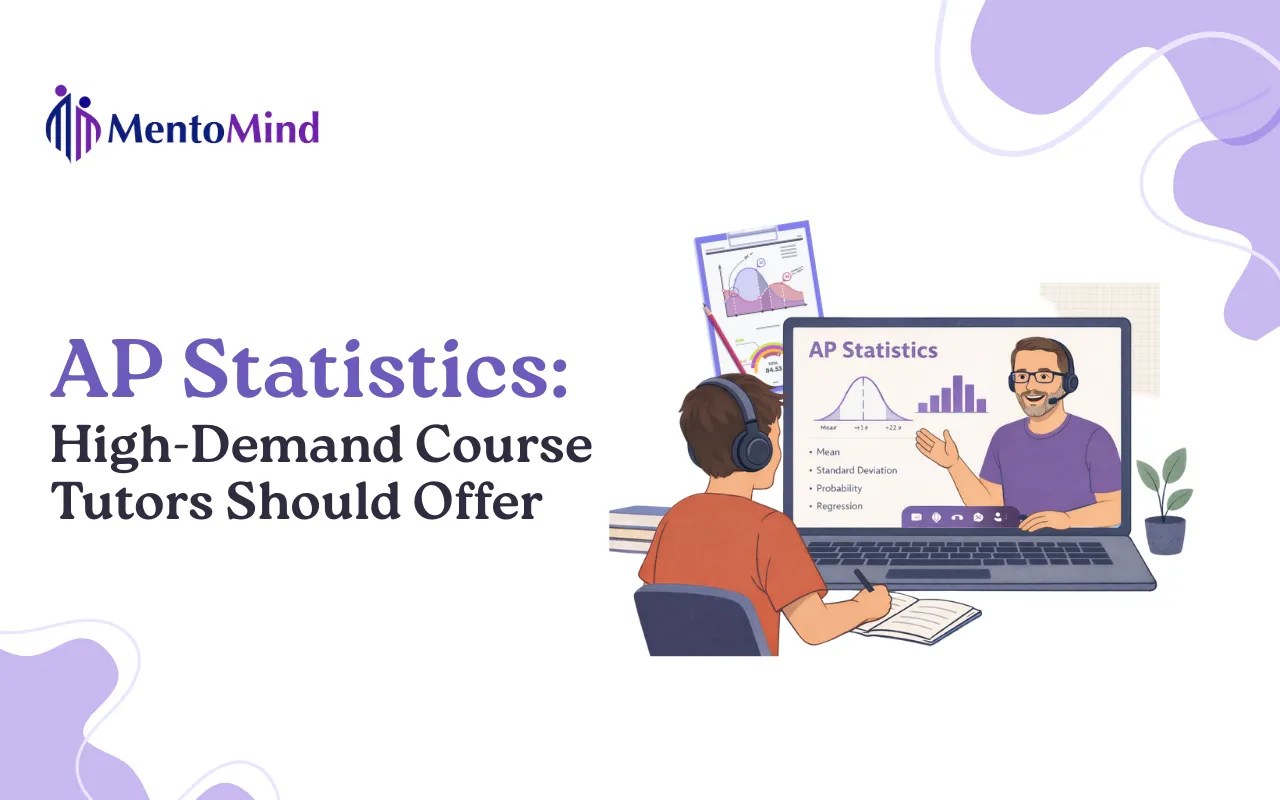
AP Statistics is one of the fastest-growing AP courses, driven by its relevance to data science, psychology, business, and social research. Unlike AP Calculus, it emphasizes data interpretation and statistical reasoning over heavy algebra, making it appealing to a broader range of students and college-bound majors.
For tutors, this growth creates a major opportunity to offer a course that is in high demand, high value, and highly scalable.
Why Is AP Statistics Growing So Quickly?
AP Statistics has grown from a specialized course to one of the most popular AP offerings. AP Statistics has been one of the fastest-growing AP courses over the past two decades, with 266,790 students taking the exam in 2025. Students choose it because it provides:
- A rigorous math credit requiring only Algebra II as a prerequisite, not calculus-level algebra
- Real-world skills in data interpretation, probability, and statistical reasoning
- A competitive advantage for majors in psychology, business, economics, biology, computer science, and social sciences
- Essential data literacy skills increasingly required by colleges and employers
- An accessible AP math pathway for strong students who prefer conceptual thinking over computational manipulation
Students normally take AP Statistics in their junior or senior year, and it’s commonly taken concurrently with or after precalculus. While not universally positioned as “the primary AP math course for juniors,” it has become a mainstream option alongside or instead of AP Calculus for students whose intended majors benefit more from statistical reasoning than advanced calculus.
👉 To see which other AP courses are trending, explore the most popular AP courses.
Is AP Statistics Hard for Students?
AP Statistics is challenging, but not for the usual math reasons. Students typically struggle with:
- Interpreting graphs and statistical results in context
- Understanding experimental design and identifying bias
- Applying probability concepts correctly
- Mastering hypothesis testing logic
- Writing clear, complete free-response explanations
What students don’t need for AP Statistics?
- Calculus knowledge
- Advanced algebra skills
- Complex symbolic manipulation
This makes AP Statistics more accessible to a wide range of learners, but students still need strong guidance to understand why statistical methods work, not just how to apply them. The course emphasizes conceptual reasoning and data interpretation over computational skills, which is a shift from traditional math classes that some students find challenging.
Who Should Take AP Statistics?
AP Statistics is a good match for students who:
- Prefer applied math over theoretical algebra
- Enjoy analyzing charts, surveys, or real-world data
- Want to pursue a major in business, psychology, economics, STEM fields, or health sciences
- Need an AP math credit but struggle with calculus
- Want a course that improves quantitative reasoning for college
Why Should Tutors Offer AP Statistics?
1. Consistent and Growing Student Demand
AP Statistics continues its strong growth, with 266,790 students taking the exam in 2025. This sustained enrollment creates predictable year-round tutoring opportunities as demand outpaces the supply of qualified tutors. Parents actively search for “AP Statistics tutor” online, making client acquisition straightforward.
2. Ideal for Profitable Group Tutoring Classes
AP Statistics works perfectly for small group instruction because concepts build sequentially. The optimal group size of 3-6 students generates 2-3 times the hourly income of one-on-one sessions while keeping costs affordable for families. A single tutor can effectively serve 12-18 students weekly through multiple small groups.
3. Flexible and Profitable Pricing Structure
One-on-one sessions range from $60-120/hour, while small group classes command $40-75 per student ($120-450/hour gross for 3-6 students). Summer intensive programs represent premium pricing at $1,200-2,500 for comprehensive 15-20 hour packages.
4. Predictable, Masterable Curriculum Structure
AP Statistics follows a fixed 9-unit College Board framework that remains stable year-over-year. Tutors can master the complete content in 40-60 hours, then create reusable lesson plans and materials that serve multiple student cohorts. No calculus knowledge required, just strong Algebra II and statistical reasoning.
5. High-Value Summer Preparation Market
Students often begin preparation during summer before junior or senior year, creating premium opportunities at $75-150/hour. Summer programs face lower competition than school-year tutoring and appeal to proactive families willing to invest in early preparation before the academic year begins.
👉 To build or expand your subject tutoring catalog, explore our subject tutoring courses.
AP Statistics Curriculum Overview for Tutors
Unit 1: Exploring One-Variable Data (15-23% of exam)
- Distributions, measures of center/spread
- Percentiles, z-scores
- Graphs: histograms, boxplots
- Teaching focus: Describe distributions using SOCS (Shape, Outliers, Center, Spread)
Unit 2: Exploring Two-Variable Data (5-7%)
- Scatterplots, correlation, regression
- Residuals, r², influential points
- Teaching focus: Correlation ≠ causation
Unit 3: Collecting Data (12-15%)
- Surveys vs. experiments
- Sampling methods, bias types
- Randomization, experimental design
- Teaching focus: Most conceptually challenging unit
Unit 4: Probability & Random Variables (10-20%)
- Basic probability rules
- Conditional probability, independence
- Binomial and geometric distributions
- Teaching focus: Students struggle with conditional probability
Unit 5: Sampling Distributions (7-12%)
- Sampling distributions of proportions/means
- Central Limit Theorem, standard error
- Teaching focus: Foundation for all inference
Unit 6: Inference for Proportions (12-15%)
- Confidence intervals and hypothesis tests
- One-sample and two-sample procedures
- Teaching focus: First formal inference introduction
Unit 7: Inference for Means (10-18%)
- t-distributions, t-tests
- One-sample, two-sample, paired procedures
- Teaching focus: Distinguish procedure types
Unit 8: Chi-Square Tests (2-5%)
- Goodness-of-fit, independence tests
- Expected counts
- Teaching focus: Contingency tables
Unit 9: Inference for Slopes (2-5%)
- Linear regression inference
- t-test for slope, conditions
- Teaching focus: Connect Unit 2 to inference
Tutor Strategies for Teaching AP Statistics Effectively
1. Use Real Data
Students grasp abstract statistical concepts more effectively when tutors use real-world examples from sports, psychology, marketing, or medical research that connect directly to their interests and future careers.
2. Teach Interpretation, Not Just Calculation
Since free-response questions comprise 50% of the AP exam and reward clear explanations over computations, tutors should require students to write full-sentence interpretations using the four-step process (State, Plan, Do, Conclude) for every problem.
3. Reinforce Hypothesis Testing Logic
Most students struggle with p-values and statistical significance, so tutors should use analogies like the courtroom (innocent until proven guilty), practice contextual p-value interpretations repeatedly, and create visual aids that make sampling distributions and test logic concrete.
4. Build Formula Recognition Before Calculation
Tutors should teach students to identify question types, count samples, check conditions, and select appropriate procedures before executing any calculations, a decision-making sequence best supported by flowcharts or decision trees.
5. Develop Statistical Analyst Thinking
Effective tutors cultivate professional statistical reasoning by requiring clear justifications, organized writing, and real-world connections in every response, supported by activities like peer review, group problem-solving, case studies, and error analysis.
Key Takeaways
- AP Statistics is one of the fastest-growing AP subjects with 266,790 students taking the exam in 2025
- Accessible to many students because it emphasizes interpretation over advanced algebra (requires only Algebra II)
- Ideal for data-driven college majors including psychology, business, economics, biology, and social sciences
- Strong tutoring opportunity with high demand, predictable curriculum, and excellent group class potential
- Effective tutoring focuses on: real data applications, interpretation skills, hypothesis testing logic, and clear written communication
- Group class model works well because concepts build gradually and systematically (3-6 students optimal)
- Measurable results through unit tests, practice exam scores, and AP exam performance drive referrals and business growth
Frequently Asked Questions
Yes. With 266,790 students taking the exam in 2025 and consistent year-over-year growth over two decades, AP Statistics is one of the most in-demand AP courses. Demand is driven by rising data-focused college majors in psychology, business, economics, and STEM fields.
It is conceptually challenging but more accessible than calculus. Students struggle with data interpretation, experimental design, probability, and hypothesis testing logic, not advanced algebra or computation. The course requires Algebra II only.
Extremely useful. AP Statistics connects directly to business analytics, marketing (A/B testing, consumer behavior), economics (data analysis), finance (risk assessment), and operations management (quality control). Many business programs require introductory statistics.
Yes. AP Statistics works extremely well for cohort-based instruction. The sequential curriculum structure and conceptual focus make group learning effective. Optimal group size is 3-6 students at similar skill levels. Group classes also improve tutor revenue (2-3x one-on-one hourly rates) while remaining affordable for families.
Many students benefit significantly from tutoring because the course requires interpreting results in context (not just memorizing formulas), understanding conceptual reasoning behind statistical methods, developing strong written explanation skills for free-response questions, and mastering hypothesis testing logic and p-value interpretation.
Ideal students include those interested in real-world math applications and data analysis, pursuing college majors in business, psychology, economics, biology, or social sciences, and needing rigorous math credit without calculus. Prerequisite: successful completion of Algebra II.
MentoMind for AP Tutoring
MentoMind offers courses AP subjects on a single platform. Track student progress across tests, assign targeted practice, and manage your tutoring business without juggling multiple tools.
- AP Courses: Structured content for multiple subjects, with more being added by tutoring partners
- Course Creation: Build your own AP courses using your materials, or use expert-created content
 Learn about White Label options for tutoring businesses
Also explore MentoMind’s AP Math course