Quick answer:
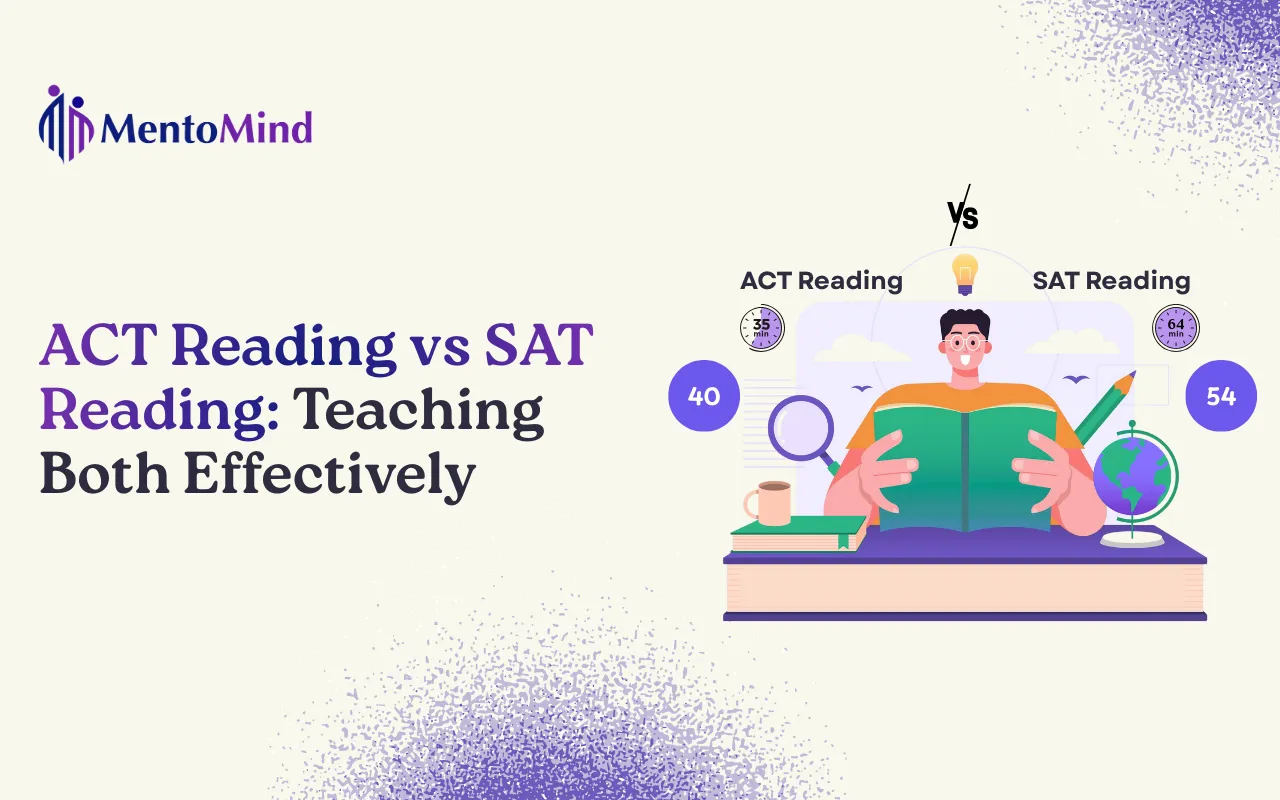
While both the ACT Reading section and SAT Reading & Writing section assess reading comprehension, critical reasoning, and vocabulary skills, they differ fundamentally in structure, timing strategies, and cognitive demands.
The ACT Reading test emphasizes speed and endurance with four lengthy passages, while the Digital SAT Reading (part of the SAT Reading and Writing section) prioritizes precision and logic through dozens of short, discrete texts.
Students often score differently on these standardized tests even when their baseline reading ability is identical. Understanding these differences is crucial for test prep success.
What Is the ACT Reading Section?
ACT Reading Test Format
| Component | Details |
|---|---|
Total Questions |
40 multiple-choice questions |
Time Limit |
35 minutes |
Passage Count |
4 long passages |
Passage Length |
600-800 words per passage |
Time Per Question |
Approximately 52 seconds |
Test Format |
Paper-based or computer-based (depending on test center) |
Skills Tested
- Main ideas
- Author’s purpose and tone
- Detail retrieval
- Inference
- Passage comparison
What Is the SAT Reading Section? (Digital SAT Format)
SAT Reading and Writing Test Format
| Component | Details |
|---|---|
Total Questions |
54 questions (27 per module) |
Time Limit |
64 minutes (32 minutes per module) |
Text Length |
25-150 words per question |
Passages Per Question |
One discrete text per question |
Test Structure |
Two adaptive modules |
Time Per Question |
Approximately 71 seconds |
Test Format |
Computer-adaptive digital test |
Skills Tested
- Logical relationships
- Vocabulary in context
- Evidence-based reasoning
- Data interpretation
- Purpose and transitions
Which Test Is Harder: ACT Reading or SAT Reading and Writing?
ACT Reading presents greater difficulty for students who
- Read slowly
- Struggle with long passages
- Need processing time
- Panic under strict time timing
SAT Reading and Writing poses greater difficulty for students who
- Miss subtle logical cues
- Struggle with transitions
- Overlook small wording differences
- Prefer big-picture ideas over detail
How Tutors Should Teach ACT Reading?
1. Teach Chunk Reading
Students should identify the passage structure, not read word by word.
2. Introduce Pacing Habits
Aim for 8 to 9 minutes per passage to avoid time traps.
3. Strengthen Retrieval Skills
Practice finding evidence quickly by scanning for keywords.
4. Focus on Inference & Tone Questions
These questions cause the most hesitation and drain time.
How Tutors Should Teach SAT Reading?
1. Practice Precision Reading
Students must read carefully because each word matters.
2. Vocabulary in Context Drills
Meaning depends on tone, logic, and sentence function.
3. Strengthen Logic & Evidence Skills
Many questions ask whether a sentence strengthens, supports, or clarifies a claim.
4. Use Targeted Micro-Drills
Sets of 10 logic questions, 10 transitions, and 10 evidence questions build accuracy quickly.
Reading Comprehension Skills: Core Foundations for Both Tests
Core Comprehension Skills for Both Tests
- Identify main ideas
- Recognize author purpose and tone
- Distinguish evidence from interpretation
- Understand argument structure
- Avoid common distractor patterns
ACT Reading Comprehension Prep
Focus on:
- Skim-reading for structure
- Locating evidence quickly
- Eliminating answers efficiently
- Managing pacing
💡 Best Drill: 1 passage in 9 minutes, then build toward 8 minutes.
SAT Reading Comprehension Prep
Focus on:
- Precision reading
- Vocabulary meaning from context
- Understanding logical relationships
- Evaluating claims and evidence
💡 Best Drill: Micro sets of 10 transitions, 10 purpose questions, 10 evidence questions.
Key Takeaways
- ACT Reading demands speed, endurance, and rapid information retrieval across four lengthy passages with extremely tight timing constraints.
- SAT Reading requires precision, logical analysis, and micro-level comprehension through dozens of short, independent text questions.
- ACT uses long-form passages (600-800 words) while SAT uses brief texts (25-150 words) per question, creating fundamentally different reading experiences.
- Match students to tests based on reading speed and cognitive reasoning style because one size does not fit all.
- Teach ACT and SAT as distinct skill sets with format-specific strategies rather than generic reading comprehension approaches.
- Time management is critical for ACT success; precision and logic are critical for SAT success. Prioritize accordingly in test prep.
- Targeted practice by question type accelerates improvement more effectively than random mixed practice.
Frequently Asked Questions
Yes. Many students take both tests to determine which produces better scores. Colleges accept either test equally.
Most educational consultants recommend 2-3 attempts per test, with focused prep between attempts.
Minimum 6-8 weeks for meaningful improvement; 12-16 weeks for substantial score increases; more time for students starting with lower baselines.
Not recommended. The different strategies required can create confusion. Choose one test, prepare thoroughly, then consider the other if needed.
Use a diagnostic that measures reading speed, accuracy, and reasoning style.
Next Steps
Run free SAT and ACT diagnostics at MentoMind to get section-level data for your students. Track progress with skill-based reporting and adjust recommendations based on real performance.
Related readings: