The ACT English section tests how well you can apply grammar and writing rules in context. Instead of memorizing every rule, focus on the ones that appear most often and learn how to recognize them in sentences.
This guide covers the most important ACT grammar rules, explains how they appear on the exam, and includes an easy-to-review ACT English grammar rules cheat sheet to help you prepare more efficiently.
What Grammar Rules Are Tested on the ACT English Section?
The ACT English section tests Standard English Conventions, Production of Writing, and Knowledge of Language. Within these categories, you’ll answer questions on grammar, punctuation, sentence structure, usage, and writing style.
Here are the most important ACT English grammar rules to know:
- Punctuation
- Subject-verb agreement
- Pronouns
- Verb tense
- Modifiers
- Parallelism
- Sentence structure
- Concision and word choice
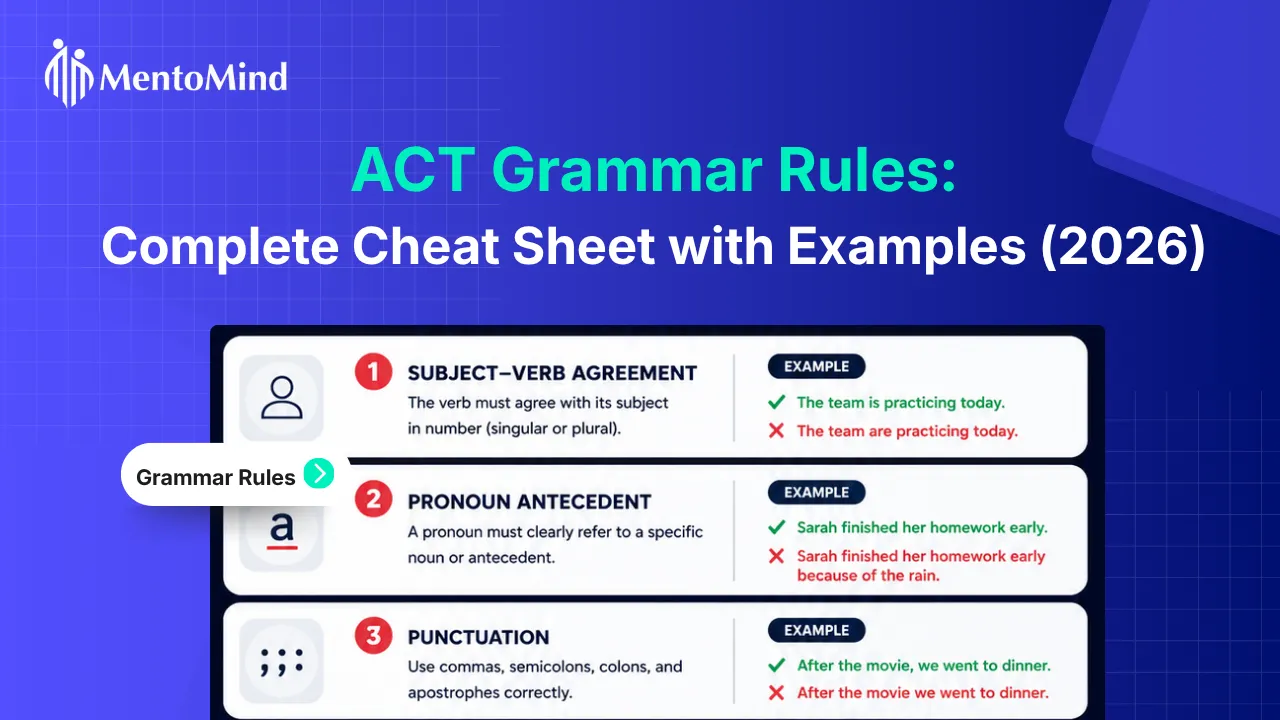
ACT English Grammar Rules Cheat Sheet
The grammar ideas that are most frequently tested on the exam are covered in the ACT English grammar rules cheat sheet below. Regularly review these guidelines so you can identify them fast and confidently rule out incorrect response options.
| Grammar Rule | What to Remember | Example |
|---|---|---|
Subject-Verb Agreement |
A singular subject takes a singular verb. A plural subject takes a plural verb. Ignore prepositional phrases when identifying the subject. |
The list of books is on the table. |
Pronoun Agreement |
A pronoun must agree with its antecedent in number and person. |
Each student submitted his or her assignment. |
Verb Tense |
Keep verb tense consistent unless the timeline clearly changes. |
She studied for hours and passed the test. |
Commas |
Use commas after introductory phrases, between items in a list, and around nonessential information. |
After the exam, we celebrated. |
Semicolons |
When two independent clauses are closely related, they should be joined with a semicolon. |
The ACT was challenging; everyone finished on time. |
Colons |
When introducing a list or explanation, use a colon after a full sentence. |
Bring three items: a pencil, an eraser, and a calculator. |
Apostrophes |
To indicate possession or create contractions, use apostrophes. They should not be used to make nouns plural. |
Sarah’s notebook |
Modifiers |
Place modifiers next to the word or phrase they describe. |
Running to class, Maya dropped her notebook. |
Parallelism |
Use the same grammatical form in lists and comparisons. |
She enjoys reading, writing, and painting. |
Sentence Structure |
Avoid sentence fragments, run-on sentences, and comma splices. |
Correct: I studied, so I felt prepared. |
Concision |
Remove unnecessary words without changing the meaning. |
Because is often clearer than due to the fact that. |
Also Read: How to Achieve the Highest ACT Score
7 Common ACT English Grammar Mistakes That Cost Points
Many students lose points on the ACT English section because they overlook small grammar errors, not because they don’t know the rules. Learning to spot these common mistakes can help you eliminate wrong answers faster and answer with more confidence.
1. Comma Splices
A comma cannot join two complete sentences on its own. If each part can stand alone, you need a period, a semicolon, or a coordinating conjunction. So you must notice: Can both halves work as separate sentences? If the answer is yes, a comma by itself isn’t enough.
Example:
Incorrect: The trial was successful, the results surprised everyone.
Correct: The trial was successful, and the results surprised everyone.
2. Sentence Fragments
A complete sentence must have a subject, a verb, and a complete thought. Clauses that begin with words like because, although, or when often look complete but leave the reader expecting more. Does this sentence make sense on its own, or does it leave me hanging?
Example:
Incorrect: Although the students studied all week.
Correct: Although the students studied all week, they still found the test challenging.
3. Run-on Sentences
A run-on sentence combines two complete thoughts without the punctuation or conjunction needed to separate them. You need to think Can I split this into two complete sentences? If you can, they need to be connected correctly.
Example:
Incorrect: The lecture ended everyone left the room.
Correct: The lecture ended, and everyone left the room.
4. Subject-Verb Agreement Errors
The ACT often places extra words between the subject and the verb to distract you. Ignore those words and identify the true subject first. You need to see who or what is actually performing the action.
Example:
Incorrect: The box of pencils are on the desk.
Correct: The box of pencils is on the desk.
5. Pronoun Errors
A pronoun should clearly refer to one noun and agree with it in number. If you have to stop and ask, “Who does she refer to?” the sentence probably needs revision.
Example:
Incorrect: When Maya spoke to Priya, she was excited.
Correct: When Maya spoke to Priya, Maya was excited.
6. Misplaced Modifiers
A modifier should appear next to the word it describes. If it doesn’t, the sentence can accidentally describe the wrong person or thing. So what is this phrase actually describing?
Example:
Incorrect: Walking to class, the rain started.
Correct: Walking to class, I noticed the rain.
7. Wordiness
The ACT rewards clear, concise writing. If two answer choices say the same thing, the shorter one is often correct, as long as it doesn’t remove important meaning. Think of Is every word adding value, or is the sentence saying more than it needs to?
Example:
Incorrect: Due to the fact that the road was closed…
Correct: Because the road was closed…
The fastest way to improve is to identify the grammar rules you miss most often and practice them consistently. Start with a free ACT diagnostic in the MentoMind app, then use MentoMind’s ACT course for targeted practice, detailed explanations, section-level analytics, and progress tracking.
How to Apply ACT Grammar Rules on Test Day?
The fastest way to answer ACT English questions is to identify the grammar rule before evaluating the answer choices. Most questions test one concept at a time, so recognizing the pattern can save time and reduce mistakes.
Read the Entire Sentence
Read the full sentence before looking at the options. The surrounding context often reveals whether the question tests grammar, punctuation, or sentence structure.
Identify the Grammar Rule
Ask yourself what the question is really testing. Is it subject-verb agreement, pronoun reference, verb tense, punctuation, or concision? Once you know the rule, eliminate choices that violate it.
Eliminate Incorrect Answers First
Don’t search for the correct answer immediately. Remove options with obvious grammar errors, unclear wording, or unnecessary repetition. This makes the final choice easier.
Prefer Clear and Concise Writing
If both answers are grammatically correct, select the one that expresses the concept in the fewest words. The ACT prefers concise writing over longer forms of writing.
Verify the Sentence After Choosing
Read the complete sentence one final time with your selected answer. Make sure it is grammatically correct, clear, and preserves the original meaning.
Ready to Master ACT English Grammar?
Knowing the ACT grammar rules is only the first step. Consistent practice with real ACT English questions helps you recognize common grammar patterns, avoid repeated mistakes, and apply the right rule under timed conditions. MentoMind gives you access to ACT practice tests, detailed explanations, and performance insights to help you build accuracy and confidence on the ACT English section.
Related reading:
Frequently Asked Questions
Start with the ACT grammar rules that appear most often, including punctuation, sentence structure, subject-verb agreement, pronouns, modifiers, and concision. Once you’re comfortable with these, move on to less common grammar concepts.
Yes. An ACT grammar rules cheat sheet is ideal for last-minute revision because it highlights the concepts you’re most likely to see on test day. It should reinforce what you’ve already practiced, not replace practice questions.
No. The grammar rules for ACT are based on standard English grammar taught in high school. The challenge comes from applying those rules quickly and accurately under timed conditions.
An ACT English cheat sheet summarizes the rules that are tested most frequently, while a grammar textbook explains the language in much greater detail. For ACT preparation, a concise review guide is usually more practical.
No. While many questions assess ACT English grammar rules, the English section also includes questions about organization, transitions, style, and sentence placement. Preparing for both grammar and writing skills is essential for a strong score.