The AP exam tests more than content knowledge. You also need to manage time, recognize question types, and apply what you know under exam conditions. AP practice tests help you build these skills while showing you where your preparation still needs work.
This guide explains how many AP exam practice tests to take, when to take them, and how to review your results. You’ll also learn how to use AP test questions and targeted practice to make your AP exam preparation more effective.
How Many AP Practice Tests Should You Take?
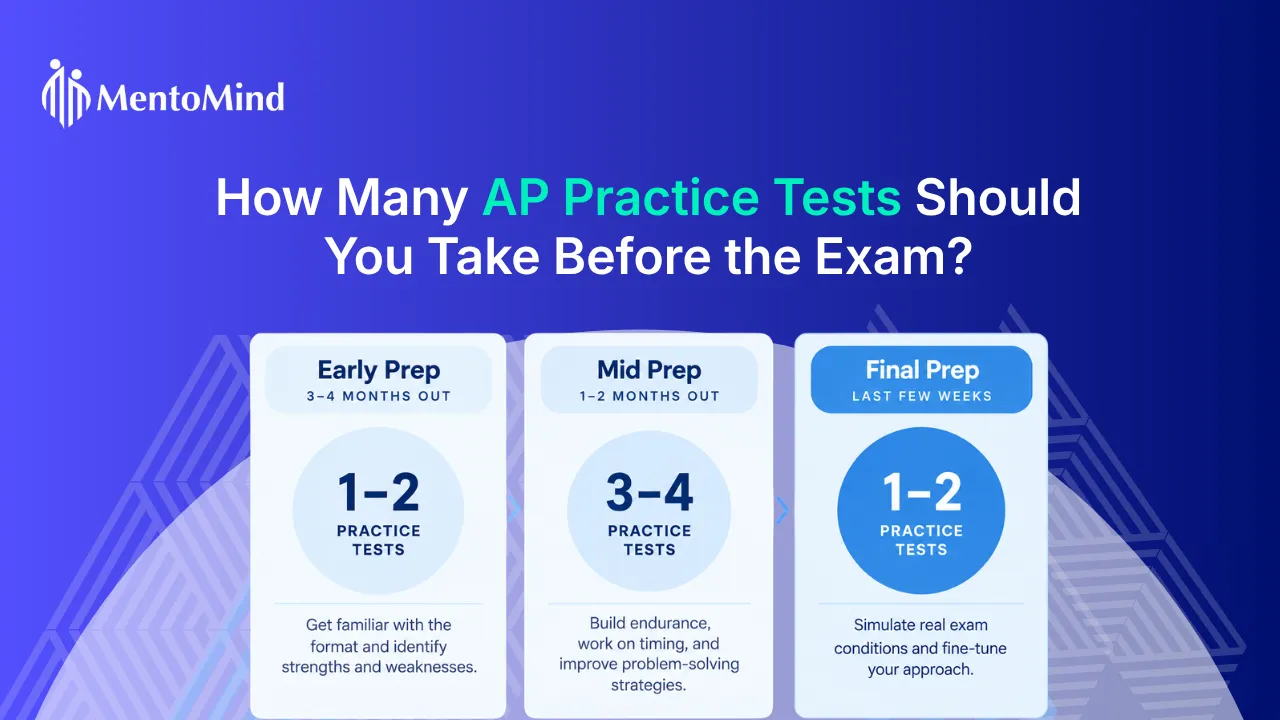
Aim for 3–5 full-length AP practice tests before the exam. Take your first test as a baseline, then use the results to target weak areas before taking the next one.
- Take 1 diagnostic test early: Find content gaps, timing issues, and question types that give you trouble.
- Take 1–2 tests during preparation: Check whether your targeted practice improves accuracy and pacing.
- Take 1–2 tests close to the exam: Recreate test-day conditions and measure your readiness.
- Take more only when needed: If your scores stay inconsistent or you still run out of time, another full-length test can help.
There is no official College Board requirement for a specific number of AP practice tests. Choose a number that gives you enough AP exam practice while leaving time to review mistakes and strengthen weak topics.
When Should You Take AP Practice Tests?
Take your first AP practice test once you have covered enough of the course to measure your current level. Then schedule the remaining tests after targeted study, with the final tests closer to exam day.
- Start with a diagnostic: Use your first test to find weak topics, timing problems, and question types you miss.
- Review before retesting: Work through the questions you missed and practice those topics before taking another test.
- Take more tests near exam day: Use your final AP exam practice tests to check your pacing and readiness.
- Leave time between tests: Give yourself enough time to fix mistakes before taking another full-length test.
This approach makes each test useful. You identify a problem, work on it, and then check your progress with another AP exam practice tests.
What Should You Do After an AP Practice Test?
Review your mistakes before taking another AP practice test. Focus on why you missed each question, then practice the weak areas before you test yourself again. Here are the things to check after every test:
- Wrong answers: Identify the topic and understand why your answer was wrong.
- Lucky guesses: Review questions you got right by guessing. You may still have a knowledge gap.
- Repeated mistakes: Look for the same error across multiple questions. It may point to a topic you need to revisit.
- Timing problems: Note questions that took too long or sections you could not finish.
- Unanswered questions: Find out whether you ran out of time or struggled with the content.
- Next steps: Use targeted AP test questions to practice the topics that caused the most problems.
For example, if you miss several questions from the same unit, don’t take another full test immediately. Review that unit, solve related questions, and then use your next AP exam practice test to check whether you improved.
Should You Take AP Practice Tests Under Timed Conditions?
Yes. Take your final AP practice tests under the same time limits and calculator rules as the real exam. This helps you spot pacing problems before test day. Use these conditions for realistic AP exam practice:
- Follow the official time limit: Do not pause the test or give yourself extra minutes.
- Use the correct calculator rules: Follow the rules for your specific AP subject.
- Complete each section in one sitting: Avoid unnecessary breaks.
- Remove outside help: Put away notes, textbooks, and your phone.
- Match the exam format: Follow the number of questions, section order, and timing whenever an official practice test is available.
- Track your pacing: Note where you spent too much time and which questions you had to rush.
How Can You Tell If You Need More AP Practice Tests?
Take another AP practice test if your score is still below your target, your results vary from test to test, or you keep losing points for the same reasons. If you have only a few weak topics left, targeted practice may help more than another full-length test. Here are the signs to look for:
- Your scores keep changing: If you score very differently on similar tests, you may need more practice with pacing, question types, or specific topics.
- You repeat the same mistakes: Missing similar AP test questions more than once usually means you need to review that concept before taking another full test.
- You cannot finish on time: If you leave several questions unanswered, work on pacing and practice under timed conditions.
- You guess too often: Frequent guesses can show that you need stronger content knowledge or a better approach to certain question types.
- You are below your target score: Take another test after targeted review to see whether your score improves.
You do not need another full-length test every time you make a mistake. If your weaknesses are limited to a few topics, use targeted AP exam practice first. Take the next full test when you are ready to check whether that work improved your score.
How Many AP Practice Tests Should You Take in the Last Month?
Take 2–3 full-length AP practice tests during the final month, with enough time between them to review mistakes and fix weak areas. Do not take several tests in a row without reviewing your results. A simple final-month schedule can look like this:
- 4 weeks before the exam: Take a full-length test to check your current score and identify your biggest gaps.
- 2–3 weeks before the exam: Review those gaps and take another test to measure your progress.
- 1 week before the exam: Take one final test under realistic exam conditions. Use it to check your pacing and readiness rather than cramming new material.
If your scores are already consistent and close to your target, you may not need three tests. Use the extra time for targeted AP exam practice instead.
Ready to Make Your AP Practice More Targeted?
Taking AP practice tests is more useful when you use the results to guide your AP test prep. MentoMind’s AP Math courses provide targeted practice questions and full-length tests to support your AP exam preparation. Combine this practice with practical AP exam tips to improve accuracy, pacing, and confidence before test day.
Related readings:
Frequently asked questions
You can find official AP practice tests and questions through College Board’s AP Classroom and individual AP course pages. College Board also provides past free-response questions, scoring guidelines, and sample responses for many AP subjects.
Yes. Past AP exam questions help you practice the question style and see how College Board awards points. Check the current course and exam description before using older exams because the content or format may have changed.
Take one full-length AP practice test during the final week. Use the other days to review mistakes, practice weak topics, and prepare for test day.
Start with official College Board questions because they match the AP course and exam standards. Use third-party tests when you need extra AP test questions or more practice with a specific topic.
No. A practice score shows how you perform on one test at one point in your preparation. It can help you track progress, but it cannot guarantee your score on the actual AP exam.
Tutors can use a diagnostic test to find content gaps, assign targeted AP test questions, and use another full-length test to measure progress. This gives students a clear practice cycle without using full-length tests just for the sake of taking more tests.