Understanding the SAT difficulty level is one of the most practical things you can do before test day. The Digital SAT is a two-module adaptive test, and the difficulty of your second module depends directly on how you perform in the first. This guide explains what makes each difficulty level different, how question difficulty connects to your score, and what you should practice at each level.
How Does the Digital SAT Define Question Difficulty?
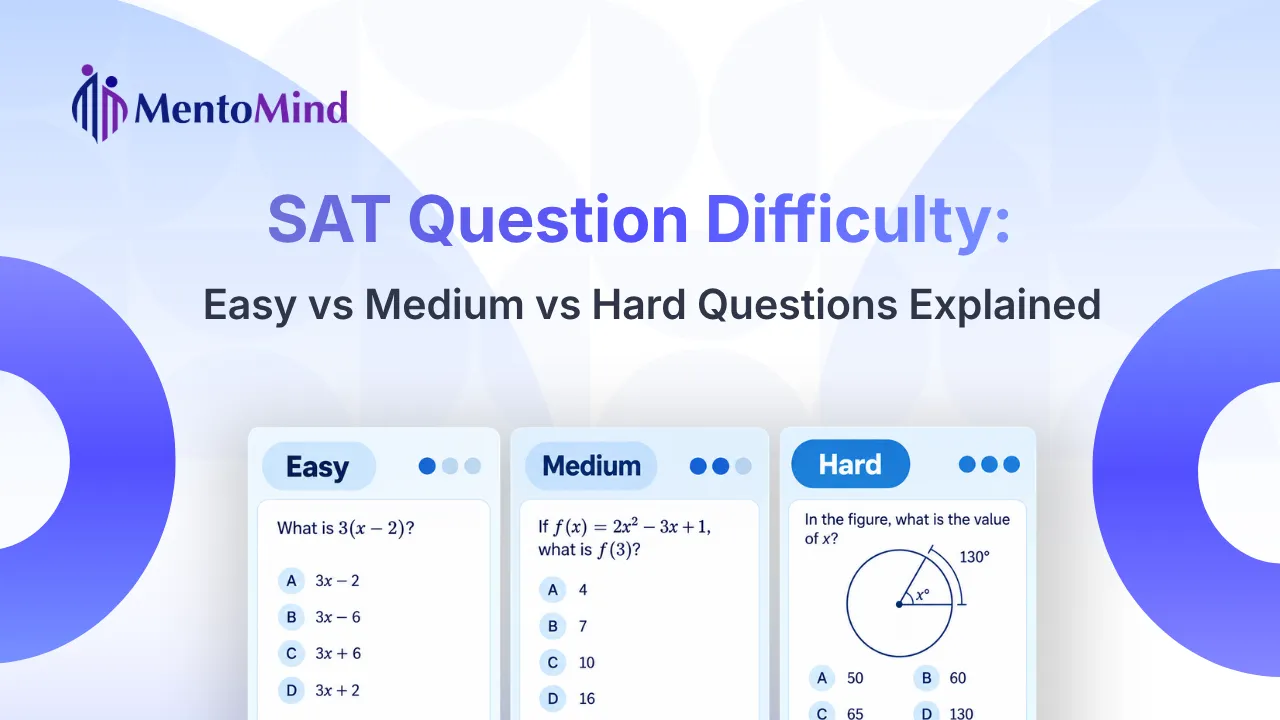
The College Board assigns every SAT question one of three difficulty labels: easy, medium, or hard. These labels reflect how students typically perform on each question, not how long it takes to solve. A question that trips up most test-takers earns a hard label, even if it looks simple at first glance.
In Module 1 of each section, you will see a mix of all three difficulty levels. The Reading and Writing questions move from easier to harder within groups of similar question types. Math questions in Module 1 also trend from easier to harder as you progress. This ordering is transparent, and knowing it can help you manage your time.
What Changes Between Easy, Medium, and Hard Questions?
The SAT question types and topics do not change based on difficulty. Whether you land in the easier or harder Module 2, you will still see Algebra, Advanced Math, Reading Comprehension, and Grammar. What changes is how those topics are tested.
Here is what typically differs:
- SAT easy questions: use familiar setups, straightforward vocabulary, and require one or two steps to reach the answer. Most prepared students get these right.
- Medium questions: introduce multi-step reasoning or slightly less common vocabulary. They reward technique more than speed. Most preparation time produces the biggest gains here.
- Hard questions: demand precise reasoning, abstract thinking, or the ability to hold multiple conditions in mind at once. In Math, they often involve non-linear systems, function transformations, or complex word problems. In Reading and Writing, they may test sophisticated vocabulary or require you to draw from evidence across a passage.
How Does Question Difficulty Connect to the Adaptive Format?
The Digital SAT uses a two-module structure for each section. Everyone takes the same Module 1, which contains a broad mix of easy, medium, and hard questions. Your performance in Module 1 determines the SAT difficulty level you face next, whether you receive the harder Module 2 (Module 2B) or the easier Module 2 (Module 2A).
Module 2B contains a higher proportion of hard questions and gives you access to the highest possible scores. Module 2A contains mostly easy and medium questions, and your score ceiling for that section is capped at roughly 590 out of 800, even if you answer every question correctly. This is why performing well in Module 1 matters so much.
| Factor | Module 2A (Easier) | Module 2B (Harder) |
|---|---|---|
Question mix |
Mostly easy and medium |
Mostly medium and hard |
Score ceiling |
~590 per section |
Up to 800 per section |
Routing |
Weaker Module 1 performance |
Stronger Module 1 performance |
Preparation priority |
Secure all easy/medium points |
Hard question practice essential |
Also Read: 3 Key Benefits of Digital SAT Adaptive Testing
Why Do Easy Questions Matter More Than You Think?
A common mistake with SAT easy questions is to focus all your study time on hard questions while assuming the easier ones will take care of themselves. On the Digital SAT, this can cost you more than you realize.
The SAT employs a method known as Item Response Theory when it comes to weighting questions. Since students who score highly always get easy questions correct, failing to answer one of them is a stronger indication of a gap in ability than failing to answer a difficult question. In certain instances, a careless error on an easy question can cause your score to drop more than missing a hard question. Make sure to protect each point that you should already be earning.
In reality, this involves two points: you should not go through the easier questions quickly in order to spare time for the more difficult ones, and you should look over your mistakes on the easy and medium questions before deciding to spend additional sessions on the harder material.
What Should You Do With Hard Questions?
SAT hardest questions carry real weight if you are aiming for a score above 650 per section. To access Module 2B, you need to perform well in Module 1, which includes a portion of hard questions. If you skip or guess on all the hard questions in Module 1, you may not clear the threshold for the harder module.
If you are wondering how many hard questions are on the SAT, there is no single fixed number; once you are in Module 2B, hard questions become more frequent. Time pressure increases because the cognitive load is higher. The best strategy is to first secure every easy and medium point, then use the remaining time for hard questions. If a hard question is consuming too much time, make your best choice and move on. Guessing is always better than leaving an answer blank.
How to Practice for Each SAT Question Difficulty Level
The kind of questions you do should correspond to the SAT exam difficulty level you’re working on. Focusing just on easy questions will give you familiarity but won’t develop the skills necessary for higher scores. On the other hand, concentrating only on hard questions without first building a solid foundation will result in carelessness and errors on questions that you should be answering correctly.
Practicing Easy Questions
- Build speed: Easy questions should feel automatic. Practice them in timed sets to train yourself to answer quickly and confidently without second-guessing.
- Avoid careless mistakes: Read each question carefully even when it looks simple. Many easy questions hinge on one specific word or condition.
- Do not skip review: If you miss an easy practice question, treat it as seriously as a missed hard one. Find out exactly why it happened.
Practicing Medium Questions
- Use an error log: Medium questions are where most score gains happen. Track the types you miss repeatedly and group them by skill.
- Break problems into steps: Multi-step questions become manageable when you slow down and write out each step rather than solving everything mentally.
- Practice elimination: On multiple-choice medium questions, eliminating two wrong answers significantly improves your odds even if you are not fully certain.
Practicing Hard Questions
- Identify recurring topics: In Math, the SAT hardest questions often involve non-linear systems, advanced functions, and complex exponential problems. In Reading and Writing, hard questions may test nuanced vocabulary in context.
- Reduce time-to-insight: Hard questions are often concise but cognitively demanding. Timed hard-question drills train you to reach the right approach faster.
- Use worked explanations: Checking whether an answer was right is not enough. You need to understand the reasoning behind each correct answer. MentoMind’s SAT practice includes detailed explanations and step-by-step video solutions via Think10x.ai, so you can see exactly how to work through a hard question.
Also Read: Should You Take an SAT Diagnostic Test?
How to Build Your Practice Around SAT Difficulty Levels
Start with a diagnostic test before deciding how to divide your study time. Your baseline score and section results will tell you which SAT difficulty level needs the most attention.
If your score at the moment is under 1000, then you should focus on the easy and medium questions. It will have a greater effect on your score to get these right consistently than to pursue hard questions for which you are not yet ready. When your score is between 1000 and 1300, you probably already deal with the easy questions so that it will be the medium ones which will bring your score up. You should therefore do some timed practice and go over every mistake. In case your desired score is above 1300, practice on hard questions becomes necessary. To reach that score range, you will need Module 2B and you must answer the hard questions correctly once you have got there.
Ready to Practice at the Right Difficulty Level?
Knowing the SAT difficulty level across easy, medium, and hard questions is only useful when your practice reflects it. MentoMind gives you SAT practice questions sorted by topic and difficulty, 11 full-length adaptive tests designed to match real exam conditions, detailed performance reports, and step-by-step video solutions via Think10x.ai for questions where you need to understand the method, not just the answer.
Related reading:
3 Key Benefits of Digital SAT Adaptive Testing
SAT Score Percentiles Explained: Where Does Your Score Rank?
Should You Take an SAT Diagnostic Test?
Frequently Asked Questions
The SAT doesn’t mark the questions with their difficulty level when you’re taking the test. In Module 1, the maths questions tend to increase in difficulty as you go on. Among SAT question types, the Reading and Writing questions are grouped according to type, with the easier ones coming before the more difficult ones in each group. You can use this sequence to plan how your time will be allocated.
Not on its own. Although the harder questions in Module 2B can increase your score, missing easier or medium-difficulty questions can offset those gains. Your final section score is influenced by both the number of questions you answer correctly and the weighting assigned to the questions by the adaptive system. A good score is achieved by keeping all three difficulty levels intact.
There is no fixed answer to how many hard questions are on the SAT, but regularly leaving out difficult questions in Module 1 might keep your score below the level required to gain access to Module 2B. When you end up in Module 2A, your section score will be capped at about 590, no matter how many questions you get right. You should try to answer all the questions rather than leaving any of them blank.
It all depends on your current score. If it’s below 1000, you should spend most of your time doing easy and medium-level questions. When your score is between 1000 and 1300, then you need to focus on medium-level questions and start including some hard ones. If your score is above 1300, hard questions must receive consistent attention. Firstly, take a diagnostic test in order to work out where your time is most effectively spent.
The SAT difficulty level is identical in both sections, but the reason why a question is classified as hard varies from section to section. In the case of Hard Math questions, the main feature is that they involve more complicated operations and require multi-step reasoning. For Hard Reading and Writing questions, it is usually necessary to have a good knowledge of vocabulary or to carry out a careful analysis of the argument in the passage. In both sections, careful and accurate practice is rewarded rather than speed.
Also Read: How to Use Desmos on Digital SAT: Commands, Shortcuts and Examples
More from MentoMind: