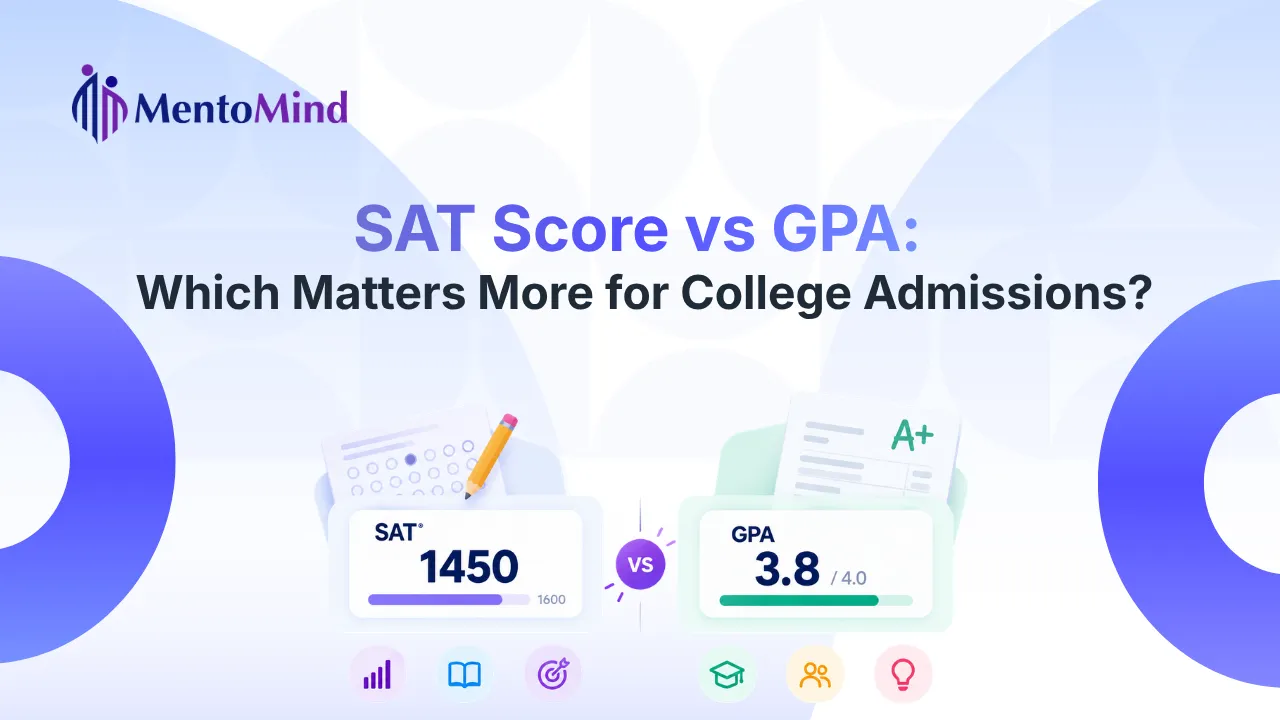
If you’re comparing SAT scores vs GPA, it helps to understand what each tells colleges and how much weight schools give them. Your GPA reflects your performance across high school, while an SAT score provides another measure of academic readiness.
This guide explains how colleges compare these factors, what to consider when building your college list, and how to balance SAT preparation with your schoolwork.
SAT Scores vs GPA: What Does Each Tell Colleges?
SAT scores vs GPA give colleges two different types of academic information. Your GPA reflects how consistently you performed in high school, while your SAT score provides a standardized measure that can be compared across students from different schools.
- GPA: Shows your performance across multiple subjects and semesters.
- Coursework: Adds context by showing how challenging your classes were.
- SAT score: Gives colleges a common benchmark for evaluating academic skills.
- Overall record: Helps admissions officers understand your academic strengths in context.
The GPA vs SAT score comparison is therefore less about choosing one winner and more about understanding what each metric adds to your application.
Why Is GPA Important in College Admissions?
Your GPA can tell colleges how you perform when academic work is part of your routine. It reflects years of assignments, exams, projects, and coursework, giving admissions officers more context than a single exam score.
A GPA can help colleges understand:
- How consistently you performed across high school
- Whether you took challenging courses and how you performed in them
- Whether your grades improved, declined, or remained steady
- How your academic record fits within your school’s grading environment
So, when asking why is GPA important, the key is that it provides a broader picture of your academic habits and performance than one standardized test can.
Is SAT Score More Important Than GPA?
An SAT score can work in your favor when it highlights an academic strength that is less obvious from your transcript. Rather than replacing your GPA, it can give admissions officers another piece of evidence when assessing your academic profile.
Consider submitting a strong score when:
- It is one of your strongest academic indicators: A high result can draw attention to skills you want your application to showcase.
- It complements your transcript: Your score can reinforce an academic strength already visible in your record.
- It meets the college’s expected range: A competitive result is generally more useful when it aligns with the scores reported by your target college.
This is why the SAT scores vs GPA question does not have one answer for every student. The more useful question is whether your SAT score makes your overall application stronger.
If SAT Math is an area you want to strengthen, Think10X.ai gives you step-by-step video explanations that show you how to approach each problem. Practice with SAT Math to understand difficult questions, learn from your mistakes, and sharpen your problem-solving skills.
What Are the Most Important Factors in College Admissions?
A college application is more than a comparison of GPA vs SAT score. Admissions officers can look across several parts of the application to understand what a student has achieved and what they could contribute to the college community.
Your application may be shaped by:
- What you achieved academically: Grades, coursework, and academic progress establish your foundation.
- How you used opportunities: Challenging classes, meaningful activities, and independent projects can show initiative.
- What matters to you: Long-term involvement in a few meaningful interests can be more informative than a long list of activities.
- How you communicate: Essays and recommendations can reveal qualities that aren’t visible in academic numbers.
- How well you fit the college’s process: Every institution has its own priorities and college admissions criteria.
This broader evaluation is why there is no single formula for admission. A strong application is one where the different pieces support a clear picture of the student.
What Do Admission SAT Scores and GPAs Look Like at Different Colleges?
There is no single benchmark that applies to every college. For example, one school may have a typical SAT range in the 1400s, while another may report a much broader range. GPA can vary just as much because schools use different grading systems and levels of course rigor.
That means admission SAT scores for colleges and admission GPA for colleges should be treated as college-specific reference points. When researching a school, look at:
- The latest SAT score range it reports
- The GPA profile of its enrolled or admitted students, if available
- The grading system used to calculate those GPAs
- The academic profile of the students who typically attend
The goal is not to hit a universal number. It is to understand where your academic profile sits relative to the college you’re considering.
How Should You Balance SAT Prep With Maintaining Your GPA?
SAT preparation should support your college application, not come at the expense of your academic performance. If preparing for the test starts affecting your grades, the extra SAT practice may no longer be worth the trade-off.
Keep these priorities in mind:
- Protect your core academics: Schoolwork comes first because your transcript reflects your performance across multiple courses.
- Use SAT practice selectively: Don’t spend hours practicing areas where you’re already performing consistently.
- Watch for burnout: If long SAT sessions leave you too tired to focus in class, reduce the workload.
- Increase preparation strategically: Put more time into SAT prep when your school schedule gives you enough room for it.
A good schedule should improve your application without weakening another part of it. If you want a structured approach to running a diagnostic and using the results, read our guide to building a diagnostic test for SAT prep.
Ready to Prepare Smarter for the SAT?
MentoMind’s Digital SAT course gives you 3,500+ SAT Reading, Writing, and Math questions, 11 full-length adaptive practice tests, detailed performance analytics, and targeted practice to help you strengthen your SAT score while balancing your GPA.
Frequently Asked Questions
Yes, it’s free to start, with no credit card required to upload your first question.
Yes. It covers math, physics, chemistry, biology, and other subjects, and accepts questions as photos, typed text, or spoken input.
ChatGPT and similar tools tend to hand over a written answer that’s easy to copy without understanding the method. Think10x.ai builds a narrated, step-by-step video specifically scoped to your question, and research on unguarded AI tools shows that skipping the method in favor of a direct answer can hurt exam performance later.
ChatGPT and similar tools tend to hand over a written answer that’s easy to copy without understanding the method. Think10x.ai builds a narrated, step-by-step video specifically scoped to your question, and research on unguarded AI tools shows that skipping the method in favor of a direct answer can hurt exam performance later.
Yes, there’s no limit. Each follow-up becomes its own video, answered specifically, so you can keep asking until the concept actually makes sense. This back-and-forth is what separates genuine AI that explains concepts from a tool that just outputs a single static answer.
A search engine points you toward content someone else already made. An AI study assistant like Think10x.ai builds a new explanation around your specific input, so the output matches your problem instead of the closest thing available online.