If you have ever felt blindsided halfway through the ACT Math section, you are not alone. Most students expect a random mix of questions, but the section is carefully structured. Once you understand how it works, the test feels far more manageable and less chaotic.
This guide breaks down the ACT math hard questions, how difficulty is ordered across the section, and the pacing strategies that make the biggest difference on test day.
What ACT Math Hard Questions Actually Look Like
Understanding the difficulty levels is one thing. Seeing them side by side is what makes it click. Here are three worked examples with full answer explanations, one from each band.
Foundational: Single-Step Algebra
Solve for x: 3x + 5 = 20
- Step 1: Subtract 5 from both sides. 3x = 15
- Step 2: Divide both sides by 3. x = 5
Straightforward. One path, one answer.
Moderate: Function Evaluation
If f(x) = 2x² − 3x + 1. What is f(−2)?
- Step 1: Substitute −2 for x. f(−2) = 2(−2)² − 3(−2) + 1
- Step 2: Resolve the exponent. (−2)² = 4, so 2(4) = 8
- Step 3: Handle the negative. −3(−2) = 6
- Step 4: Add everything. 8 + 6 + 1 = 15
On questions like this, the incorrect options are usually built around small sign errors made when students rush. Writing out each step helps you avoid those traps.
Advanced: Hard ACT Math Problems in Practice
A 5-12-13 triangle is scaled so its area doubles. What is the new length of the longest side?
- Step 1: Confirm the right triangle, 5² + 12² = 25 + 144 = 169 = 13². The longest side is 13.
- Step 2: Apply area scaling and when a shape scales by factor k, area scales by k². Area doubles, so k² = 2, meaning k = √2.
- Step 3: Calculate the new longest side = 13√2 ≈ 18.4
This problem feels hard because it combines several basic ideas such as right triangle recognition, area scaling, and square roots, and the real skill is identifying those pieces and working through them step by step.
How Is ACT Math Ordered by Difficulty?
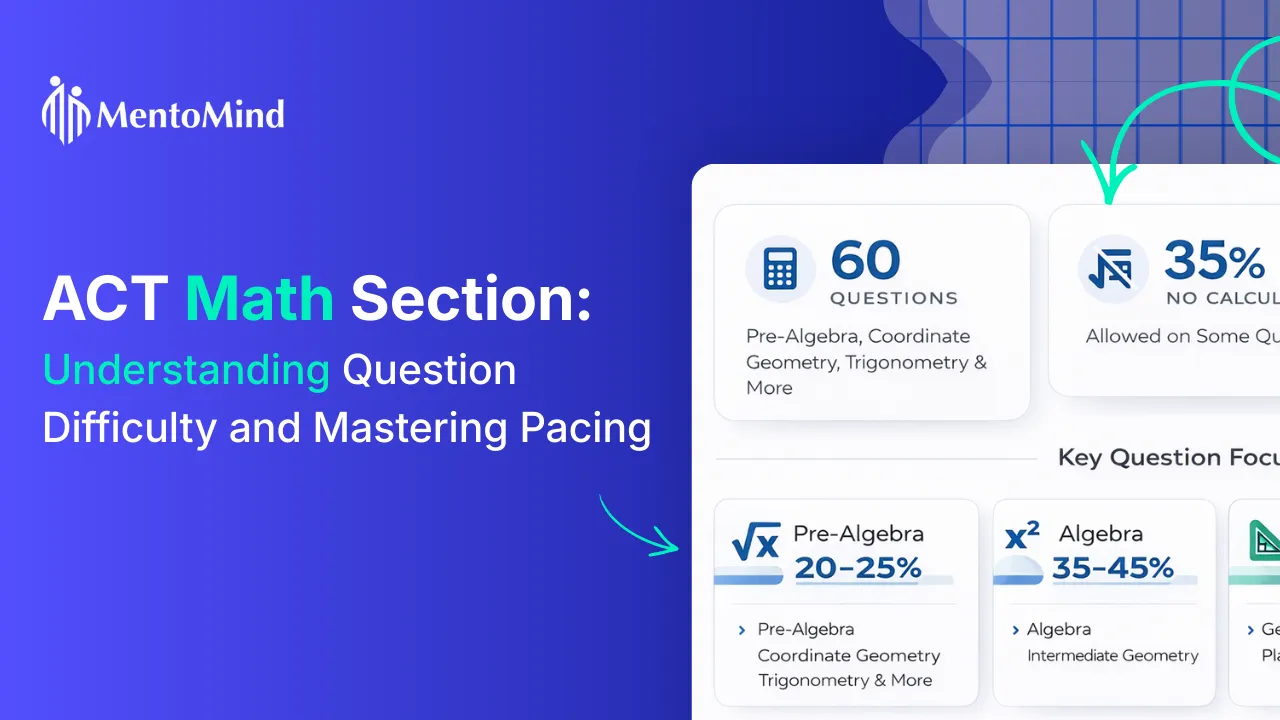
ACT Math is the only section of the test that runs in a fixed order of difficulty, from the first question to the last. That predictability is a major strategic advantage if you know how to use it.
Think of the section in three bands:
| Band | Question Range | What is Tested |
|---|---|---|
Foundational |
Que 1 to 15 |
Arithmetic, ratios, linear equations, basic geometry |
Moderate |
Que 16 to 30 |
Functions, quadratics, systems of equations, coordinate geometry |
Advanced |
Que 31 to 45 |
Trigonometry, higher math, multi-concept problems |
ACT Math Formulas You Cannot Afford to Forget
Unlike the SAT, the ACT offers no formula sheet, requiring students to recall all necessary formulas from memory.
The good news is that the list of high-frequency formulas is manageable. Here are the formulas to prioritize based on the ACT math concepts that appear most often.
Geometry
- Area of a triangle: A = ½ × base × height
- Area of a circle: A = πr²
- Circumference of a circle: C = 2πr
- Pythagorean theorem: a² + b² = c²
- Angles in a triangle add to 180°. Angles in a circle add to 360°
- Parallel lines and a transversal: big angles are equal, small angles are equal, and any big plus any small angle equals 180°
- Trigonometric ratios: SOH-CAH-TOA
Coordinate Geometry
- Slope-intercept form: y = mx + b
- Slope formula: m = (y₂ − y₁) / (x₂ − x₁)
- Midpoint formula: ((x₁ + x₂) / 2, (y₁ + y₂) / 2)
Algebra
- Quadratic formula: x = (−b ± √(b² − 4ac)) / 2a
- Discriminant: D = b² − 4ac. If D > 0, two real solutions. If D = 0, one solution. If D < 0, no real solutions
Statistics and Problem Solving
- Average: Total Sum / Number of Things
- Probability: Favorable outcomes / Total possible outcomes
- Direct variation: y = kx
How to Pace Yourself Through ACT Math
ACT Math pacing works best when students front-load their time instead of treating every question equally. The Enhanced ACT gives 50 minutes for 45 questions, but the smartest strategy is to move quickly through easy questions to save time for harder ones.
ACT Math pacing framework (45-question format):
- Reach Question 15 by minute 13
- Reach Question 30 by minute 28
- Use remaining time on the final 15 questions
The most effective pacing habit is strategic skipping. If a question feels tough and you are unable to decide which answer is right after about 45 seconds, mark it and move on. Spending too long on one hard problem often costs time on moderate questions that are easier points.
Pacing on ACT Math is a discipline skill and it improves with timed practice.
ACT Math Strategies That Actually Improve Scores
ACT Math strategy matters because it protects accuracy under time pressure. Students who adjust their approach based on difficulty score higher than those who treat every question the same.
Read questions differently based on difficulty
On easy questions, read carefully once and solve without overthinking. On moderate and hard questions, read twice before solving to catch misdirection, extra information, or hidden unit changes.
Protect easy points
Slow down on the simplest questions and prioritize accuracy early, since rushing easy problems is one of the fastest ways to lose points on ACT Math.
Use difficulty to control time spent
If an easy question takes more than 45 seconds, reread it. If a hard question stalls after about 75 seconds, guess and move on. The ACT rewards completion, not perfection.
Break hard problems into steps
Hard ACT Math problems usually combine two or three familiar concepts. Identify the first step and work forward. If it does not come together quickly, guess and continue.
Frequently Asked Questions
ACT Math is challenging but very learnable, depending on your preparation and strengths. The foundational questions are accessible for most students who have completed algebra, while moderate questions require careful setup and multi-step thinking. The hardest questions combine multiple concepts and feel difficult mainly because of time pressure, not unfamiliar material. The section follows a predictable structure, which means the right preparation makes a real difference.
The Enhanced ACT is not easier; it has fewer questions but similar difficulty and timing per question. It includes 45 questions in 50 minutes compared to the previous 60 questions in 60 minutes, so each question carries slightly more weight. Accuracy matters more than ever, and whether it feels easier or harder depends on the individual student.
ACT Math questions run from easiest to hardest, from the first question to the last. Foundational questions appear first, followed by moderate multi-step problems, with the most advanced questions closing out the section. It is the only ACT section where this difficulty ordering is guaranteed.
The hardest ACT math questions combine two or three familiar concepts rather than testing obscure material. For example, a problem may require recognizing a right triangle, applying area scaling, and working with square roots in one sequence. The difficulty comes from identifying the concepts involved, not from the concepts themselves.
Yes, you should always guess if you cannot solve a question. The ACT does not penalize wrong answers, so leaving a question blank guarantees zero points while guessing gives you a chance. Eliminating even one or two answer choices improves your odds, especially when time is running out.
Practice ACT Math with MentoMind
Now that you understand how ACT Math difficulty works and how to pace yourself, the next step is putting those strategies into practice. If you’re looking for a smarter way to prepare for the ACT, MentoMind offers an online prep experience built around real test conditions and clear feedback.
MentoMind’s ACT prep includes:
- 1,000+ expert-curated ACT questions aligned to real exam difficulty
- 4 full-length ACT practice tests designed to match test-day timing and structure
- A free diagnostic test to identify your starting score and priority areas
- AI-guided help with hints and explanations when you’re stuck
- Progress reports and analytics to track improvement by section and topic
- Built-in pacing practice to develop speed and accuracy under pressure
You can start with free practice questions and a diagnostic test to explore the platform. Upgrade anytime to get full access to all tests, progress reports, and study tools.