Preparing students for AP Chemistry requires more than strong subject knowledge. An effective tutor must combine structured instruction, targeted practice, and proven exam strategies. This guide covers everything you need to understand the exam format, calculator policy, scoring system, and the most effective ways to teach each unit.
What Is the AP Chemistry Exam?
AP Chemistry, or Advanced Placement Chemistry, is a rigorous college-level high school course covering topics such as atomic structure and properties, molecular and ionic compound structure and properties, intermolecular forces and properties, chemical reactions, kinetics, thermochemistry, equilibrium, acids and bases, thermodynamics and electrochemistry.
It emphasizes conceptual understanding, problem solving, and scientific reasoning to prepare students for the AP Chemistry exam and STEM studies.
The AP Chemistry exam consistently ranks among the most challenging Advanced Placement tests. According to 2025 College Board AP score distributions:
- Approximately 77.9% of students earned a score of 3 or higher
- Only 17.9% achieved the top score of 5
How is the AP Chemistry Exam Structured?
The AP Chemistry exam is divided into two main parts: a multiple-choice portion and a free-response portion. Both parts give you access to a periodic table and a reference sheet of useful formulas and constants, so you don’t need to memorize those resources during the test.
Digital delivery with handwritten responses
The exam uses a hybrid format; questions are presented through the Bluebook testing app, but you write your free-response answers by hand in paper booklets that are collected at the end of the session.
Calculator policy
Calculators are permitted on both portions of the exam (this policy changed in recent years so plan to use one as part of your strategy).
Question types
The multiple-choice items test conceptual understanding and problem solving, while the free-response questions ask you to show work, explain reasoning, and perform quantitative analysis.
Tips Tutors Can Share with Their Students
- Encourage students to practice using the testing app in advance so they’re comfortable navigating digital questions on exam day.
- Train students to write clear, well-labeled free-response answers, including diagrams, step-by-step work, and correct units.
- Help students practice with an approved calculator and understand when it’s useful versus when a conceptual approach is more efficient.
What Is the Format of the AP Chemistry Exam?
The AP Chemistry test is 3 hours and 15 minutes long and includes two distinct sections.
Section I: The Multiple-Choice
- 60 questions in 90 minutes
- 50 percent of the final score
- Calculator use is allowed
Section II: The Free-Response
- 7 questions in 105 minutes
- 50 percent of the final score
- Calculator use is allowed
- 3 long response questions (10 points each)
- 4 short response questions (4 points each)
How Is the AP Chemistry Exam Scored?
The AP Chemistry exam has two sections: multiple choice and free response. Each section counts for 50 percent of the total score.
Multiple-choice section
- 60 questions in total.
- Your raw multiple-choice score is the number of correct answers. There is no penalty for incorrect answers.
Free-response section
- 7 questions in total, with three long questions worth 10 points each and four short questions worth 4 points each. The free-response section has a maximum raw score of 46 points.
| AP Score | Percentage of Students Securing Each Score |
|---|---|
5 |
17.9% |
4 |
28.6% |
3 |
28.8% |
2 |
15.9% |
1 |
6.2% |
What You Need to Teach for the AP Chemistry Exam
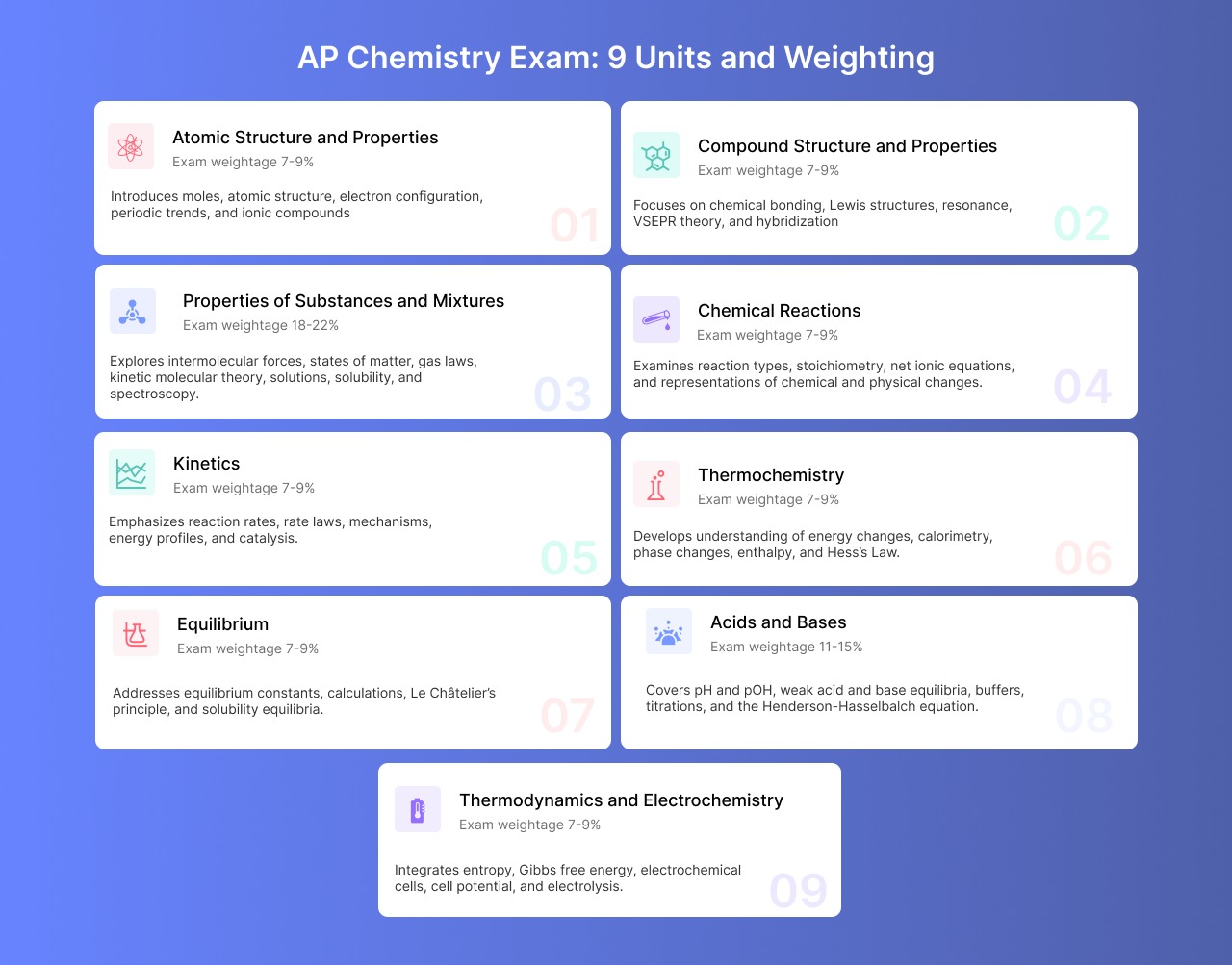
AP Chemistry exam covers nine major units.
- Atomic Structure and Properties
- Molecular and Ionic Compound Structure and Properties
- Intermolecular Forces and Properties
- Chemical Reactions
- Kinetics
- Thermodynamics
- Equilibrium
- Acids and Bases
- Applications of Thermodynamics
What Key Concepts Should Tutors Cover in AP Chemistry?
As a tutor, your goal is to build conceptual understanding and exam fluency. Begin each unit with a brief conceptual overview, use worked examples to demonstrate problem solving, and follow with targeted practice that mirrors AP question styles. Emphasize connections between topics, for example how thermodynamics informs equilibrium reasoning, and coach students to show clear, labeled work on free-response problems.
Core Content to Teach and Assess
- Energy changes including endothermic and exothermic processes and basic thermochemistry concepts
- Chemical equilibrium including the dynamic balance of forward and reverse reactions, equilibrium constants, K calculations, and Le Châtelier’s principle
- Reaction mechanisms and kinetics focusing on elementary steps, rate laws, and how mechanisms explain observed rates
- Solubility equilibria including solubility product constants (Ksp), equilibrium-based solubility calculations, and factors that affect solubility
High-Yield Topics to Prioritize
Focus extra practice time on topics that frequently appear on the exam and require multi-step reasoning:
- Equilibrium, including buffers and common-ion effects
- Acids and bases, including pKa and pKb, titrations, pH calculations, and buffers
- Thermodynamics, including enthalpy, entropy, spontaneity, and related calculations
Scientific Practices to Integrate into Every Lesson
Build these skills into lessons, assignments, and exam preparation so students apply content knowledge like scientists:
- Use models and representations such as diagrams, energy profiles, and molecular models
- Analyze experimental data by interpreting graphs, calculating rates, and assessing uncertainty
- Apply mathematical reasoning through unit conversions, algebraic manipulation, and error checking
- Construct evidence-based explanations using data and chemical principles
- Connect practice problems and case studies to underlying theory and exam expectations
How to Teach Your Students for the AP Chemistry Exam
Effective AP Chemistry instruction combines strong content knowledge with structured exam preparation. Tutors should focus on identifying learning gaps early, reinforcing conceptual understanding, and building confidence through regular, exam-style practice.
1. Begin with a Diagnostic Assessment
Start by administering an initial assessment to evaluate each student’s strengths and weaknesses. Use the results to prioritize topics, customize lesson plans, and set realistic improvement goals.
2. Use Active Recall and Spaced Repetition
Encourage students to strengthen memory and understanding through consistent review habits:
- Have students test themselves regularly using flashcards and practice questions
- Schedule review sessions over increasing intervals to improve long-term retention
- Ask students to summarize key concepts in their own words to reinforce learning
3. Train Students to Explain Their Reasoning
Encourage students to justify every answer they give, even when it is correct. If a student cannot explain why an answer works, revisit the underlying concept. This approach strengthens long-term understanding and improves free-response performance.
4. Develop Formula Fluency
Although students receive a formula and constant sheet during the exam, they should be fluent in using key formulas without relying on it.
Practice helping students:
- Recognize when a formula applies
- Rearrange equations correctly
- Estimate reasonable answer ranges
This improves speed and accuracy under timed conditions.
5. Strengthen Experimental and Data Interpretation Skills
AP Chemistry frequently tests students on experimental scenarios and data analysis. Even in online tutoring, students should practice:
- Interpreting graphs and tables
- Explaining trends and sources of error
- Connecting results to chemical principles
Use released questions, virtual labs, and example datasets to build these skills.
6. Build Estimation and Problem-Solving Efficiency
Calculators are permitted on both sections of the AP Chemistry exam. However, students should still learn to:
- Estimate answers quickly
- Eliminate unrealistic options
- Recognize calculation shortcuts
This saves time and reduces careless mistakes.
7. Use Official College Board Materials
Whenever possible, incorporate:
- Official AP Chemistry questions
- Released free-response questions
- Official scoring guidelines
These resources best reflect exam style and scoring expectations.
8. Maintain Core Skill Readiness
Ensure each student has solid foundations in:
- Algebra and logarithms
- Scientific notation
- Unit analysis and conversions
- Basic stoichiometry and bonding concepts
- Calculator operation and settings
Weaknesses in these areas may limit higher-level progress.
9. Follow a Structured Study Plan
A consistent, long-term study plan helps students build skills gradually and avoid last-minute cramming. Tutors can use the following 10-week framework as a foundation and adjust it based on individual needs.
| Week | Primary Focus | Practice Approach |
|---|---|---|
1-2 |
Atomic structure and chemical bonding |
Multiple-choice drills and flashcard review |
3-4 |
Chemical reactions and stoichiometry |
Guided problem sets and targeted practice |
5-6 |
Thermodynamics and kinetics |
Free-response practice and data analysis |
7-8 |
Equilibrium and acids and bases |
Mixed practice sets and section-level tests |
9-10 |
Comprehensive review and mock exams |
Full-length timed practice exams |
Final Thoughts
Preparing students for the AP Chemistry exam is both a challenge and an opportunity for tutors. Success depends on building strong conceptual foundations, reinforcing problem-solving skills, and guiding students through consistent, exam-focused practice.
By combining diagnostic assessments, targeted instruction, structured study plans, and regular performance reviews, tutors can help students develop confidence and resilience alongside academic mastery.
With the right strategies, tools, and commitment, AP Chemistry tutors play a vital role in shaping student success. Thoughtful preparation not only improves exam scores but also equips students with the skills they need for future studies in science and related fields.
Frequently Asked Questions
The AP Chemistry exam lasts 3 hours and 15 minutes. Section I includes 60 multiple choice questions in 90 minutes with a calculator. Section II includes 7 free response questions in 105 minutes with a calculator. Each section counts for 50 percent of the final score.
The exam is scored on a 1 to 5 scale. Section I and Section II contribute equally. Students generally need about 70 to 75 percent correct to earn a 5.
The exam covers nine units, with the heaviest emphasis on Intermolecular Forces and Acids and Bases. Other units include Atomic Structure, Compound Structure, Chemical Reactions, Kinetics, Thermodynamics, Equilibrium, and Applications of Thermodynamics.
Section I consists of 60 multiple choice questions in 90 minutes with no calculator. Section II consists of 7 free response questions in 105 minutes with a calculator. Both sections carry equal weight.
The total testing time is 3 hours and 15 minutes. Section I runs for 90 minutes. Section II runs for 105 minutes.
Tutors should begin with a diagnostic assessment to identify learning gaps, prioritize active problem-solving over passive review, introduce free-response practice early, focus on high-impact units, build strong calculator fluency, and schedule full-length practice exams every three to four weeks starting three to six months before the exam.
Sometimes, a Visual Explanation Makes All the Difference
While MentoMind supports your exam preparation with AI-powered learning tools, Think10X.ai helps you create professional explanation videos from any AP Chemistry question image in just 15 minutes.
Here’s how it works
- Upload a question photo (handwritten, printed, or textbook)
- AI solves it step by step and creates an animated video
- Get narrated explanations ready to share or embed
Turn complex calculations and concepts into clear, easy-to-follow walkthroughs your students can revisit anytime.
👉 Create your first explanation video at Think10x.ai