What is the Digital SAT?
The Digital SAT evaluates skills in Math and Evidence-Based Reading and Writing (EBRW). It’s adaptive, meaning question difficulty adjusts based on your answers. Correct answers lead to harder questions, incorrect ones to easier ones.
The SAT consists of two main sections, Math and EBRW, each scored between 200 and 800, for a total score ranging from 400 to 1600. Your raw score (number of questions answered correctly) is converted to a scaled score that accounts for test difficulty. Colleges often consider your highest score, so taking the SAT multiple times can be beneficial.
Understanding the SAT’s Focus: The SAT tests a specific and fixed list of concepts across both sections. Unlike tests that rely on rote memorization, the SAT focuses on logic and application, so understanding concepts deeply is more important than simply memorizing formulas or vocabulary.
Math Section
The SAT Math section has about 44 questions covering:
- Algebra
- Advanced Mathematics
- Problem-Solving and Data Analysis
- Geometry and Trigonometry
Mastering these topics, especially high-yield areas, is essential for a high score. The math section includes calculator-allowed and no-calculator parts; develop efficient strategies for both.
Key points:
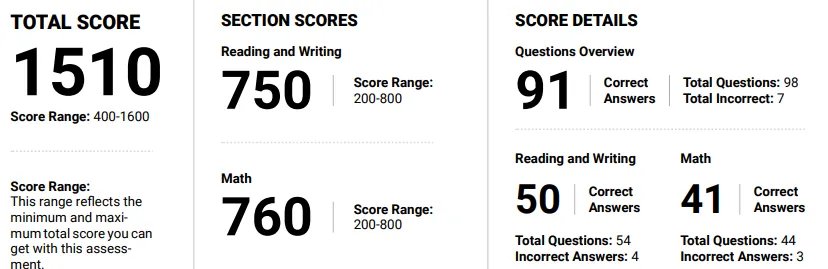
- Aim to make no more than 3 mistakes in Math for a 1500+ score.
- Use the DESMOS calculator effectively on allowed questions.
Evidence-Based Reading and Writing (EBRW)
This combined section has about 54 questions divided into:
- Information and Ideas
- Craft and Structure
- Expression of Ideas
- Standard English Conventions
Strong reading skills and time management are critical. For Writing, understanding grammar rules, sentence structure, and parallel structure helps identify correct answers and improve your score.
How Does the Digital SAT Scoring Work?
The adaptive format means:
- Correct answers lead to harder questions, which carry more weight.
- Incorrect answers lead to easier questions, potentially limiting your maximum score.
Scaled scores reflect raw scores adjusted for difficulty, enabling fair comparisons across test versions. A 1500 score places you in the 97th percentile, outperforming 97% of test takers.
On official practice tests, missing 5-6 Math questions can still yield scores around 750-770 if harder questions are answered correctly. Similarly, a raw score of 63-64 in EBRW can result in 760-780, depending on difficulty.
Using Practice Tests Effectively
Practice tests are one of the most powerful tools for SAT preparation. They help you:
- Familiarize yourself with the SAT structure and question types.
- Identify strengths and weaknesses before test day.
- Build endurance and manage test anxiety.
- Develop time management skills.
To maximize benefits:
- Take full-length practice tests in a quiet room with timed conditions matching the actual SAT.
- Use a calculator for the math sections as you would on test day.
- Review your answer sheet carefully after each test to analyze mistakes and identify patterns.
- Maintain a detailed log of mistakes to identify recurring patterns and avoid future errors. Track not just which questions you missed, but why you missed them and what type of mistake it was.
- Re-solve every question from scratch if time permits after completing a practice test. This helps catch careless errors and reinforces correct problem-solving approaches.
- Focus your study plan on weak areas such as grammar rules, advanced math topics, or reading comprehension.
- Use official SAT practice materials, including the College Board’s tests, Khan Academy resources, and reputable prep books like the SAT Prep Black Book.
- Simulate test-day conditions to reduce anxiety and improve stamina.
- Take practice tests regularly, ideally every two weeks, to monitor progress and adjust your study plan accordingly.
Consistent practice and careful review of errors will lead to steady improvement and help you approach your target score.
Why Target a 1500 on the Digital SAT?
A 1500 is a benchmark score that opens doors to some of the most prestigious colleges and universities. Many top-tier schools, including Ivy League institutions, consider a 1500 highly competitive and a strong indicator of academic readiness. Additionally, achieving a 1500 can significantly boost your chances of receiving merit-based scholarships and standing out in competitive admissions pools.
Recommended Study Plan
For optimal performance, follow this structured approach:
- Schedule: Take one full-length Bluebook test every 2-3 weeks and dedicate 10-15 hours a week to studying for 2-3 months.
- Study Sessions: Work in focused 30-45 minute bursts rather than long, sporadic cram sessions. This approach improves retention and prevents burnout.
- Practice Frequency: Regular, consistent practice is more effective than last-minute cramming.
What are Some Tips for Scoring a 1500 on the Digital SAT?
A score of around 1500 is typically achieved with scores of around 750 on both Math and EBRW.
Tip 1. Accuracy
Take time to understand each question and use elimination strategies to narrow answer choices. Apply the 3/4 Rule for difficult questions: if you cannot eliminate at least 3 out of 4 answer choices, make your best guess and move on rather than spending excessive time.
Tip 2. Time Management
Allocate your time wisely across sections and revisit difficult questions if time permits.
Tip 3. Master Tools
Learn to use the DESMOS calculator efficiently for math problems.
Tip 4. Study Smart
Focus on high-yield topics and track recurring mistakes to avoid them.
Tip 5. Health and Mindset
Get adequate rest, eat well, and stay hydrated. On test day, eat a good breakfast to stay energized, but avoid sugary foods and caffeine that can cause energy crashes. Practice relaxation techniques such as deep breathing to manage test anxiety and stay calm during the exam.
What If You Don’t Score a 1500?
While 1500 is a competitive score, many colleges accept lower scores, and other parts of your application (GPA, extracurriculars, essays) also matter. If you don’t reach 1500, don’t be discouraged; use your score as a baseline to improve or consider test-optional schools.
Conclusion
To score around 1500 on the Digital SAT, aim to miss no more than 2-3 questions in Math and 3-4 in EBRW. Because of adaptive scoring, the difficulty of questions you answer correctly plays a significant role in your final score. Using official practice tests under realistic conditions, reviewing mistakes carefully, and following a structured study plan are key strategies to reach your target score. Consistent effort, smart preparation, and managing test anxiety will position you well to achieve a 1500 or higher.
Ready to boost your SAT score and open doors to your dream colleges? Start with a diagnostic test, focus on your weak areas, and build your skills steadily. Your preparation journey is as important as the score itself. Good luck!