A Quiet Reversal Is Reshaping College Admissions
For a few years, it looked like the standardized test might be fading into history. After 2020, hundreds of colleges dropped their SAT test and ACT requirements, and many families assumed test optional was the new normal.
That assumption no longer holds. One by one, the same universities that went test optional during the pandemic have been walking that decision back. The most recent and most symbolic reversal came from Columbia University, long the lone Ivy League holdout committed to a permanent test optional policy. In June 2026, Columbia announced it will require SAT or ACT scores again, starting with the 2027-28 admissions cycle, according to Higher Ed Dive. With Princeton confirming the same effective date on its own admissions site, all eight Ivy League schools are expected to require standardized test scores beginning with the 2027–28 admissions cycle.
To understand why standardized testing is returning, let’s look at what changed, what colleges learned, and what it means for students applying in the coming years.
Why Did Colleges Go Test Optional in the First Place?
To understand why testing is returning, it helps to remember why it left. The pandemic shut down testing centers in 2020, making it nearly impossible for many students to sit for the SAT exam or ACT on schedule, so colleges suspended requirements as a temporary emergency measure.
Some schools later made the policy permanent, framing it as a way to widen opportunity for students with less access to tutoring and test prep resources. Application volume rose sharply, partly because students once discouraged from applying without strong scores now had an easier path in.
For a while, this looked like a lasting shift. The data that followed told a more complicated story.
How Far the Reversal Has Spread
Columbia’s announcement made headlines because it closed out the Ivy League, but the change reaches well beyond those eight schools. Reviewing several admissions cycles of data, many colleges concluded that scores were helping identify strong students who might otherwise be overlooked, not just filtering applicants out.
Beyond the lvy league
MIT reinstated its testing requirement in 2022, and Caltech followed in 2024, with both citing faculty research indicating that standardized test scores provide valuable information about students’ academic preparedness for rigorous STEM coursework. Stanford, Georgetown, Dartmouth, Harvard, Brown, Yale, Cornell, and the University of Pennsylvania have also reinstated standardized testing requirements through updates to their respective admissions policies.
Pressure is growing on public university systems
The University of California system, one of the most prominent test blind holdouts, has faced growing pressure from its own faculty to reconsider. More than a thousand UC faculty members signed letters calling for a return to standardized testing, citing concerns about incoming students’ math preparation, and the UC Academic Senate opened a formal review in 2026, as reported by Inside Higher Ed. As of mid-2026, the UC Board of Regents has postponed any decision until at least June 2027, so the system remains test blind for the current admissions cycle, and it is not yet clear whether or when that will change.
The Reasoning Behind the Reversal
Admissions offices rarely reverse a high profile policy without a clear reason. A few themes come up again and again in the explanations schools have given.
- Predictive value. Faculty reviews found test scores remained one of the more reliable indicators of college level performance, even after accounting for high school grades.
- Grade inflation. Rising GPAs nationwide make it harder to tell a genuinely exceptional transcript apart from a merely good one. A standardized score offers a consistent point of comparison.
- Fair comparison across schools. Course rigor and grading scales vary widely between high schools. A shared test gives committees one measure that means the same thing everywhere.
- Preparedness concerns. Some institutions reported that students admitted without test scores struggled more than expected with foundational math and reading demands once on campus.
None of this means grades, essays, and extracurriculars stopped mattering. Admissions remains holistic. The test score is simply back as a meaningful piece of that larger picture.
College Admissions Before vs. After the Return of Standardized Testing
Seen side by side, the shift is easy to summarize.
| Aspect | Test Optional Era (2020-2023) | Return of Testing (2024-2028) |
|---|---|---|
SAT or ACT requirement |
Optional at most selective colleges |
Required at Ivy League schools and a growing list of top universities |
Role of GPA |
Primary factor, harder to compare across different high schools |
Reviewed alongside test scores for a fuller picture |
Preparedness signals |
Harder to gauge incoming math and reading readiness |
Test scores restored as an early, consistent signal |
Applicant pool size |
Very high, with many applicants submitting no scores |
May stabilize somewhat as required scores narrow the pool |
Test prep priority |
Often deprioritized or skipped entirely |
A core part of a competitive application strategy |
The table makes one thing clear. The return of testing is a shift in how the entire application gets evaluated, not just a policy footnote.
What This Means for Students Applying Between 2026 and 2028
For students, the biggest practical implication is timing. Juniors applying in the 2026-27 cycle still have some flexibility at a few schools, including Columbia and Princeton, but that window is closing fast. Current freshmen and sophomores won’t have that option, since taking the SAT will already be a requirement at their target schools rather than a choice.
This matters most for students targeting Ivy League schools, top STEM programs, and other reach schools with intense competition. Even at colleges that remain test optional, a solid SAT exam score only strengthens an application, never weakens it.
How Students Should Respond
A few concrete steps separate scrambling in senior year from walking into test day prepared.
Build the timeline backward from your application deadlines
Map your target application deadlines first, then work backward to leave room for at least one retake if needed, ideally beginning core skill building in ninth or tenth grade rather than a single cram session of SAT prep.
Treat the digital SAT as its own format
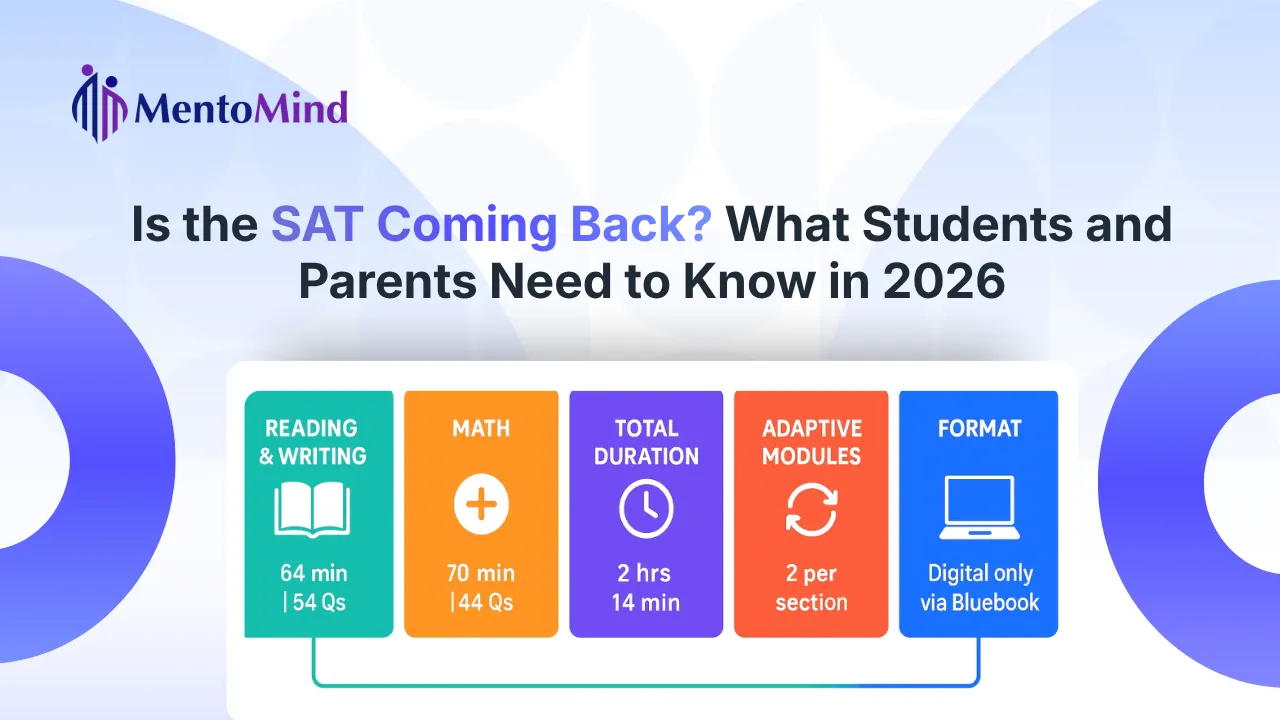
According to College Board, the Digital SAT is shorter than the paper version, gives students more time per question, and adjusts the difficulty of the second module in each section based on performance on the first, all through the Bluebook app. That SAT digital pacing and on-screen experience is worth dedicated practice on its own.
Practice by skill, not just by full test
Sitting for a full practice SAT test has its place, but it is not the most efficient way to improve. Real gains come from identifying specific weak areas, whether an algebra concept, a reading question type, or a grammar rule, then drilling them with focused, adaptive practice until they become automatic.
Where MentoMind Fits Into This Shift
Putting those steps into practice takes the right tools, and this is the kind of structured SAT prep MentoMind supports. Instead of handing every student the same static problem set, MentoMind uses adaptive practice that adjusts to a student’s actual skill level in real time, so study time goes toward the concepts most likely to move a score.
Content is organized concept-wise, which makes it easier to isolate a specific algebra rule or grammar pattern rather than working through an entire section to find it. Every wrong answer comes with a clear explanation, and analytics and progress tracking follow a student across both Digital SAT and ACT content, so the data reflects where they actually stand rather than a single test-day snapshot.
For tutors, dashboards bring that same information into one place, making it easier to see which concepts a student has mastered and which still need attention across a full roster. Personalized study plans then translate those insights into a specific next session, whether a student is still building foundational skills or refining a strategy for a top percentile score.
The Bottom Line
Testing policy will likely keep shifting at the margins, and some schools may stay test optional for a while longer. But building a college list on the assumption that this will hold true everywhere is a riskier bet than it was a few years ago.
A strong SAT test score remains one of the clearer, more controllable ways to stand out in a competitive applicant pool. Students who understand the current landscape and prepare early are better positioned to turn this shift into an advantage rather than a scramble. Starting early leaves more time to build skills, improve scores, and approach college applications with confidence.
Frequently Asked Questions
No. Many colleges remain test optional or test blind. However, the trend among the most selective universities is clearly moving back toward required testing, with every Ivy League school having announced a return to standardized testing requirements for its applicable admissions cycle by 2027-28.
Not necessarily harder, just different in format. It is shorter, computer adaptive, and delivered through College Board’s Bluebook app, so the skills tested are similar but the SAT digital pacing and on-screen experience take separate practice.
Many strong scorers build core skills in ninth or tenth grade, then shift into focused SAT prep in tenth and eleventh grade. Starting early leaves more room for real improvement and less last minute pressure.
Submitting a strong score can only help, never hurt, since test optional simply means the choice is yours. Given how quickly policies have shifted in recent years, more schools moving in the same direction is a reasonable possibility, though not a certainty.