
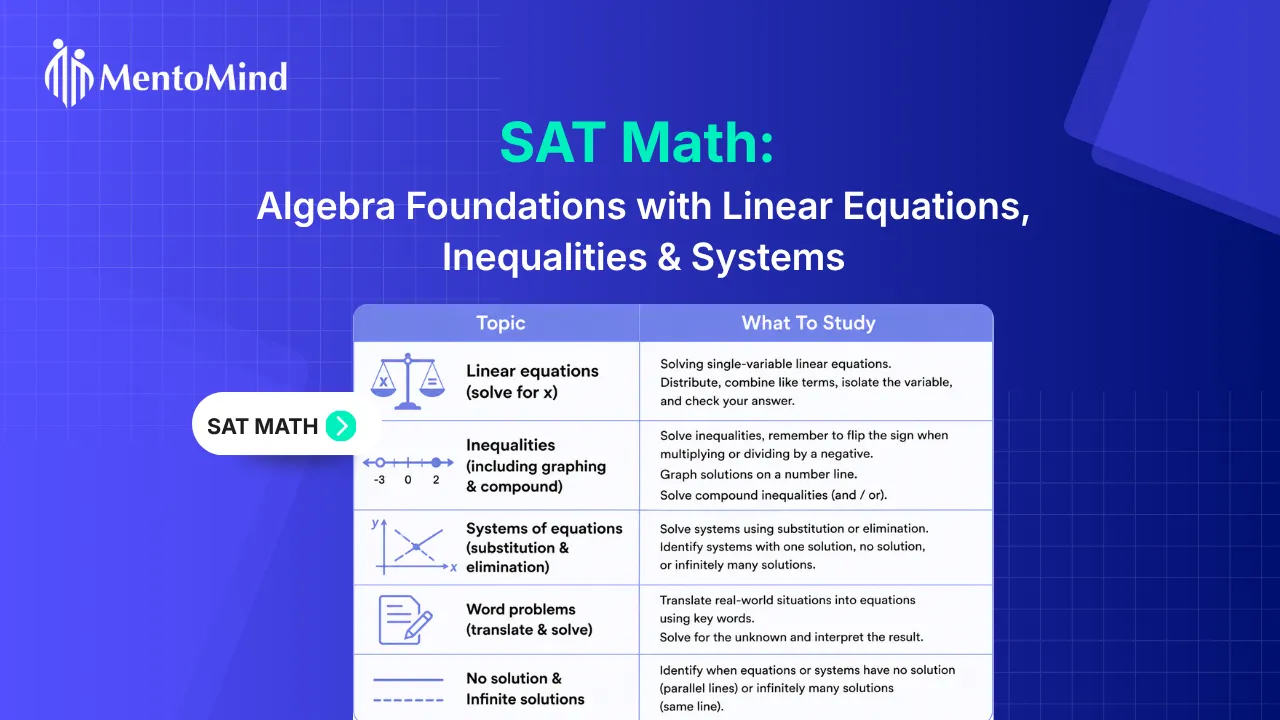
In this article, you’ll learn how to solve SAT algebra problems step by step. This includes solving linear equations and finding the value of x, working with inequalities and handling sign changes correctly, solving systems of equations using substitution and elimination, translating word problems into equations, and quickly identifying no-solution and infinite-solution systems.
What Is Algebra? Understanding Variables, Expressions, and Equations
Not sure what algebra really means? Watch this quick video to get a feel for variables, expressions, and equations, and see how algebra helps you describe and solve real-world problems.
What Algebra Is Most Important for the SAT?
The SAT’s Math section focuses heavily on four algebra pillars – linear equations, inequalities, systems of equations, and word problem translation. When it comes to algebra for SAT, linear equations appear in some form in almost every algebra problem on the test and often require you to solve for x. If a student can solve any linear equation quickly and set up equations from word problems confidently, they are already ahead of most test-takers. Everything else builds on top of that foundation.
1. How to solve single variable linear equations
The goal is to isolate the variable on one side of the equation by performing the same operation on both sides.
Key Rule – Whatever you do to one side, do to the other.
General Process
- Distribute any parentheses
- Combine like terms on each side separately
- Move all variable terms to one side, constants to the other
- Divide both sides by the coefficient of the variable
Example
Solve for x in the equation 3(2x – 4) = 18
- Step 1. Distribute 6x – 12 = 18
- Step 2. Add 12 to both sides 6x = 30
- Step 3. Divide by 6 x = 5
Key Tip – Always check your answer by plugging it back into the original equation. On the SAT, this takes ten seconds and saves you from careless errors.
When the equation has variables on both sides, just collect them on one side first.
2. How to solve inequalities including graphing and compound inequalities
Key Rule – When you multiply or divide both sides by a negative number, FLIP the inequality sign.
Example
- Solve -3x + 6 > 15
- Subtract 6 -3x > 9
- Divide by -3 (flip the sign) x < -3
Graphing on a number line
- Open circle for strict inequalities (< or >)
- Closed circle when the endpoint is included (≤ or ≥)
- Shaded arrow points in the direction of the solution set
Compound inequalities
- “And” inequalities, solve all three parts simultaneously -2 < 3x + 1 ≤ 10
- Subtract 1 from all three parts -3 < 3x ≤ 9
- Divide all three parts by 3 -1 < x ≤ 3
“Or” inequalities, solve each inequality separately, then combine the solution sets.
Key Tip – On the SAT, compound inequalities almost always have a specific answer among the choices. Plug in the boundary values to quickly check which answer matches.
3. How to solve systems of equations using substitution and elimination
A system of equations involves two equations with two unknowns. The goal is to find values for both variables that satisfy both equations simultaneously. You have two primary methods: substitution and elimination
When to use substitution
Substitution is fastest when one equation already has a variable isolated
System
- y = 2x + 3
- 3x + y = 18
Since y is already isolated in the first equation, substitute directly into the second
- 3x + (2x + 3) = 18
- 5x + 3 = 18
- 5x = 15
- x = 3, then y = 2(3) + 3 = 9
Key Tip – If one equation starts with “y =” or “x =”, use substitution. It will almost always be the faster path.
When to use elimination
Elimination is faster when both equations are in standard form (Ax + By = C) and the coefficients line up nicely for cancellation.
System
- 2x + 3y = 12
- 4x – 3y = 6
The y coefficients are already opposites. Add the equations
- (2x + 4x) + (3y – 3y) = 12 + 6
- 6x = 18
- x = 3, then 2(3) + 3y = 12, so 3y = 6,
- y = 2
Key Tip – If no variable is isolated and you see matching or easily scaled coefficients, jump straight to elimination. On SAT, this saves 30 to 60 seconds per problem.
4. How to translate word problems into equations for the SAT
The SAT tests whether you can read a real-world situation and build a correct equation from it. Most mistakes happen in the translation step, not the solving step .
The translation cheat sheet
| Word / Phrase | Translates to |
|---|---|
is / equals / was |
= |
more than / increased by |
+ |
less than / decreased by |
– |
of / times / product |
× |
per / for each |
rate or coefficient |
a number / how many |
variable (example – x, h, n) |
Example problem
Maria earns $12 per hour working at a bookstore. After working some hours this week, she also received a $15 bonus. Her total earnings were $111. How many hours did she work?
Translation is 12h + 15 = 111
- Now solve step by step
- Subtract 15 from both sides
- 12h = 96
- Divide both sides by 12 h = 8 hours
Key Tip – Before writing any equation, circle the quantity you are solving for and assign it a variable name. This one habit eliminates most word problem mistakes.
For two-variable word problems, look for two separate facts in the problem. Each fact gives you one equation. Then solve the system.
5. Understanding no solution and infinite solution systems
These question types appear frequently on the SAT, and recognizing them instantly is worth serious points.
No-solution systems
A system has no solution when the two equations represent parallel lines. This means they never intersect, so there is no point that satisfies both equations.
How to spot it – When you simplify both equations to slope-intercept form (y = mx + b), the slopes (m values) are equal but the y-intercepts (b values) are different.
Example
2x + 4y = 8 simplifies to y = -½x + 2 x + 2y = 7 simplifies to y = -½x + 3.5
Same slope (-½), different intercepts. No solution.
Infinite-solution systems
A system has infinitely many solutions when both equations simplify to the same line.
This means every point on the line satisfies both equations, so there are infinitely many solutions.
How to spot it- When simplified, both equations become identical.
Example
2x + 4y = 8 x + 2y = 4
Multiply the second equation by 2 – 2x + 4y = 8. This is exactly the first equation. Infinitely many solutions.
Key Tip – On the SAT, these problems often ask you to find a missing constant. Set the simplified equations equal and solve for the constant.
6. Practice real SAT style algebra problems
Work through each problem and aim to hit the time targets. These reflect actual SAT difficulty and format.
Problem 1. Target time is 45 seconds
If 4(x – 3) + 2x = 2(x + 6), what is the value of x?
- Distribute – 4x – 12 + 2x = 2x + 12
- Combine like terms – 6x – 12 = 2x + 12
- Subtract 2x – 4x – 12 = 12
- Add 12 – 4x = 24
- Divide – x = 6
Answer is 6
Problem 2. Target time is 60 seconds
A school is ordering notebooks and pens. Notebooks cost $3 each and pens cost $1.50 each. The school ordered 40 items total and spent exactly $90. How many notebooks were ordered?
- Let n = notebooks and p = pens.
- n + p = 40 (total items)
- 3n + 1.5p = 90 (total cost)
- From the first equation p = 40 – n
- Substitute 3n + 1.5(40 – n) = 90
- 3n + 60 – 1.5n = 90
- 1.5n = 30
- n = 20
Answer is 20 notebooks
Problem 3. Target time is 50 seconds
For what value of k does the system below have no solution?
- 3x – 6y = 12
- x – 2y = k
- Divide the first equation by 3
- x – 2y = 4
For no solution, the left sides must match but the right sides must differ. The left side of the second equation already matches. So for no solution k ≠ 4
k = 4 creates infinitely many solutions because both equations become identical.
Any other value of k breaks this match, so the system does not form identical equations.
Problem 4. Target time 75 seconds
If -2 ≤ 3x + 1 < 10, which of the following could be a value of x?
- Subtract 1 from all parts -3 ≤ 3x < 9
- Divide all parts of the inequality by 3.
- Since we are dividing by a positive number, the inequality signs stay the same.
- -1 ≤ x < 3
- Valid answers – x = 0, x = 1, x = 2.5 (any value in [-1, 3))
Algebra Problems with Video Solutions and Detailed Explanations
Try solving these algebra practice problems on your own before checking the solutions, and focus on how to solve for x step by step.
Question 1.
In the system of equations below, k is a constant.
- 4(x + 3) – 2x = 2y + 10
- 5x – 5y = k
For what value of k does the system of equations have infinitely many solutions?
A) 2 B) 5 C) -10 D) -5
Solution
Simplify the first equation
- 4x + 12 − 2x = 2y + 10
- 2x + 12 = 2y + 10
- 2x − 2y = −2
- x − y = −1
Second equation
- 5x − 5y = k
- Divide by 5
- x − y = k/5
For infinitely many solutions, both equations must be the same
- k/5 = −1
- k = −5
Final Answer is −5
Key rule
For infinitely many solutions, both equations must simplify to the same equation.
Why the other choices are wrong
A (2) does not make both equations identical. B (5) gives a different line, so only one solution exists. C (−10) changes the equation so the lines are parallel, not identical.
Think10x.ai video explaining a system of equations with infinite solutions
Question 2.
The system below has exactly one solution.
- ax + 3y = 12
- 6x + 9y + c = 24
Which of the following cannot be the value of a?
A) 1 B) 2 C) 3 D) 4
Solution
- Rewrite the second equation 6x + 9y = 24 − c
- Divide by 3 2x + 3y = (24 − c)/3
- For exactly one solution, the lines must have different slopes.
- First equation slope = −a/3
- Second equation slope = −2/3
- Set slopes equal to find when there is NOT exactly one solution −a/3 = −2/3
- a = 2
- Final Answer is – 2
Key rule
A system has exactly one solution when the slopes are different. If slopes are equal, the system has either no solution or infinitely many solutions.
Why the other choices are wrong
A (1), C (3), and D (4) all give slopes different from −2/3, so the system still has exactly one solution.
Think10x.ai video explaining how to identify when a system has exactly one solution
Frequently Asked Questions
Linear equations are the most important topic on the SAT Math section. Most algebra problems and questions require you to quickly solve for x, and that skill underlies everything else on the test.
The SAT Math section is 44 questions total, and roughly 35-40% fall under the Algebra domain, around 13 to 15 questions covering linear equations, systems, and inequalities.
It depends on the structure. If one equation has a variable isolated, substitution is fastest. If both are in standard form with easy-to-match coefficients, use elimination. Recognizing which applies quickly is the real skill to build.
Identify exactly what the question is asking before writing anything. Circle the quantity you need to find and assign it a clear variable. Then translate each sentence into a mathematical relationship one at a time. This costs five seconds but eliminates the most common mistakes.
A no-solution system has equal slopes but different y-intercepts. An infinite-solution system has equations that are multiples of each other. On the SAT, these questions often ask you to find a missing constant, set up ratios between corresponding coefficients and solve.
Check the sign-flip rule at the exact moment you multiply or divide by a negative number, not at the end. Write a small note (“flip!”) next to that step. After solving, always test a value from your solution set in the original inequality to confirm.
Want a Step-by-Step Video Explanation For Your Own SAT Math Question?
The video explanations above were created using Think10x.ai.
Upload a clear photo of any math problem, including probability, algebra, geometry, or calculus, and our tool will turn it into a narrated, animated explanation in minutes.
👉 Try it at Think10x.ai