
Every SAT tutor eventually gets the same question from a parent. “So, is this a good score?”
How you answer determines whether that parent walks away reassured, confused, or ready to book the next session. Most tutors respond with a number and a percentile. That is not enough. Parents do not think in percentiles. They think “will my child get into their top school” and “is the tutoring working.”
This guide gives you a step-by-step framework for translating SAT data into conversations parents can act on, covering five practical steps, six student archetypes with ready-to-use scripts, and what to include in a written progress report.
Why SAT Score Conversations Often Stall
The issue is rarely a lack of tutor knowledge. It is a presentation. Most score conversations present data the way a test report does, as a list of numbers with no story attached.
Here is what a stalled conversation looks like.
A parent sees a score of 1180. They are not sure if that is good or concerning. The tutor mentions it is roughly the 68th percentile. The parent nods. The tutor notes the student struggled with algebra. The meeting ends. Nothing is booked.
Here is what a productive conversation looks like.
“Sarah scored 1180, which places her above roughly 68% of students who took the SAT this year. Her first-choice school, Penn State’s Smeal College of Business, reports a middle 50% SAT range of 1170 to 1370 for admitted students. To be a strong applicant, we’d want her in the 1300 range. She is losing the most points in two specific areas – nonlinear equations and inference questions. Both are teachable. Here is what I would recommend over the next six weeks.”
Same score. Completely different conversation. The second version gives parents context, a gap, a cause, and a plan.
Step 1. Lead with percentile, not points
A raw SAT score means little to a parent who has not studied the test. The number 1250 carries almost no meaning without a frame of reference.
Start every score conversation with percentile, stated in plain language.
Instead of “She scored 1250.”
Say, “She scored 1250, which puts her above roughly 81% of students who took the SAT this year. She is in the top fifth of test takers nationally.”
Parents immediately understand the “top 20%.” They rarely internalize “1250” without help.
Percentile reference table (College Board User Percentiles, Class of 2025)
| SAT score | Approx. user percentile | Plain-language framing |
|---|---|---|
1000 |
48th |
Right at the national average |
1100 |
63rd |
Above the national average |
1200 |
76th |
Top quarter of all test takers |
1300 |
86th |
Top 14% nationally |
1400 |
93rd |
Top 7%, competitive for selective schools |
1500 |
98th |
Top 2%, competitive for any school in the country |
Once you have anchored the score in percentile terms, move immediately to what it means for this specific student’s goals.
Step 2. Show the gap to the target school
Percentile context is useful. Target school context is what makes parents engaged.
Ask early in the tutoring relationship which schools the student is considering. Then look up the middle 50% SAT range for those schools and note it before every parent meeting.
When presenting a score, show the gap directly.
Example script
“Right now, Marcus is at 1220. His first-choice school, University of Michigan, has a middle 50% SAT range of 1350 to 1530 for admitted students. To be competitive, we would want him closer to 1400. We have roughly a 180-point gap to close over the next several months. That is very achievable with a structured plan.”
This framing does three things –
- Makes the goal concrete and personal, not generic
- Shows the parent why continued prep is worth it
- Positions you as someone with a plan, not just someone who runs tests
For students already within their target school’s range – “She is already in the middle 50% at her top choice. We are now working toward the 75th percentile, which strengthens her application and can unlock merit scholarships.”
Step 3. Break down sub-skills, not just sections
Section scores (Math 200 to 800, Reading and Writing 200 to 800) are a step forward. But they are still too broad to be useful for most parents.
“He is at 580 in Math” tells a parent almost nothing about why or what comes next.
Sub-skill data changes the conversation. It moves you from “he is weak in math,” which creates vague concern, to “he is losing the most points in nonlinear equations and geometry, which together make up roughly 30% of the Math section. Both are teachable.”
Why this matters
MentoMind’s analysis of 316,770 student responses across 3,594 practice tests shows that geometry, specifically circles, right triangles, and area and volume, is the most universal weak zone across all score tiers. Even high scorers frequently revisit these topics. When tutors name the specific sub-skill, parents hear a concrete problem with a concrete solution. That is a session they will commit to.
The same dataset identified six recurring student archetypes, each requiring a different parent conversation.
Step 4. Set a data-backed improvement timeline
Parents want a realistic picture, not a guarantee. The most credible tutors set specific expectations tied to effort and timeline.
Realistic improvement ranges by starting score (3-month horizon)
| Starting Score | Realistic Gain | Study Hours Needed |
|---|---|---|
Below 1000 |
+100 to +150 points |
80 to 100 hours |
1000 to 1200 |
+80 to +120 points |
50 to 70 hours |
1200 to 1350 |
+50 to +100 points |
30 to 50 hours |
1350 and above |
+30 to +70 points |
20 to 40 hours |
Note – Gains are front-loaded. MentoMind’s practice test data shows the largest score jumps occur between a student’s second and third full-length test. Progress typically plateaus after the fifth or sixth attempt without targeted sub-skill work.
Make the timeline personal. “Based on where James is starting, a realistic target for his October test date is somewhere between 1280 and 1320. To get there, we would want roughly 40 focused hours over the next ten weeks.”
Specific, honest predictions build more trust than open-ended encouragement.
Step 5. Handle the hard conversations
When the Score Is Lower Than Expected
Acknowledge before explaining.
Script – “A first diagnostic score almost never reflects a student’s ceiling. It shows where she is right now, before structured preparation. Let me walk you through where the points went and what that tells us about what is possible.”
Then go straight into sub-skill data. The more specific you are, the more in control the parent feels.
When Progress Is Slower Than Expected
Do not say – “He just needs more practice.”
Say – “Let me show you exactly where progress is happening and where it has been slower. Her algebra accuracy has moved from 62% to 81% over the last four weeks. The overall score has not shifted as much yet because we are still working through geometry, which takes longer to consolidate. Here is what I expect to see by our next checkpoint.”
Sub-skill progress data keeps parents confident even when the composite score is lagging.
When Expectations Are Unrealistic, be honest early.
Script – “I want to support your goals, and I also want to be transparent about timelines. Moving from 980 to 1550 is a 570-point improvement. That is not impossible, but it typically requires 18 to 24 months of intensive prep and multiple test attempts. I would like to set milestone targets together – 1100 by spring, 1250 by next fall, and we reassess from there. That keeps the door open to ambitious goals without setting either of us up for disappointment.”
The 6 Student Archetypes and What to Say to Each Parent
Archetype 1. The balanced student (approximately 67% of students)
Profile – Relatively even scores across Math and Reading and Writing. No dramatic weakness, no dramatic strength.
What to say – “Your son is scoring fairly evenly across both sections, which is a solid foundation. The challenge is that balanced students often do not have one obvious area to target first. We are going to look at the sub-skills within each section and find where a focused two-week push would produce the biggest point gain.”
Archetype 2. The math-dominant student
Profile – Math score significantly higher than Reading and Writing. Common among STEM-focused students.
The data – 92% of students scoring 1450 or higher are math-dominant. This archetype has a clear path to elite scores, but only if Reading and Writing improves alongside Math.
What to say – “Her math foundation is strong, and that is typically harder to build from scratch. Right now, Reading and Writing is the ceiling. Students at her level who bring up their verbal score tend to see the fastest composite improvements. That is where we will focus.”
Archetype 3. The reading-dominant student
Profile – Reading and Writing score significantly higher than Math. Common among humanities-focused students.
The data – 92% of 1450-plus scorers are math-dominant. Reading-dominant students rarely reach the top score tier without substantial math improvement.
What to say – “His reading scores are genuinely strong, and that matters for college writing and coursework. To move the composite, we need to bring up Math. The most efficient path is targeting algebra and problem-solving, which make up the largest portion of the Math section.”
Archetype 4. The foundations-weak student
Profile – Below-average scores in both sections, typically below 1000. Gaps span multiple content areas.
The data – Students starting below 1000 typically need 12 to 16 weeks and 80 to 100 hours of focused prep to see meaningful improvement. Score volatility is highest in this group, with gains appearing rapidly once foundational gaps are addressed.
What to say – “Right now we are building skills, not just test strategy. The good news is that students at this level often improve quickly once the foundational gaps are closed. A 100 to 150 point gain in two to three months is realistic. Consistent practice is the key ingredient.”
Archetype 5. The disengaged student (approximately 11% of students)
Profile – Underperforms relative to apparent knowledge. Skips easy questions, finishes sections early, leaves time unused.
The data – Students in the bottom score tier skip 14% of easy questions and leave an average of 50-plus minutes unused across the test. The problem is not content knowledge. It is mental disengagement during the test.
What to say – “What the data is showing is actually encouraging. There are questions on this test your son almost certainly knows how to answer, but he is not attempting them. He is finishing sections well before time is up and leaving points on the table. This is a strategy and engagement problem, not a knowledge problem. Those are faster to fix than content gaps. We will work specifically on pacing and test-taking approaches.”
Archetype 6. The hard-question collapser
Profile – Strong performance on easy and medium questions. Accuracy drops sharply on hard questions or late in sections. Common among students who have already done significant prep.
The data – In Math Module 2, accuracy drops sharply in questions 15 to 22. Middle-tier students lose an average of 13 percentage points late in sections. Even students routed to the easier module see accuracy fall to 61% by the end. This reflects stamina and pressure, not content weakness.
What to say – “She is solid through most of the test. What we are seeing is a pattern where performance drops in the final stretch of harder question sets. This is a pacing and endurance issue, and it is very addressable. We will add timed practice specifically designed to build consistency in those late-section moments.”
What to Include in a Parent-Facing Progress Report
A written report after every full-length practice test is the single most effective retention tool available to tutors. Parents who receive written data are more likely to re-engage, share the report with their partners, and renew.
A strong parent-facing report includes six elements.
- Current score with percentile – anchors the conversation
- Target score and gap – shows the specific distance remaining
- Top 3 sub-skill strengths – gives parents something concrete and positive
- Top 3 sub-skill gaps – explains where sessions will focus
- Progress since the last report – shows movement, not just position
- Recommended next steps – specific and actionable
How Automated Reports Change the Tutor-Parent Relationship
Writing individual progress reports for every student is one of the most time-consuming tasks in a tutoring business. Tutors who skip reports lose clients because parents who do not see data in writing are less likely to renew.
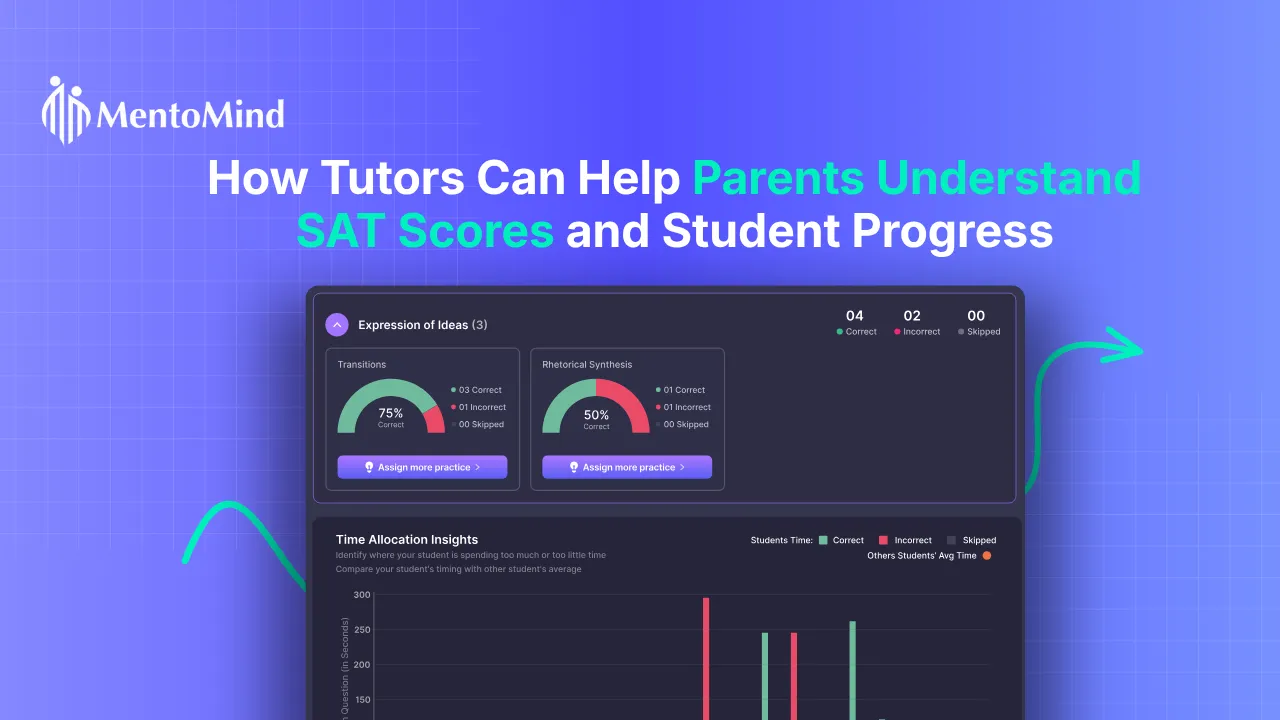
MentoMind automatically generates downloadable PDF progress reports for every student. Each report breaks down performance by topic and sub-skill, shows score trends across practice tests, and is formatted for parents rather than educators.
Parents who receive a specific, data-rich report after each test are significantly more likely to ask “what’s next?” than parents who receive only a verbal summary. The report creates the conversion opportunity before you even reach out.
Frequently Asked Questions
Frame the score relative to the student’s specific goals, not a universal standard. A 1150 is a strong starting point for a student targeting regional state schools and a significant gap for a student aiming at a top-30 university. Context makes the number useful rather than discouraging.
Use plain-language framing. “Your child scored higher than roughly X out of every 100 students who took the SAT this year.” Most parents immediately understand that framing, while the percentile number alone rarely lands.
Show sub-skill progress even when the composite score has not moved yet. Saying “her algebra accuracy improved from 62% to 81% over four weeks” keeps parent confidence intact while the overall score catches up. Accuracy gains in specific topics are leading indicators of score improvement.
After every full-length practice test, at minimum. For students in intensive prep, a brief written update every two weeks that highlights three data points significantly improves parent confidence and reduces churn.
Set the target based on the middle 50% SAT range of admitted students at the student’s target schools. For most state universities, 1200 to 1350 is competitive. For selective schools in the top 50 nationally, 1400-plus is the typical target. For highly selective schools in the top 20, 1480-plus is advisable.
Be honest early. Acknowledge the goal, then walk through realistic milestone targets. A student at 980 aiming for 1550 needs an 18 to 24 month roadmap. Tutors who set accurate expectations retain clients significantly longer than those who overpromise early.
Yes. MentoMind automatically generates downloadable PDF progress reports broken down by topic and sub-skill. Tutors can share these with parents after every practice test without any manual report writing.
Conclusion
The tutors who build lasting client relationships treat parent communication as a core skill, not a side task. Every SAT score contains a story – where the student is, where they need to be, why the gap exists, and what you will do about it. When you tell that story with specific data, parents feel informed and confident their child is in the right hands.
That is the conversation that gets renewed.
Ready to give every parent a report they will actually understand? Explore MentoMind’s tutor dashboard and automated reporting tools. Set up your free branded platform and start your first diagnostic today.