If you’re preparing for college admissions, understanding the PSAT vs SAT comparison is one of the first steps. Both exams measure the same Reading, Writing, and Math skills, but they differ in purpose, difficulty, scoring, and how the results are used. Knowing when to take each test, how PSAT scores compare to SAT scores, and if the SAT is harder than the PSAT can help you plan your preparation more effectively.
This guide explains the core differences between the PSAT and SAT, including their format, scoring, difficulty, cost, and role in college admissions. You’ll also learn which exam is right for you and how to transition from the PSAT to the SAT with confidence.
What is the PSAT?
The PSAT (Preliminary SAT) is a practice exam that prepares students for the SAT. It measures the same Reading, Writing, and Math skills in a shorter, slightly less difficult format.
Most students take the PSAT in 10th or 11th grade to measure their readiness for the SAT and identify areas that need improvement. Juniors who take the PSAT/NMSQT may also be selected for the National Merit Scholarship Program depending on their scores.
The PSAT helps students:
- Experience the digital SAT format before taking the SAT.
- Identify strengths and skill gaps.
- Build a study plan based on their performance.
- Qualify for National Merit Scholarships through the PSAT/NMSQT.
What is the SAT?
The SAT is a standard college admissions exam used by many colleges and universities in the United States. It measures the Reading, Writing, and Math skills students need for college-level coursework.
Most students take the SAT during their junior or senior year of high school as part of the college application process. Many colleges consider SAT scores alongside a student’s grades, coursework, extracurricular activities, and other application materials.
The SAT helps students:
- Demonstrate college readiness.
- Strengthen college applications at schools that consider SAT scores.
- Qualify for scholarships at some colleges and universities.
How is the PSAT Different From the SAT?
When comparing PSAT vs SAT, the two exams have similar structures. but they differ in purpose, scoring, difficulty, and how the results are used.
Here’s a side-by-side comparison:
| Feature | PSAT | SAT |
|---|---|---|
Purpose |
Practice for the SAT and qualification for the National Merit Scholarship Program |
College admissions exam |
Who Takes It |
Primarily 10th and 11th grade students |
Primarily 11th and 12th grade students |
Difficulty |
Slightly less challenging |
More challenging |
Format |
Digital adaptive test |
Digital adaptive test |
Sections |
Reading and Writing, Math |
Reading and Writing, Math |
Score Range |
320–1520 |
400–1600 |
College Admissions |
Not used for admissions |
Used by many colleges and universities |
Scholarships |
PSAT/NMSQT scores may qualify students for National Merit Scholarships |
Some colleges use SAT scores for merit-based scholarships |
Cost |
Usually covered by schools or offered at a low cost |
Registration fee set by the College Board |
How Do the PSAT and SAT Formats Compare?
The PSAT and SAT use the same digital adaptive format. Both exams include a Reading and Writing section and a Math section, with each section divided into two adaptive modules.
The main difference is the length of the test. The SAT includes more questions and takes longer to complete, while the PSAT is shorter. Apart from these differences, students can expect a similar testing experience on both exams.
| Feature | PSAT | SAT |
|---|---|---|
Sections |
Reading and Writing, Math |
Reading and Writing, Math |
Modules |
2 adaptive modules per section |
2 adaptive modules per section |
Question Types |
Multiple-choice and student-produced responses |
Multiple-choice and student-produced responses |
Adaptive Testing |
Yes |
Yes |
Test Length |
Shorter |
Longer |
Number of Questions |
Fewer |
More |
Is the SAT Harder Than the PSAT?
One of the most common questions in the PSAT vs SAT discussion is whether the SAT is harder. Yes, the SAT is harder than the PSAT. It includes more challenging questions, covers concepts in greater depth, and requires stronger analytical and problem-solving skills. SAT places greater emphasis on applying those skills in unfamiliar and multi-step scenarios. Students may also need to manage more questions and maintain accuracy over a longer testing time.
If you’re transitioning from the PSAT to the SAT, focus on building strong fundamentals first. Then practice higher-difficulty questions under timed conditions to improve accuracy, confidence, and pacing.
Need help understanding difficult SAT Math questions? Think10x.ai provides step-by-step video explanations that walk through each solution from start to finish. Instead of showing only the correct answer, it walks through the complete solution and explains the reasoning behind each step. This makes it easier to understand unfamiliar question types, review mistakes, and apply the same approach to similar SAT problems.
How Do PSAT Scores Compare to SAT Scores?
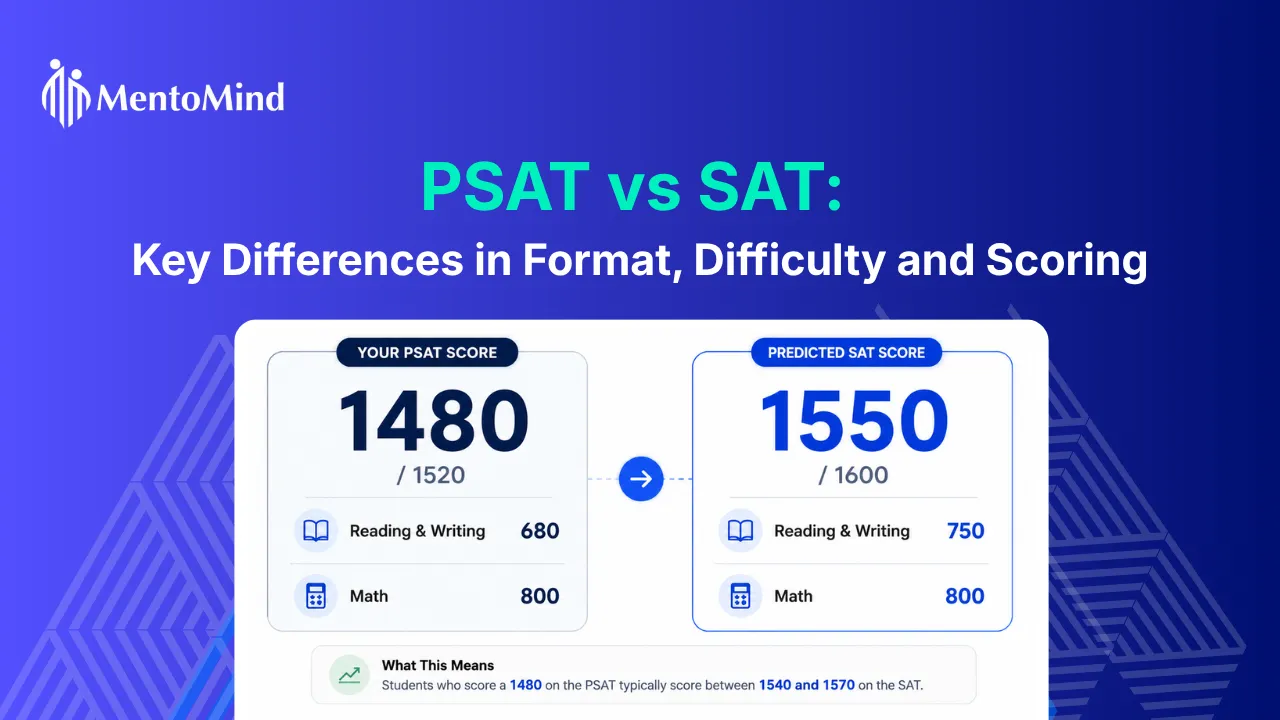
The PSAT is rated on a scale of 320 to 1520, while the SAT is rated on a scale of 400 to 1600. Although the score ranges differ, the PSAT is designed to predict how students may perform on the SAT. The College Board provides score conversion tables that help students estimate an equivalent SAT score based on their PSAT performance.
| Score Feature | PSAT | SAT |
|---|---|---|
Total Score Range |
320–1520 |
400–1600 |
Reading and Writing |
160–760 |
200–800 |
Math |
160–760 |
200–800 |
A higher PSAT score often indicates strong SAT readiness, but it does not guarantee the same SAT score. The SAT includes more difficult questions, so improving your score typically requires additional practice before test day.
Does the PSAT Matter for College Admissions?
No. Colleges do not use PSAT scores to make admissions decisions. The PSAT measures your readiness for the SAT and, for eligible juniors, can qualify you for the National Merit Scholarship Program.
Taking the PSAT helps you understand your current performance before taking the SAT. Your score report highlights strengths and areas for improvement, making it easier to build a focused study plan. It also gives you experience with the digital testing format before the college admissions exam.
How Much Does the PSAT Cost?
As of July 2026, the PSAT/NMSQT and PSAT 10 cost $18. The PSAT 8/9 costs $14. Many students pay less or nothing because schools, districts, or states often cover all or part of the test fee. Some schools may also charge a small administrative fee. If you’re unsure whether you need to pay, check with your school counselor before registration.
Unlike the PSAT, the SAT requires students to register individually with the College Board and pay a separate registration fee.
How Should You Prepare for the PSAT and SAT?
The PSAT and SAT test similar skills, but your preparation should change as you move from one exam to the other. Use the PSAT to identify gaps in your knowledge, then focus your SAT preparation on improving those areas.
For the PSAT
- Learn the test format and question types.
- Build strong Reading, Writing, and Math fundamentals.
- Use your score report to identify strengths and weaknesses.
For the SAT
- Practice more challenging questions.
- Take full-length, timed practice tests.
- Review mistakes and understand why each answer is correct.
- Focus on pacing, accuracy, and consistency.
Frequently Asked Questions
Yes, students can take the SAT without taking the PSAT. However, the PSAT gives you practice with the same test format and helps you identify areas to improve before the SAT.
There is no single PSAT score that guarantees SAT success. A strong PSAT score usually shows that you have a solid foundation, but your SAT performance depends on additional practice and preparation.
If you plan to take both exams, prepare for the SAT because it covers the same core skills at a higher level. Your SAT preparation will also help you perform better on the PSAT.
Candidates can take the PSAT multiple times, but most take it once or twice during high school. The PSAT/NMSQT scholarship qualification only applies during the eligible junior-year testing period.
No. A PSAT score cannot replace an SAT score for colleges that require or consider SAT results. The PSAT is designed for practice and scholarship qualification, not college admissions.
Ready to Start Your SAT Preparation?
Take the Digital SAT practice test on MentoMind and see where you stand. Review your performance by topic, identify the concepts that need more practice, and build a personalized study plan based on your results. If you need help with challenging SAT Math concepts, explore our guides on SAT Math Functions: Linear, Quadratic and Exponential Functions, Master SAT Math Algebra Foundations, and SAT Math Quadratic Equations to strengthen the skills tested on the exam.
Start preparing for the Digital SAT with MentoMind.