Only 41.7% of Pennsylvania students score Proficient or Advanced on the PSSA Math test. For parents worried about their child’s score, and tutors working to improve it, that gap is where targeted preparation makes the biggest difference.
Students who improve are not the ones who study more in general. They are the ones who focus on the exact topics, question types, and scoring rules used on the test.
This guide explains what is tested at each grade, how scoring works, and five steps that consistently move students from Basic to Proficient.
What Is the PSSA Test?
PSSA stands for Pennsylvania System of School Assessment. It is Pennsylvania’s yearly state test for students in grades 3 to 8, administered by the Pennsylvania Department of Education (PDE) and developed by Data Recognition Corporation (DRC).
The PSSA measures how well students meet Pennsylvania Academic Standards, which define what students should know and be able to do at each grade level. Students are not ranked against one another; instead, their performance is measured against state standards.
Results are used by schools, districts, and external organizations to evaluate student progress and plan better instruction. All public schools must take part, including charter and cyber charter schools.
Three subjects are tested on the PSSA:
- Mathematics: All grades 3 to 8, every year
- English Language Arts (ELA): All grades 3 to 8, every year. Covers reading, writing, text-dependent analysis, and language standards.
- Science: Grades 5 and 8 only
What Is on the Pennsylvania PSSA Math Test?
The PSSA Math has two sections and three question types:
- Multiple-choice
- Open-ended
- Technology-enhanced items
Multiple-Choice Questions
Each question has four answer choices. Students pick one. These are the most common types on the test. They are the easiest to prepare for using free released items and practice sets.
Open-Ended Questions
Students must solve a problem AND write out how they did it. A grader scores each answer using a rubric from 0 to 4 points. This is where students lose the most points.
| Score | What the Grader Looks For |
|---|---|
4 – Full marks |
Correct answer AND all steps shown AND a clear explanation. Small mistakes are OK if the student still shows full understanding. |
3 – Almost there |
Mostly correct answer and explanation. There may be small errors or missing steps, but the student still shows good understanding. |
2 – Partial credit |
Some correct work and some understanding shown, but the answer or explanation is incomplete or partly wrong. |
1 – Minimal credit |
Very limited understanding shown. The work is mostly wrong or incomplete, but there is some relevant effort. |
0 – No credit |
No correct answer and no evidence of understanding. Blank, off-topic, or copied answers also receive 0. |
Students have access to this rubric during the test. The key teaching point: students must show every step. Even a partially correct answer earns points if the working is clear. A bare final answer with no working shown can score 0.
Technology-Enhanced Items (TEIs)
The 2026 PSSA uses online testing only. Some questions are interactive. Students may need to drag and drop answers, sort items, or rank choices on screen.
These questions test the same math skills. Students who have never seen the interface before can lose time on format rather than content.
Calculator and Formula Sheet Rules
Grade 3 students cannot use a calculator at all. For grades 4 to 8, Section 1 begins with a non-calculator portion, then continues with questions where a calculator is permitted. Section 2 allows a calculator throughout. Remind students to bring their own calculator unless the school provides one.
A PSSA formula sheet is provided to students in grades 4 to 8 and can be used at any point during the test.
Is the PSSA Math Timed?
No. Students take as long as they need. But a section started on one day cannot be continued the next day. Teach students that showing clear working matters more than finishing quickly.
PSSA Math Topics by Grade: What Is Actually Tested?
The PSSA Math test is built around Assessment Anchors and Eligible Content. These are the exact topics and skills the PDE says can appear on the test for each grade. Knowing your student’s anchors stops you from wasting time on topics that will not be tested.
| Grade Level | Math Topics on the Test |
|---|---|
Grades 3 to 5 |
Numbers and Operations, Fractions, Algebraic Thinking, Geometry, Measurement and Data. Key examples: comparing and adding fractions, area and perimeter, multiplication and division, interpreting graphs and data tables. |
Grades 6 to 7 |
The Number System, Ratios and Proportional Relationships, Expressions and Equations, Geometry, Statistics and Probability. Key examples: percent and ratio problems, writing and solving equations, negative numbers, and interpreting statistical data. |
Grade 8 |
The Number System, Functions, Expressions and Equations, Geometry, Statistics and Probability. Key examples: linear functions and slope, systems of equations, transformations, and scatter plot interpretation. |
In short, every grade tests Numbers, Geometry, and Statistics and Probability. Middle school adds Ratios and Expressions. Grade 8 adds Functions.
Three topic transitions tutors should watch across grades:
- Fractions are a major focus in grades 3 to 5 and a common source of gaps for students entering middle school.
- The jump from grade 5 to grade 6 is one of the biggest step-ups in the PSSA. Students move from arithmetic-heavy content into algebraic thinking, and many find this transition hard.
- Grade 8 introduces Functions as a new topic. This feeds directly into high school Algebra I and the Keystone Exam.
When Is the 2026 Pennsylvania PSSA Math Test?
The state sets a testing window. Each school picks its own specific days within it. Confirm exact dates directly with the school.
- Math (Grades 3 to 8): April 27 to May 1, 2026
- ELA (Grades 3 to 8): April 20 to 24, 2026
- Science (Grades 5 and 8 only): April 27 to May 1, 2026
- Make-up Testing: May 4 to 8, 2026
How Are PSSA Math Scores Calculated?
After the test, each student gets three things:
- Raw Score: The total number of points they earned
- Scale Score: A number on a fixed scale. For Math, the Proficient cutoff is 1000 for every grade from 3 to 8.
- Performance Level: One of four labels that shows how the student did
| Score Level | What It Means |
|---|---|
Advanced |
Great work. Students are above grade level. |
Proficient |
Good work. Students meet the state standard. This is the goal. |
Basic |
Getting close but not there yet. More help is needed. |
Below Basic |
Big gaps in knowledge. Extra support is needed right away. |
Score reports are broken down by Assessment Anchor, not just one overall number. A student who scores Basic overall may be doing well in Geometry while scoring close to zero on Expressions and Equations.
How Tutors Should Use the Individual Student Report
The Individual Student Report (ISR) is the most useful tool a tutor has after test day. Schools send them out in November. Most parents receive one and put it in a drawer. Tutors who know how to read it gain a direct line to the highest-leverage gaps.
The ISR breaks results down by Assessment Anchor, not just an overall score. Without it, you are planning sessions around guesswork rather than evidence.
When a parent shares the ISR, identify the two lowest-scoring anchors. Those become the focus for the first four weeks of prep. Do not review content the student already knows. Every session spent on a strong anchor is a session wasted on a weak one.
Pennsylvania PSSA Math Proficiency: Where Students Stand in 2026
These numbers matter. But statewide averages only tell part of the story. The gaps tend to cluster in predictable places.
The most recent statewide results are from the 2024 to 2025 school year. The PDE released them in November 2025. Spring 2026 results will come out in autumn 2026.
- Math: 41.7% of students scored Proficient or Advanced. This is up from 40.2% the year before. It is the second year in a row of improvement.
- ELA: 49.9% scored Proficient or Advanced. This is down from 53.9%, the fourth consecutive year of decline.
- Science: Scores were not reported in 2024 to 2025 because Pennsylvania updated its science standards. Only participation rates were shared.
According to PDE’s November 2025 release, schools that used PA Firefly or Classroom Diagnostic Tools (CDT) at least once before testing scored 5.5% higher in overall proficiency than those that did not.
The gap is especially wide in larger urban districts. According to Chalkbeat’s analysis of the 2024-25 results, around a quarter of Philadelphia students in grades 3-8 scored Proficient or Advanced in Math, well below the statewide 41.7%.
Tutors working in Philadelphia, Pittsburgh, Allentown, and other major Pennsylvania cities should treat the figures in this section as directly relevant to their students.
Where Students Lose the Most Points on PSSA Math
Three areas account for most of the gap between Basic and Proficient.
- Open-ended questions are the biggest source of lost points. A student who understands math but cannot explain their steps in writing can score 0 on a question they solved correctly. Teaching students to write out every step and label their reasoning is worth more prep time than any additional content review.
- The non-calculator section catches students who rely on a calculator for arithmetic. Grade 4 through 8 students face non-calculator questions at the start of Section 1. Students who cannot do mental math or written computation quickly lose confidence early and rush the rest.
- Fractions and proportional reasoning create compounding gaps. A student who enters grade 6 without solid fraction foundations will struggle with ratios, percent, and expressions immediately. Tutors should assess fraction fluency before anything else, regardless of the student’s grade.
How to Teach PSSA Math: 5 Steps That Move Students from Basic to Proficient
A focused 6 to 8 week plan gives enough time to close the highest-priority gaps before the testing window. These five steps are ordered by the impact they have on student scores.
Step 1. Diagnose Before You Teach
Before reviewing any content, run a quick diagnostic to find out which topics your student is weak in. Targeted practice on specific anchors closes gaps faster than broad review.
Prep strategy should differ by grade band, not just by topic. For grades 3 to 5, the biggest gains come from fraction fluency and open-ended writing practice. Students at this level often know the math but cannot explain it. Spend at least 30% of prep time on written explanations, not just correct answers.
For grades 6 to 8, proportional reasoning and algebraic thinking are the highest-leverage skills. Grade 6 students who struggle with ratios will carry that gap into expressions and equations. Grade 8 students need extra work on functions and slope, which are new concepts with no prior PSSA coverage. Tutors should run a short diagnostic on functions specifically before assuming any prior understanding.
Step 2. Use Real Item Samplers for Open-Ended Practice
Most prep materials focus only on multiple-choice. Open-ended questions make up a significant share of the total score. Use PDE’s free PSSA Item and Scoring Samplers (item samplers) at pa.gov, last updated August 2024. Each includes real released items with sample answers scored at every rubric level.
Step 3. Familiarize Students with the Test Platform
Unfamiliar online environments cause test anxiety, especially in grades 3 to 5. The free PSSA online tools training at wbte.drcedirect.com/PA simulates the real test environment including the calculator, formula sheets, interactive items, and ELA text passages.
Practicing in this environment helps students get comfortable reading and answering questions on screen. Where possible, have students practice on the same device they will test on.
Step 4. Track Progress by Topic, Not Just Overall Score
One overall score does not tell you where the problem is. Tracking by Assessment Anchor shows whether a specific content area weakness is getting better between sessions. This lets you adjust instructions in real time.
Step 5. Assign Adaptive Practice Between Sessions
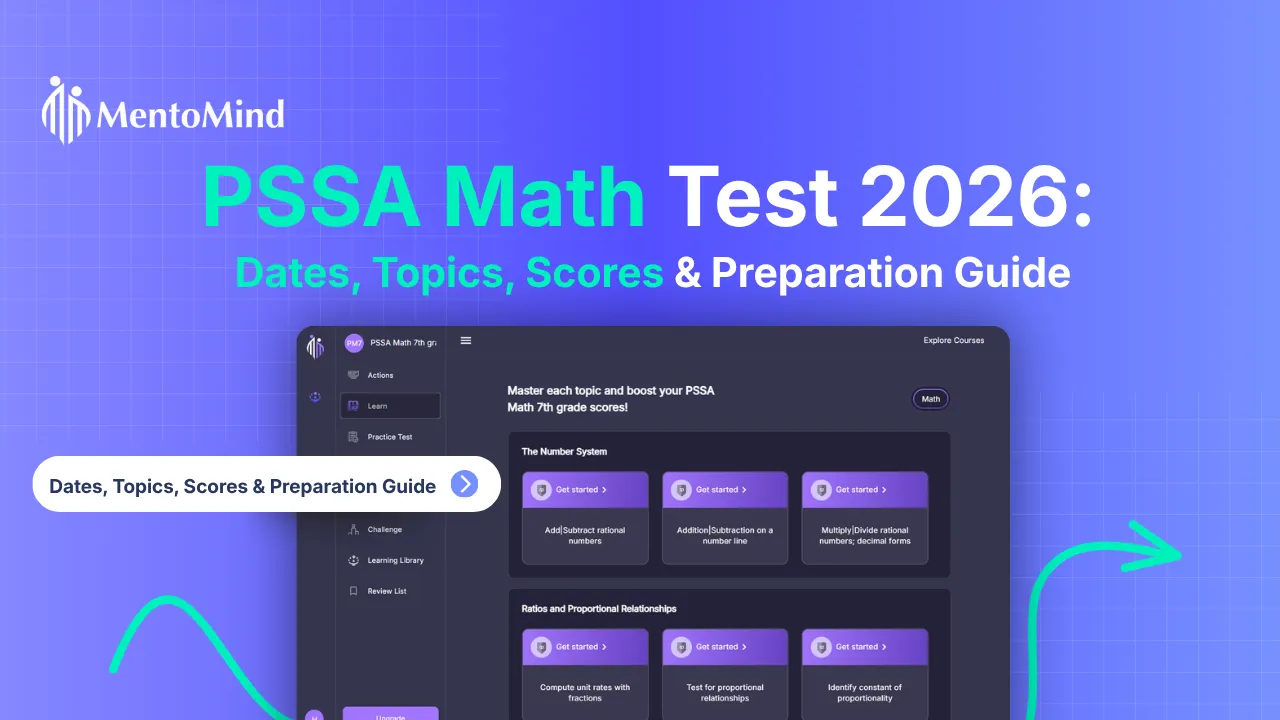
Platforms like MentoMind are built around PSSA Math topics for grades 3 to 8. When a student gets a question wrong, step-by-step video explanations show exactly how to solve it. Progress is tracked by topic, so tutors can see at a glance which areas are improving and which need more work.
Who Administers the Pennsylvania PSSA Math Test?
District assessment coordinators and school assessment coordinators (SACs) manage the administration of the test at each school. District assessment coordinator training makes sure testing is done the same way across all schools.
PSSA accommodations are available for students with an IEP or 504 Plan. These can include extra time, assistive technology, or a different format, and must be set up in the DRC Insight Portal before the test. Students with more significant disabilities may qualify for the Pennsylvania Alternate System of Assessment (PASA).
Pennsylvania regulations officially allow students to be excused from the PSSA only for a documented religious objection after a parent reviews the test materials with the school principal. However, some families report that individual districts accept broader “philosophical” or personal objections in practice.
The Bottom Line
The PSSA Math test is not a mystery. The topics, rubrics, and practice questions are all publicly available.
Tutors who build sessions around Assessment Anchors, open-ended writing practice, and the live DRC platform give their students the highest chance of moving up a performance level.
Frequently Asked Questions
It depends on the grade and the student. The test covers exactly what Pennsylvania Academic Standards say each grade should know. Students who keep up with their grade-level math throughout the year generally find it manageable. The biggest challenge is the open-ended section, where students must show all their work in writing. That skill responds well to targeted practice.
No. PSSA scores are used for statewide accountability and instructional planning, not as a classroom grade and not to determine grade promotion. Teachers and tutors use the results to identify where students need targeted support.
The PSSA exam has no time limit. Each section must be finished in one sitting. A student cannot start a section on Monday and finish it on Tuesday.
For Math, the Proficient cutoff is a scale score of 1000 at every grade from 3 to 8. There is no single pass or fail. Students receive one of four performance level labels.
Proficient is the passing standard set by Pennsylvania. Advanced is above that. Students scoring Basic or Below Basic benefit most from targeted practice on their two or three weakest Assessment Anchors.
The PSSA meets Pennsylvania’s requirements under the Every Student Succeeds Act (ESSA). It is federally required testing in Math and ELA for grades 3 through 8. Without it, Pennsylvania would risk losing federal education funding.
No. The PSSA covers grades 3 through 8 only. Once students reach high school, they take the Keystone Exams in Algebra I, Biology, and Literature instead.
The Smarter Way to Improve PSSA Math Scores
Help your students move from Basic to Proficient with targeted PSSA Math practice, AI video explanations, and progress tracking by skill.
Schedule a demo at MentoMind