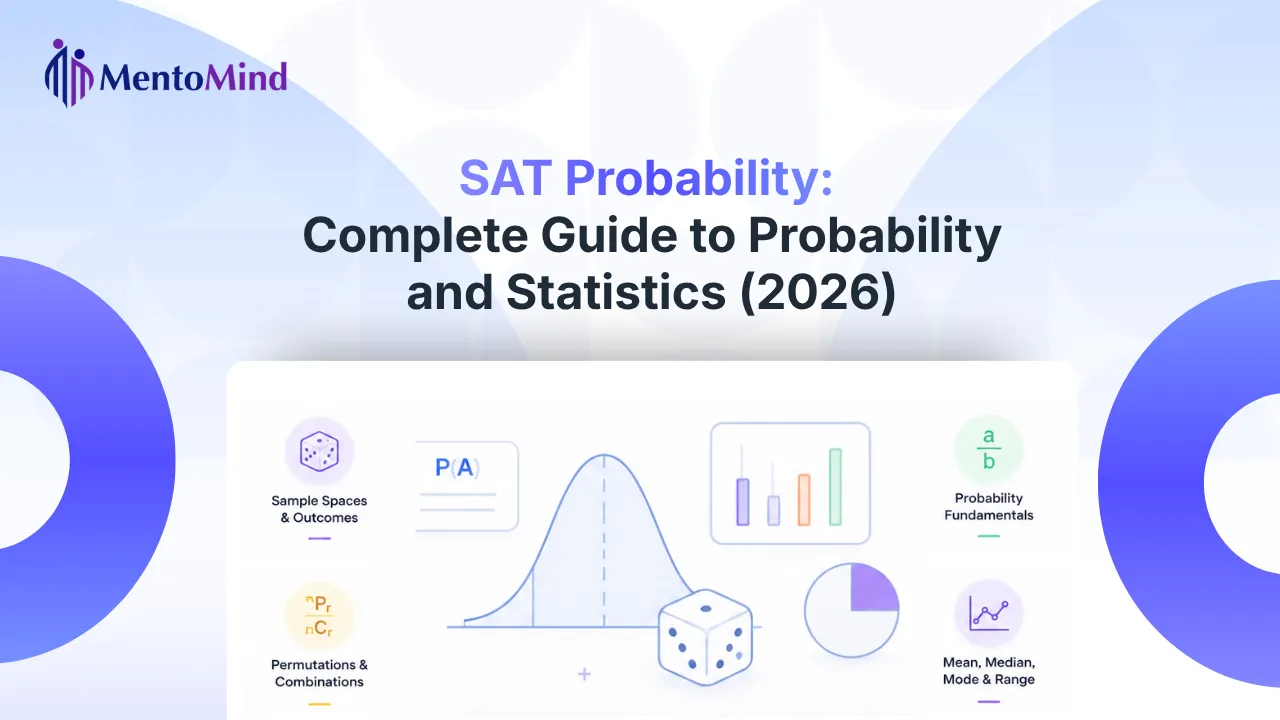
If you’re preparing for SAT Math, understanding probability and statistics is essential because these topics appear in real-world data analysis and problem-solving questions throughout the Digital SAT. Success depends on knowing when to apply probability rules, interpret data correctly, and choose the right strategy for each question.
This guide explains the SAT probability and statistics concepts tested on the Digital SAT, breaks down common SAT probability questions and SAT statistics questions, and shows you how to solve them accurately with proven strategies and examples.
What Probability and Statistics Topics Are Tested on the SAT?
The Digital SAT tests include questions on probability, data analysis, ratios, percentages, and statistics. You’ll interpret data, calculate probabilities, compare data sets, and solve problems based on real-world scenarios instead of memorizing complex formulas.
Here are the main probability and statistics topics tested on the SAT:
1. Probability
SAT probability questions measure your ability to calculate the chance of an event. You’ll solve problems involving simple probability, complementary probability, relative frequency, and probabilities based on tables or data sets. Most SAT probability questions require you to identify the total number of possible outcomes before finding the correct probability.
2. Statistics
SAT statistics questions focus on analyzing and interpreting data. You’ll work with concepts such as mean, median, range, percentages, and data distribution. Some questions ask you to compare data sets, while others test whether you can choose the most appropriate measure to describe the data.
3. Data interpretation
Common statistics on SAT exams consist of graphs, scatterplots, line charts, bar charts, and two-way tables. Your task is to accurately read the data, identify patterns or trends, and draw conclusions based on the information provided.
4. Ratios, rates, and percentages
Ratios, rates, and percentages appear in SAT probability and statistics questions. These concepts will help you calculate relative frequencies, compare quantities, interpret survey results, and answer multi-step data analysis questions.
What Are SAT Probability Questions and How Do You Solve Them?
SAT probability questions require you to calculate the likelihood of an event by comparing the number of positive outcomes to the total number of possible outcomes. Most questions involve everyday situations, such as selecting an item, drawing a card, interpreting survey results, or analyzing information in a table.
Students lose points because they use the wrong denominator, ignore possible outcomes, or answer a question other than the one asked.
The basic probability formula is
Probability = Number of Favorable Outcomes ÷ Total Number of Possible Outcomes
Once you’ve identified the sample space, determine which outcomes satisfy the condition in the question. Then divide the favorable outcomes by the total number of possible outcomes. In many cases, simplifying the fraction or converting it to a decimal is the final step.
1. Simple probability
Simple probability defines the chance of a single event occurring.
Example: A jar contains 8 green beads and 12 yellow beads. If one bead is selected at random, what is the probability of choosing a green bead?
- Favorable outcomes = 8
- Total possible outcomes = 20
Probability = 8/20 = 2/5
2. Complementary probability
Some probability SAT questions ask for the probability that an event does not happen. Instead of counting every unfavorable outcome, calculate the probability of the event first and subtract it from 1.
Formula – Complementary Probability = 1 − P(Event)
Example – The probability of a student passing a quiz is 0.82. What is the probability that the student does not pass?
1 − 0.82 = 0.18
Using the complement is often the fastest approach when there are many possible outcomes.
3. Experimental Probability
Not every SAT probability question uses theoretical outcomes. Some estimate probability from observed results collected during an experiment.
Example – A spinner is spun 200 times and lands on blue 48 times. Based on these results, what is the probability of landing on blue?
Probability = 48/200 = 0.24
Experimental probability uses observed data instead of all possible outcomes, so always base your calculation on the results provided in the question.
If you’ve ever arrived at the wrong answer and weren’t sure where your approach went off track, you’re not alone. Reviewing complete solution walkthroughs can help you identify those mistakes faster. Think10x.ai provides step-by-step video explanations for SAT Math questions, so you understand the reasoning behind each solution and can apply it to similar problems on test day.
How Do SAT Statistics Questions Work?
SAT statistics questions test whether you can interpret data and choose the correct statistical measure for a given situation. Instead of memorizing definitions, focus on understanding what each measure tells you and when to use it.
| Statistical Measure | What It Tells You | When You'll Use It on the SAT |
|---|---|---|
Mean |
The average value of a data set. |
Calculate an average or determine how adding, removing, or changing a value affects the average |
Median |
The middle value after arranging the data in order. |
Identify the center of a data set, especially when one unusually high or low value could affect the mean. |
Range |
The difference between the highest and lowest values. |
Compare how spread out two data sets are or determine how a new value changes the spread. |
Data Displays |
Trends, comparisons, and relationships shown in graphs or tables. |
Interpret scatterplots, bar graphs, line graphs, and two-way tables to identify the conclusion supported by the data. |
Should You Add or Multiply in SAT Probability Questions?
Use addition when the question asks for the probability of one event or another. Use multiplication when it asks for the probability of one event and another happening together. Identifying these keywords before you calculate helps you choose the correct method.
| Look for These Words | Use | Example |
|---|---|---|
Or, either, at least one |
Add the probabilities (if the events are mutually exclusive). |
What is the probability of drawing a heart or a spade from a standard deck of cards? |
And, both, followed by |
Multiply the probabilities. |
What is the probability of rolling a 4 and then a 6 on two independent dice rolls? |
Not, doesn’t, except |
Use the complement rule: 1 − P(Event). |
What is the probability of not selecting a red ball from the bag? |
Before solving SAT probability questions, read the question once to identify the event you’re calculating. Then look for words such as or, and, or not.
5 Common Mistakes Students Make on SAT Probability and Statistics Questions
Most SAT probability and statistics questions are easy to understand once you figure out what the question is asking. Students mostly lose points when they apply the wrong method. It also happens when they misread the data or overlook important details, not because the calculations are difficult.
- Starting the calculation too soon – Many students reach for a formula before understanding the problem. Read the question carefully and identify what you’re solving before you begin.
- Using the wrong probability rule – Mixing up and, or, and not is one of the most common mistakes. These words determine whether you should multiply, add, or use the complement rule.
- Misreading graphs and tables – Don’t move straight to the answer choices. Check the title, axis labels, units, and scale first. A small detail can completely change the correct answer.
- Using the wrong statistical measure – Mean, median, and range answer different questions. Choose the measure that matches what the question asks instead of defaulting to the average.
- Ignoring the context – Some questions use real-world scenarios where not every outcome is equally likely or where the data comes from an experiment. Base your calculations on the information provided instead of making assumptions.
How Should You Prepare for SAT Probability and Statistics?
The best way to improve SAT probability and statistics is to build a clear understanding of the concepts and practice applying them in different question types. Consistent SAT practice tests will help you recognize recurring patterns, choose the right method, and solve questions more accurately under timed conditions.
1. Understand the concept before the formula
A formula is only useful if you understand when to use it. Make sure you understand the meaning of probability, mean, median, range, ratios, and percentages. That way, you’ll know how to approach the question no matter how it’s worded.
2. Spend time on one skill before moving on
It’s tempting to change the subject, particularly after giving a few wrong answers. Avoid giving in to the temptation. Until you can solve several iterations of the same problem without second-guessing yourself, stick to one idea. After that, switch to mixed practice.
3. Don’t rush past your mistakes
The correct answer is not the most important aspect of practice. You’ve got it wrong. Was your denominator incorrect? Did you miss the word “not”? Did you select the incorrect statistical measure? Answer those questions first, and you will be less likely to make the same mistake.
4. Practice questions that feel like the real test
The Digital SAT has its own style. The language is concise, the data is correct, and many of the questions test your ability to interpret rather than calculate information. The more you practice with official or SAT-style questions, the more comfortable you will become with the format.
5. Let speed come naturally
You are more likely to make thoughtless mistakes if you rush to come up with a solid SAT study plan. Prioritize improving the technique. You will accelerate effortlessly once that becomes automatic.
Ready to Take the Next Step?
If you’re still second-guessing your answers on SAT probability and statistics questions, more practice isn’t always the answer. The right feedback is. MentoMind combines adaptive Digital SAT practice with personalized insights, so you know what to improve and where to focus your time.
The Digital SAT tests foundational probability concepts that fit within the SAT Math curriculum. Most questions can be solved using basic probability rules, data interpretation, and logical reasoning without advanced conditional probability formulas.
You can use Desmos throughout the SAT Math section, but it won’t be your primary tool for probability. Most SAT probability questions require you to count outcomes, interpret data, and apply the correct probability rule.
Probability and statistics appear within the Problem-Solving and Data Analysis domain of SAT Math. The College Board doesn’t assign a fixed number of questions to each topic, so the mix varies from one test to another.
Most SAT probability questions are presented through everyday scenarios, tables, surveys, or data sets. Your first step should be identifying the information that matters before deciding which probability rule to use.
Make your best decision without letting a single question take too much time. Rule out any answer options that are clearly incorrect, select the strongest remaining option, and return to the question later if time allows.