
Key Takeaways:
- Students using spaced repetition in recent 2025 studies performed substantially better on exams, in some contexts scoring up to 37% higher.
- Brain imaging research suggests spaced learning strengthens durable memory patterns in retrieval-related cortical networks.
- A simple 1-3-7-14-30 spaced repetition schedule captures most of the benefit.
- Spacing works across ages and domains, from K-12 education to medical training.
- 20–30 minutes of focused daily review consistently outperforms last-minute study marathons.
What Is Spaced Learning?
Spaced learning, also known as spaced repetition or distributed practice, is a study method where material is reviewed at increasing intervals over time rather than in one long session.
In research comparing distributed practice vs massed practice, distributed practice consistently produces stronger long-term retention.
Major reviews, including Carpenter et al. (2022) in Nature Reviews Psychology, confirm:
- Spacing improves long-term retention
- Retrieval practice strengthens memory
- Spacing plus active recall is one of the most reliable learning strategies in cognitive science
For SAT and ACT prep, this means reviewing algebra rules, grammar patterns, vocabulary, and reading strategies across weeks not just before a practice test.
Why Is Spaced Repetition Better Than Cramming?
- Cramming increases short-term familiarity.
- Spaced repetition strengthens durable recall that survives delay.
| Feature | Cramming | Spaced Practice |
|---|---|---|
Retention after 1 week |
Typically lower |
Typically higher |
Test-day recall |
Often fragile |
More automatic |
Stress level |
High |
More manageable |
Illusion of mastery |
Strong |
Lower but more accurate |
Long-term learning |
Minimal |
Durable |
How the Forgetting Curve Affects Study Retention?
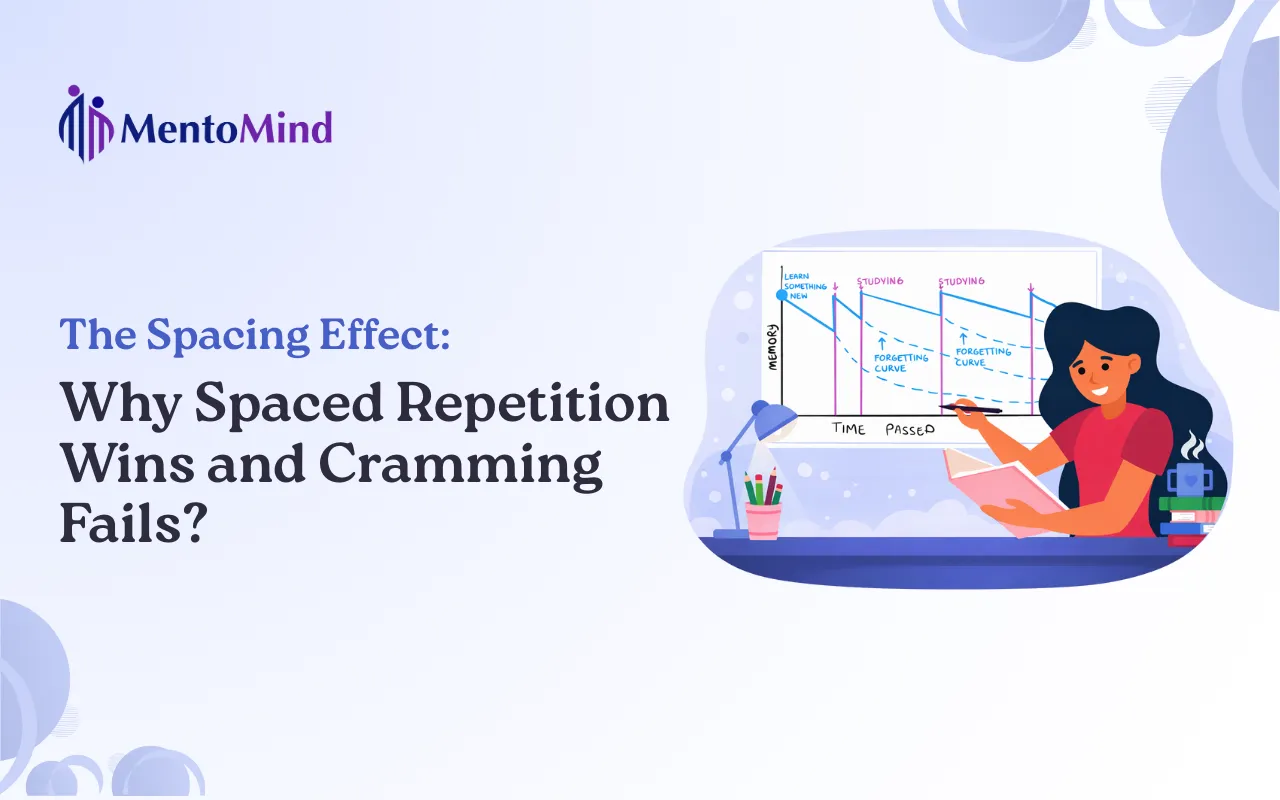
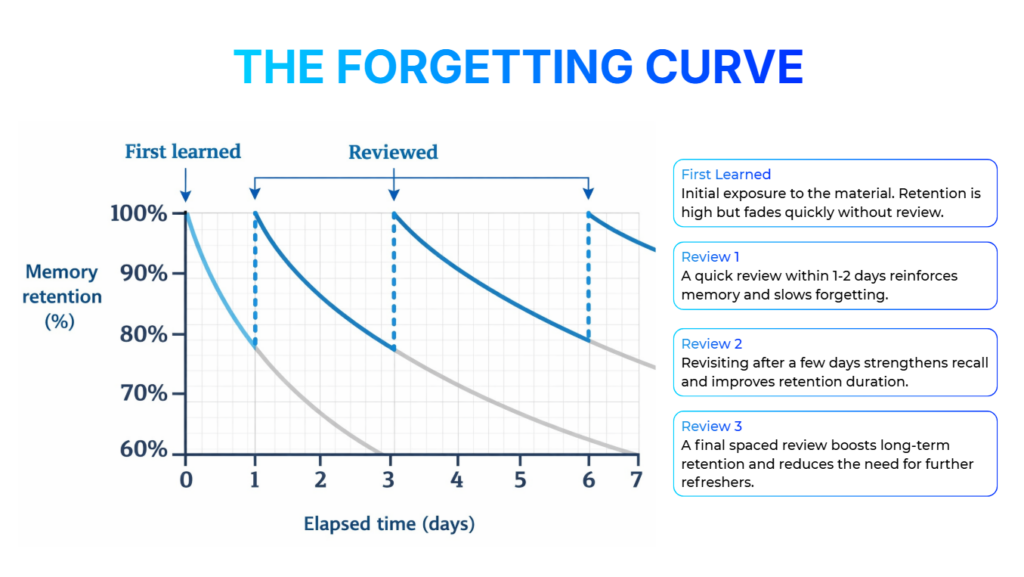
The forgetting curve describes how quickly new information fades when it is not revisited.
Research shows:
- New information declines rapidly without reinforcement
- Most material fades within days when not reviewed
- Familiarity does not equal long-term retention
Spaced repetition interrupts the natural forgetting process.
Each time you successfully recall information just before it begins to fade, the memory becomes stronger. Over time, the gap between forgetting grows longer, and retrieving the information becomes faster and more reliable.
This is why active recall at spaced intervals outperforms passive rereading.
What Does Research Say About Spaced Repetition? (2022–2025)
The spacing effect has been replicated for over a century. Recent studies reinforce its strength.
| Study | What They Did | What They Found |
|---|---|---|
Zou et al., 2025 |
7T fMRI scans over 10 months |
Spaced learning associated with stronger re-encoding patterns in prefrontal networks |
Burel et al., 2025 |
Surveyed 523 medical entrance exam students |
Spaced repetition users had significantly higher odds of passing |
Vagha et al., 2025 |
90 students using spaced flashcards vs traditional study |
Spaced group scored substantially higher |
Winter et al., 2025 |
Tracked Anki usage |
Greater spacing frequency correlated with higher exam scores |
Martinengo et al., 2024 |
Review of 23 studies |
Digital spaced learning improved retention |
Carpenter et al., 2022 |
100+ years of research review |
Spacing and retrieval outperform massed study |
What This Means for SAT/ACT Students?
Many well-known studies on spaced learning come from medical and professional education. However, research across psychology, language learning, and K–12 education shows that the same memory processes operate in all learning domains.
Encoding, consolidation, and retrieval follow the same basic patterns whether students are learning anatomy, algebra, grammar, or reading strategies.
This is why spaced practice consistently improves:
- Algebra transformations
- Grammar conventions
- Vocabulary retention
- Data interpretation
- Reading comprehension strategies
How Does Spaced Repetition Improve Memory?
Memory improves through three mechanisms:
- Effortful retrieval strengthens neural connections
- Re-encoding stabilizes activation patterns across cortical networks
- Spacing increases resistance to forgetting
Repeated spaced retrieval leads to:
- Faster recall
- Fewer errors
- Lower cognitive strain during testing
How to Build a Spaced Repetition Schedule?
A simple research-backed spaced repetition schedule looks like this:
| Day | Activity | Time |
|---|---|---|
Day 1 |
Full lesson and practice |
45 minutes |
Day 2 |
Closed-book recall quiz |
10 minutes |
Day 3 |
Flashcards + 3 problems |
15 minutes |
Day 7 |
Mixed review |
20 minutes |
Day 14 |
Timed exam-style set |
15 minutes |
Day 30 |
Quick diagnostic |
10 minutes |
How to Study Effectively Using Spaced Repetition?
- Active recall instead of rereading
- Error analysis by mistake category
- Creating flashcards with one clear concept per card
Does Spaced Repetition Work for Everyone?
Spacing works best when:
- Reviews are completed consistently
- Retrieval replaces passive rereading
- Intervals are realistic
- Motivation remains steady
When applied consistently, spaced repetition produces durable gains. When applied inconsistently, results weaken.
How Parents Can Evaluate a Program?
- Is practice spaced across weeks?
- Is active recall required?
- Are sub-skills tracked clearly?
- Does difficulty adjust both up and down?
- Is progress measurable over time?
Why Spaced Repetition Reduces Test Anxiety?
When retrieval becomes automatic:
- Cognitive load decreases
- Working memory remains available
- Answers surface faster
- Confidence becomes more stable
Students who cram may feel prepared, but under test pressure they often find it hard to retrieve what they studied. Spaced learners tend to recall information more steadily and with less hesitation.
For high-stakes exams, composure influences performance.
Bottom Line
The research behind spaced repetition is extensive, well-replicated, and still growing.
Studies consistently show that:
- Retrieval strengthens memory
- Distributed practice stabilizes it
- Consistency outperforms intensity
Spacing helps students retain more and perform more calmly.
Spaced repetition means reviewing small amounts of material over several weeks instead of all at once. Students practice remembering information just as it begins to fade, which strengthens long-term memory.
8 to 12 weeks before your test date is ideal for full spacing benefits. Even 4 weeks of spaced practice outperforms a single week of cramming. If you are planning multiple test dates, maintain the same spaced deck and extend the schedule.
Cramming creates a “fluency illusion” where everything feels familiar but fades within days. It puts information in short-term memory, so you feel confident. But your brain never stored it for the long term.
Ideally, 20 to 30 minutes of focused daily practice works best . Consistency matters more than session length. Seven short sessions across a week beats one long session on the weekend.
Sources:
Carpenter, S. K., Pan, S. C., & Butler, A. C. (2022). The science of effective learning with spacing and retrieval practice. Nature Reviews Psychology, 1(9), 496–511.
Martinengo, L., et al. (2024). Spaced digital education for health professionals: Systematic review and meta-analysis. Journal of Medical Internet Research, 26, e57760.
Zou, F., et al. (2025). Benefits of spaced learning are predicted by the re-encoding of past experience in ventromedial prefrontal cortex. Cell Reports, 44(2), 115232.
Burel, J., et al. (2025). Spaced repetition and other key factors influencing medical school entrance exam success. BMC Medical Education, 25, 1036.