
TL;DR:
The HSPT Quantitative Skills section measures logic-based numerical reasoning through the following question types:
- Number series
- Geometric and non-geometric comparisons
- Number manipulation
Why Is the HSPT Quantitative Skills Section So Important?
The HSPT Quantitative Skills section plays an important role in admissions because it measures how efficiently students apply logic to numerical problems, rather than how well they recall math content.
Unlike curriculum-based sections, this part of the test focuses on pattern recognition, logical relationships, and numerical reasoning, offering insight into a student’s problem-solving approach and ability to think through unfamiliar situations.
Since performance depends on recognizing patterns quickly and applying logic accurately, even modest improvements in reasoning efficiency can lead to measurable gains.
HSPT Quantitative Skills Section Overview
| Category | Details |
|---|---|
Total questions |
52 questions |
Time limit |
30 minutes |
Skills measured |
Pattern recognition, logical problem-solving and numeric reasoning |
Calculator |
Not permitted |
What Types of Questions Are on the HSPT Quantitative Skills Section?
The HSPT Quantitative Skills section includes four primary question types, each designed to measure logic-based numerical reasoning.
1. Number Series
These questions test your ability to recognize patterns in a sequence of numbers and determine what comes next.
📝 Example:
Question: 10, 14, 18, 22, 26, __
Explanation: Each number increases by 4, so the correct answer is 30.
2. Geometric Comparisons
These questions require you to compare geometric figures or properties such as area, perimeter, angles, or elapsed time.
📝 Example:
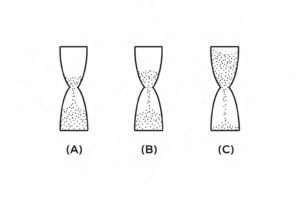
Question: In the image above, three hourglasses show different amounts of sand that has fallen. Which hourglass represents the most time passed?
Explanation: Compare how much sand has fallen in each hourglass. The one with the most sand passed through represents the greatest amount of time.
3. Non-Geometric Comparisons
These questions require you to compare numerical or algebraic expressions rather than shapes or diagrams. You evaluate each expression and then choose the statement that correctly describes their relationship.
📝 Example:
Question:
(A) (4 × 2) − 3
(B) (4 × 3) − 2
(C) (4 + 3) − 2
Which statement correctly describes the relationship among A, B, and C?
(I) A is > B
(II) C is > B
(III) A = C
(IV) A, B, and C are equal
Explanation: Evaluate each expression and compare the results. Then select the option that accurately describes how the values relate to one another.
4. Number Manipulation
Number manipulation questions involve multi-step numerical reasoning using fractions, decimals, or percentages. The focus is on understanding how numbers relate and applying logical steps efficiently.
📝 Example:
Question: What number is 5 more than two-thirds of 27?
Explanation: Two-thirds of 27 is 18. Adding 5 gives a final answer of 23.
Is the HSPT Quantitative Skills Section Hard?
The Quantitative Skills section can feel challenging at first because it emphasizes logic and reasoning. However, the skills it tests can be developed and tend to improve with focused, consistent practice.
Students who perform well typically build proficiency by:
- Practicing pattern-based questions by first identifying the rule that connects the numbers before choosing an answer.
- Using timed drills to adjust to test pacing and learn when to move on.
- Reviewing mistakes to understand why an answer is correct, not just which option is right.
- Practicing questions across all Quantitative topics, including number series, geometric comparisons, non-geometric comparisons, and number manipulation.
- Strengthening mental math skills to solve efficiently without writing out every step.
- Applying a skip-and-return strategy to avoid spending too much time on any single question.
What Mistakes Should You Avoid in the HSPT Quantitative Skills Section?
Mistake 1# Skipping this section during preparation
Treating Quantitative Skills as less important limits opportunities to raise your overall score.
Mistake 2# Rushing through questions without identifying patterns
Quick guesses often lead to avoidable errors.
Mistake 3# Ignoring answer explanations
Understanding why an answer is correct is essential for improving reasoning skills.
Mistake 4# Practicing without timing yourself
Untimed practice does not prepare students for real exam conditions.
Additional Test Day Tips for HSPT Quantitative Success
- Arrive mentally prepared for fast reasoning: Get enough sleep and eat a balanced breakfast so you can think clearly and stay focused during rapid, logic-based questions.
- Read Quantitative instructions carefully: Before starting, note that this section is timed tightly and does not allow calculators.
- Read each question with purpose: Quantitative questions are often short but require careful attention to patterns, comparisons, or relationships.
- Answer every question: Since there is no penalty for wrong answers, make your best guess if needed rather than leaving any question blank.
- Manage pacing actively: Avoid spending too long on one question. Skip difficult ones and return if time allows.
- Confirm your answers match the correct question numbers: Because questions move quickly, periodically confirm your answers match the correct question numbers.
- Use remaining time strategically: If you finish early, review questions that involved multiple steps or required careful reasoning.
Frequently Asked Questions
The HSPT Quantitative Skills section assesses logical thinking, pattern recognition, and problem-solving using numbers rather than memorized math formulas.
There are 52 multiple-choice questions to be completed in 30 minutes, making pacing an important factor.
You can expect number series, geometric and non-geometric comparisons, and number manipulation questions that focus on reasoning and logic.
No. Calculators are not allowed, so students must rely on mental math and logical reasoning.
It can feel challenging at first because it is logic-based, but performance typically improves with focused and consistent practice.
Effective preparation includes practicing logic-based questions, using timed drills, and reviewing mistakes to understand the correct reasoning.
Schools value the HSPT Quantitative Skills section because it reflects a student’s ability to think logically, recognize patterns, and solve problems efficiently under time pressure.
Your Next Steps for HSPT Quantitative Skills Prep
Acing the HSPT Quantitative Skills section comes from understanding how the questions are structured and approaching them with focus and efficiency. With targeted practice and smart pacing, students can build confidence and maximize their performance on test day.
The good news? MentoMind will soon be launching a self-paced HSPT course designed to support students at every stage of preparation, including:
- 1000+ expert-curated practice questions across all HSPT sections
- 2 full-length practice tests aligned with real exam timing and difficulty
- A diagnostic assessment to identify strengths and areas for improvement
- Progress reports to track performance by section and topic
- Hints and explanations for guided learning
- Logic and vocabulary modules to strengthen core reasoning skills
👉 Stay tuned for updates and be among the first to explore a smarter, more structured approach to HSPT preparation with MentoMind.
Related reading: