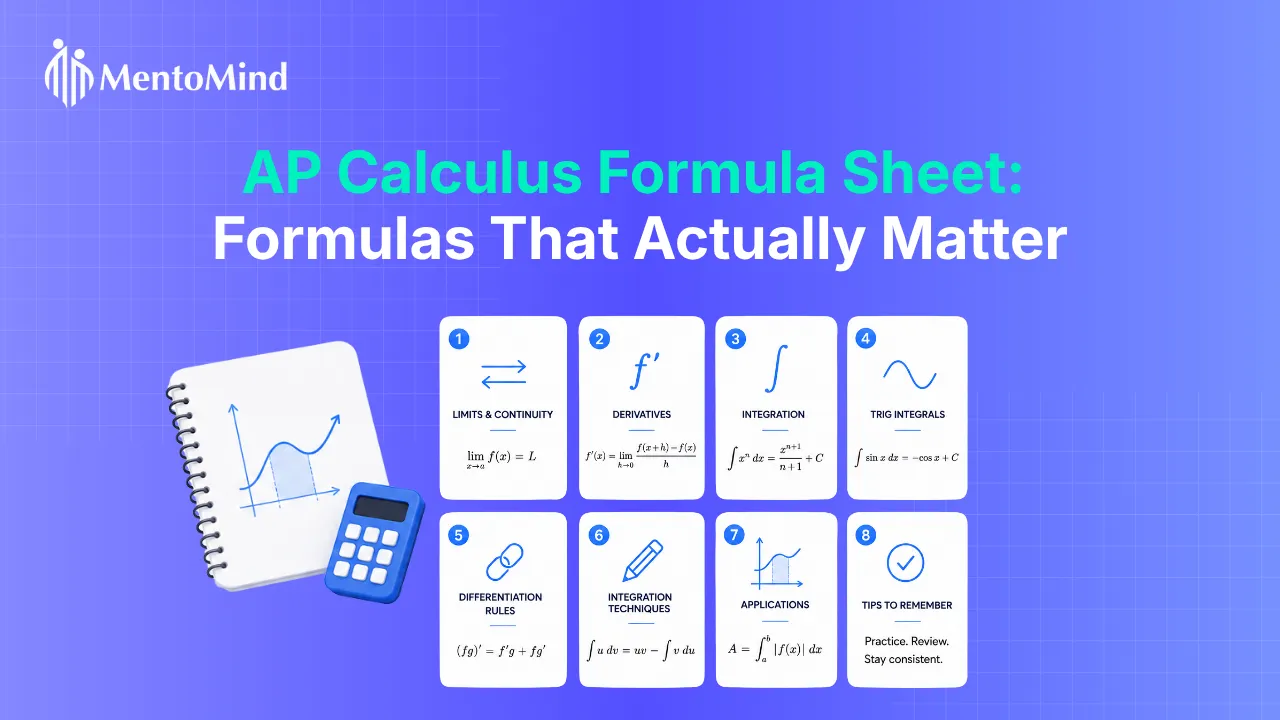
If you are preparing for AP Calculus, knowing the right formulas can save time and help you choose the correct approach during a problem. The AP Calculus formula sheet you create for review should focus on the formulas you actually need to recall, not every calculus formula you have learned.
This article breaks down the key AP Calculus formulas for AB and BC, explains which ones to prioritize, and shows how to use an AP Calculus cheat sheet effectively during your AP Calculus review.
Does AP Calculus Have a Formula Sheet?
No. The College Board does not provide an official AP Calculus formula sheet during the AP Calculus AB or BC exam. You must know the formulas needed to solve the questions and know when to apply them. You can still create an AP Calculus cheat sheet for studying. Use it to organize key formulas, note formulas you often forget, and review them during your AP Calculus review.
Which AP Calculus Formulas Should You Memorize?
Focus on formulas you use often to find derivatives, evaluate integrals, analyze functions, and solve application problems. For AP Calculus AB, prioritize the core derivative, integral, and application formulas. AP Calculus BC includes those topics plus additional formulas for parametric equations, polar functions, and infinite series.
1. Derivative formulas
These are the core AP Calculus formulas and derivative rules covered in the College Board framework.
| Rule or formula | Expression |
|---|---|
Power rule |
d/dx(xⁿ) = n · xⁿ⁻¹ |
Constant rule |
d/dx(c) = 0 |
Constant multiple rule |
d/dx[c · f(x)] = c · f'(x) |
Sum rule |
d/dx[f(x) + g(x)] = f'(x) + g'(x) |
Difference rule |
d/dx[f(x) – g(x)] = f'(x) – g'(x) |
Product rule |
(f · g)’ = f’g + fg’ |
Quotient rule |
(f/g)’ = (f’g – fg’) / g² |
Chain rule |
d/dx[f(g(x))] = f'(g(x)) · g'(x) |
Exponential |
d/dx(eˣ) = eˣ |
Natural logarithm |
d/dx(ln x) = 1/x |
Sine |
d/dx(sin x) = cos x |
Cosine |
d/dx(cos x) = -sin x |
Tangent |
d/dx(tan x) = sec²x |
Cotangent |
d/dx(cot x) = -csc²x |
You should also know the definition of the derivative:
f'(x) = lim (h → 0) [f(x + h) – f(x)] / h
College Board includes the definition of the derivative, derivative notation, basic derivative rules, product and quotient rules, and the derivatives of trigonometric, exponential, and logarithmic functions in the AP Calculus framework.
2. Integral formulas
For integration, focus on the basic antiderivative rules and the Fundamental Theorem of Calculus. College Board covers these in Unit 6 for both AB and BC.
| Rule or formula | Expression |
|---|---|
Power rule |
∫ xⁿ dx = (xⁿ⁺¹ / (n + 1)) + C, n ≠ -1 |
Exponential |
∫ eˣ dx = eˣ + C |
Reciprocal |
∫ (1/x) dx = ln|x| + C |
Sine |
∫ sin x dx = -cos x + C |
Cosine |
∫ cos x dx = sin x + C |
Secant squared |
∫ sec²x dx = tan x + C |
Cosecant squared |
∫ csc²x dx = -cot x + C |
For a definite integral, the Fundamental Theorem of Calculus gives:
∫ₐᵇ f(x) dx = F(b) – F(a), where F'(x) = f(x).
Students should also understand the connection between an accumulation function and its derivative:
d/dx [ ∫ₐˣ f(t) dt ] = f(x)
3. Formulas for motion and applications
Some of the most useful AP Calculus exam formulas connect derivatives and integrals to real-world situations. College Board specifically includes position, velocity, acceleration, related rates, linearization, optimization, and other applications of differentiation.
- Velocity: v(t) = s'(t)
- Acceleration: a(t) = v'(t) = s”(t)
- Displacement: ∫ₐᵇ v(t) dt
- Total distance: ∫ₐᵇ |v(t)| dt
- Average rate of change: [f(b) – f(a)] / (b – a)
- Average value: [1 / (b – a)] ∫ₐᵇ f(x) dx
- Linearization: L(x) = f(a) + f'(a)(x – a)
For total distance, check where velocity changes sign before evaluating the integral. The integral of velocity gives displacement, not necessarily total distance.
What changes for AP Calculus BC?
BC includes all AB content plus additional topics. The College Board framework adds parametric equations, vector-valued functions, polar functions, and infinite sequences and series in Units 9 and 10.
For BC review, pay particular attention to:
- Parametric derivatives
- Second derivatives of parametric equations
- Parametric arc length
- Polar derivatives
- Polar area
- Geometric series
- Convergence and divergence tests
- Alternating series error
- Taylor polynomials
- Lagrange error bounds
- Taylor and Maclaurin series
- Radius and interval of convergence
These BC topics are not just extra formulas to memorize. You need to know which formula, theorem, or test fits the problem. College Board explicitly emphasizes selecting and applying appropriate mathematical definitions, theorems, and tests.
For AP Calculus review, focus on understanding when each formula applies. Memorizing a formula without knowing what the result represents will not help much when the question changes its wording.
How Should You Organize an AP Calculus Formula Sheet for Review?
Group your formulas by topic and add a short note about when to use each one. A useful AP Calculus study guide should help you choose the right formula quickly, not force you to memorize a long list without context.
Here are the best ways to organize your AP Calculus cheat sheet:
- Group derivative rules together: Keep the power, product, quotient, and chain rules in one section.
- Keep integral rules together: Add basic antiderivatives and the Fundamental Theorem of Calculus in another section.
- Separate applications: Create a section for motion, average value, accumulation, area, and volume formulas.
- List key theorems separately: Include the conditions and conclusions for the Intermediate Value Theorem, Mean Value Theorem, and other required theorems.
- Create a BC-only section: Add parametric equations, polar functions, vector-valued functions, and sequences and series separately if you are taking BC.
- Add a “when to use it” note: For example, write “use the chain rule for a composite function” next to the rule.
- Track your mistakes: Add formulas or rules you forget during practice so your sheet reflects your weak areas.
College Board expects students to use calculus concepts across graphical, numerical, analytical, and verbal representations, so your AP Calculus review should include more than formula recall.
How Can You Tell Which AP Calculus Formula to Use?
Start with what the question asks you to find. Then identify the calculus concept involved and choose the formula or rule that matches it.
Here are common clues to watch for:
- Rate of change: Use a derivative or average rate of change.
- Accumulated change: Use a definite integral.
- Position, velocity, or acceleration: Connect them using derivatives and integrals.
- Total distance: Check where velocity changes sign, then integrate the absolute value of velocity.
- Maximum or minimum: Find critical points and apply the appropriate derivative test.
- Area: Use a definite integral to find the area between curves or under a curve.
- Approximation: Check whether linearization applies.
- Convergence or divergence: For AP Calculus BC, identify the series and choose the appropriate convergence test.
The wording often tells you which AP Calculus formula or rule you need. Read the question first, identify the task, and then choose the method.
4 Common Mistakes Students Make With AP Calculus Formulas
Students often lose points when they use the wrong AP Calculus formula, skip a required condition, or confuse two similar concepts. Check these four mistakes before your next AP Calculus review:
- Using the chain rule incorrectly: When one function appears inside another, differentiate the outer function and then multiply by the derivative of the inner function.
- Confusing displacement with total distance: (\int_a^b v(t),dt) gives displacement. For total distance, account for where velocity changes sign.
- Skipping theorem conditions: Check the required conditions before applying the Mean Value Theorem or Intermediate Value Theorem.
- Choosing the wrong series test: For AP Calculus BC, identify the series first. Then choose a convergence test that fits it.
Knowing the AP Calculus formulas is only one part of exam preparation. If you’re preparing for both AB and BC, see MentoMind’s AP Calculus AB vs BC guide to understand which additional topics you need to study.
Ready to Put Your AP Calculus Formulas Into Practice?
MentoMind’s upcoming AP Calculus AB and BC courses are designed around targeted MCQ and FRQ practice, calculator and no-calculator questions, diagnostics, and full-length practice tests. The AB course includes 2,500+ targeted practice questions and 4 full length tests. Use targeted practice to apply the formulas you’ve learned and identify the topics that need more review.
Start your AP Calculus practice
Related readings:
Frequently Asked Questions
Yes. The 2026 AP Calculus AB and BC exams include a built-in Desmos graphing calculator in Bluebook. A graphing calculator is required for Part B of Section I and Part A of Section II.
Displacement measures the net change in position and comes from integrating velocity over an interval. Total distance measures the entire path traveled, so you must account for points where velocity changes sign.
An AP Calculus AB formula sheet should cover the core formulas for limits, derivatives, applications of differentiation, differential equations, integration, and applications of integration.
An AP Calculus BC formula sheet should include the core AB formulas plus BC topics such as parametric equations, polar functions, vector-valued functions, and sequences and series.
No. Parametric equations, polar coordinates, and vector-valued functions are BC topics, not part of the AB course framework. They make up Unit 9 in AP Calculus BC.
Infinite sequences and series deserve extra attention. Unit 10 accounts for 17%–18% of the BC multiple-choice section and includes geometric series, convergence tests, Taylor polynomials, error bounds, and power series.