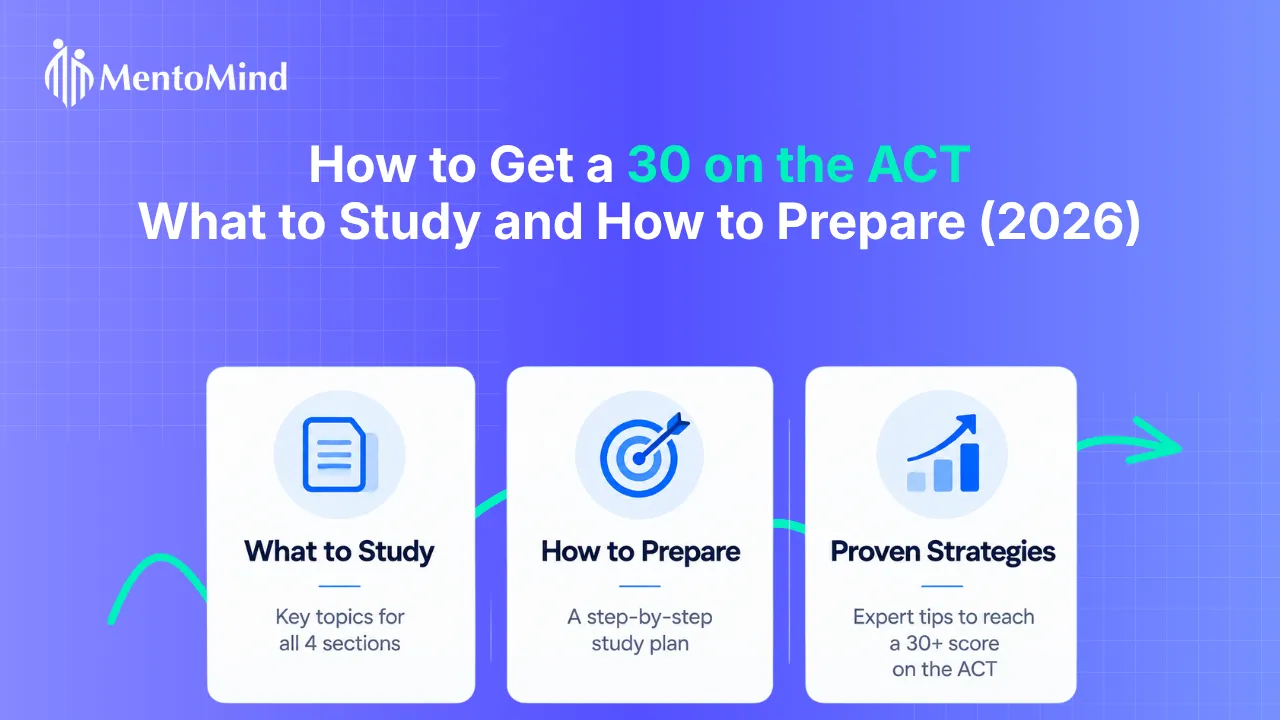
An ACT score of 30 is achievable with focused preparation, consistent practice, and a clear strategy for each section. Your approach should depend on your current score, target score, and how much time you have before test day.
This guide explains how to get a 30 on the ACT, how to improve your Math score, build an effective study plan, and use practical ACT tips and tricks to improve your performance.
How to Get a 30 on the ACT
The fastest way to work towards an ACT score of 30 is to stop treating the test as one big score. Break your target into section scores, find the questions that are holding you back, and spend your preparation time where it can make the biggest difference.
Know what your 30 needs to look like
Your section scores do not have to be identical to reach a 30 Composite. Set individual targets for English, Math, and Reading based on your strengths. This makes your ACT study plan more practical and gives you a clear score to work towards in each section.
Protect the points you should be getting
Before chasing difficult questions, make sure you are not losing marks on concepts you already know. Careless errors, misunderstood questions, and avoidable timing issues can add up quickly. Fixing these problems can create meaningful ACT score improvement.
Use your results to guide your next move
After each practice session, look at what changed. Which section improved? Which question types are still costing you points? Use those answers to adjust your ACT prep schedule and decide how to increase your ACT score without simply studying more.
How to Get a 30 on Math ACT
To get a 30 on Math ACT, focus on mastering the core concepts first, then work on accuracy and pacing. You do not need to solve every difficult question to reach your target; protecting the points from questions you can solve confidently is just as important.
Focus on the most tested math skills
Build a strong foundation in algebra, functions, geometry, statistics, and other frequently tested concepts. Use your practice results to decide which topics deserve more time in your ACT study plan.
Protect your easy and medium points
A few avoidable mistakes can make a significant difference when you are targeting an ACT score of 30. Read each question carefully, check your calculations when time allows, and avoid rushing through questions you know how to solve.
Improve your math speed
Once your accuracy is consistent, add timed Math practice to your ACT prep schedule. Learn to recognize familiar question types quickly, use efficient solution methods, and move on when a question is taking too long. These are some of the most useful ACT tips and tricks for improving Math performance.
If you need extra practice for ACT Math, MentoMind gives you targeted questions and detailed explanations to help you build accuracy. When you need more guidance, Video Solutions for ACT Math, powered by Think10x.ai, breaks down solutions step by step.
Also Read – How to Achieve the Highest ACT Score
How Should You Build an ACT Study Plan?
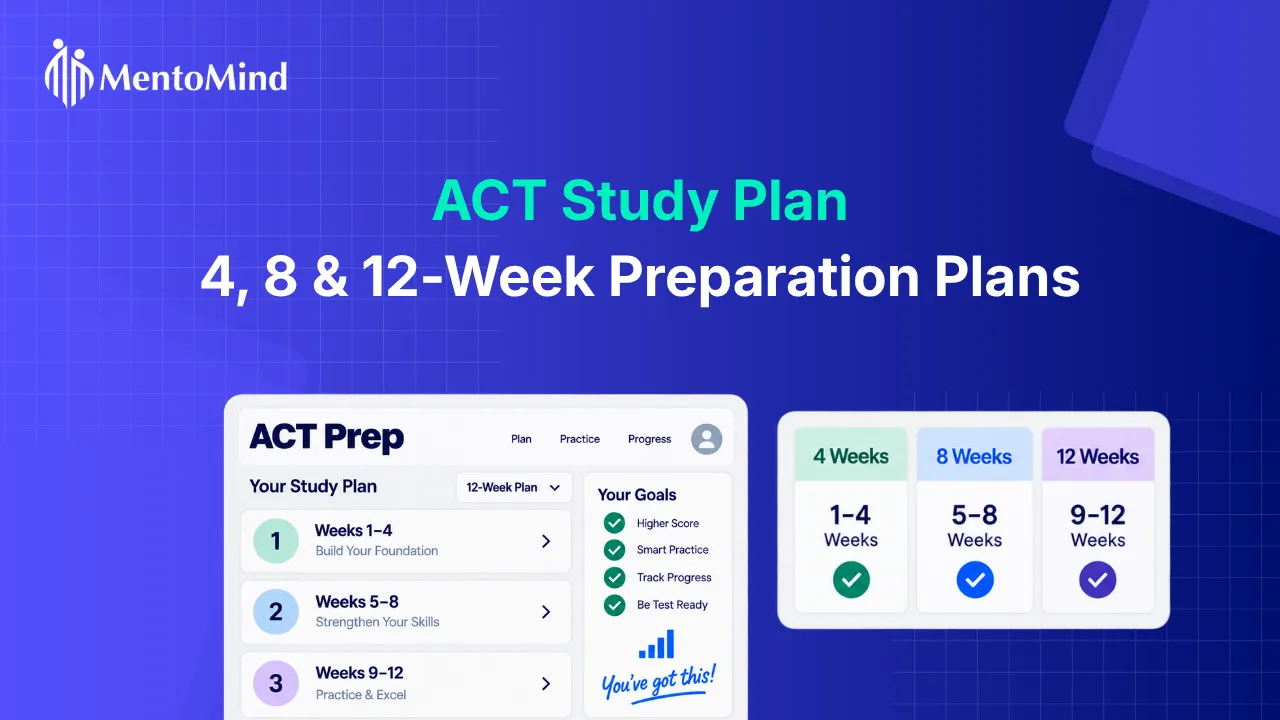
Build your ACT study plan around your test date, target score, and available study time. Give each week a clear purpose, then adjust the workload as you see what is and isn’t working. Here is how you can do it
- Start with your deadline – Count the weeks available before test day and divide them into clear preparation stages.
- Set section-level goals – Decide what you want to achieve in English, Math, and Reading rather than relying only on a Composite target.
- Plan around your real routine – Build your ACT prep schedule around school, homework, activities, and other commitments you cannot move.
- Give each study block one purpose – Use specific tasks such as learning a concept, practicing a question type, reviewing an error pattern, or completing timed work.
- Space out difficult topics – Return to challenging concepts across multiple sessions instead of trying to master them in one sitting.
- Use checkpoints – Set dates to review your section scores, accuracy, and pacing. These checkpoints show whether your preparation is producing meaningful ACT score improvement.
- Keep strong sections active – Give your better-performing sections occasional practice so they do not become an afterthought.
- Build in flexibility – Leave some open time each week for missed sessions, school deadlines, or topics that take longer than expected.
- Change the plan as you improve – Your priorities should shift as your scores change. Do not keep following the same routine simply because you wrote it down at the start.
- Reduce the workload near test day – Use the final days to consolidate what you know, keep your routine steady, and avoid cramming.
The best ACT study plan is one you can actually follow. A realistic schedule gives you enough structure to stay consistent while leaving room to adapt as you work towards an ACT score of 30.
Which ACT Tips and Tricks Actually Work?
The most useful ACT tips and tricks are question-solving techniques that help you reach an answer more efficiently. Use the method that fits the question instead of relying on one approach for every problem.
- Plug in numbers – When a Math question uses variables, choose simple values and substitute them to test the relationship.
- Work backwards – If the answer choices contain numbers, start with an option and check whether it satisfies the conditions.
- Estimate first – For calculations that do not require an exact value, estimate the result before working through the full calculation. This can help you spot unreasonable answers.
- Use grammar rules, not sound – In English, choose the option that follows the tested grammar or punctuation rule rather than the one that simply sounds natural.
- Look for textual evidence – In Reading, choose the answer supported by the passage. Avoid options that rely on assumptions or outside knowledge.
- Check what the question actually asks – Pay attention to words such as except, least, most likely, and primarily. They can completely change what you need to find.
- Use the simplest valid method – If a question can be solved with a quick substitution or formula, there is no need to use a longer method.
These techniques are most effective when you already know the underlying concepts. They can make your ACT preparation tips more practical by giving you different ways to approach questions.
Ready to Get More Out of Your ACT Preparation?
Preparing for the ACT can be frustrating when you keep practicing but are not sure what is actually helping. MentoMind gives you ACT practice tests, detailed explanations, and performance insights to help you see what is working and what still needs attention.
Related reading
Frequently Asked Questions
There is no fixed number of questions you can miss and still get an ACT score of 30 because ACT scoring depends on your performance in each section. Focus on building strong section scores rather than aiming for a specific number of mistakes.
Yes. You can still reach a 30 Composite without scoring exactly 30 in every section. A stronger performance in one section can balance a lower score in another, so your ACT study plan should reflect your individual strengths and targets.
There is no single required Math score for a 30 Composite. Your English, Math, and Reading scores are combined to determine your Composite, so the Math score you need depends on your performance in the other sections. If Math is your weaker area, targeted ACT preparation tips can help you improve it.
The most effective ACT test prep strategies combine focused practice, timed sections, and regular progress checks. Start by strengthening individual skills, then move towards mixed and timed practice as your accuracy improves.
The time needed for ACT score improvement depends on your starting score, target score, and available study time. A consistent ACT prep schedule can help you make steady progress, especially when you focus on the areas with the most room for improvement.