
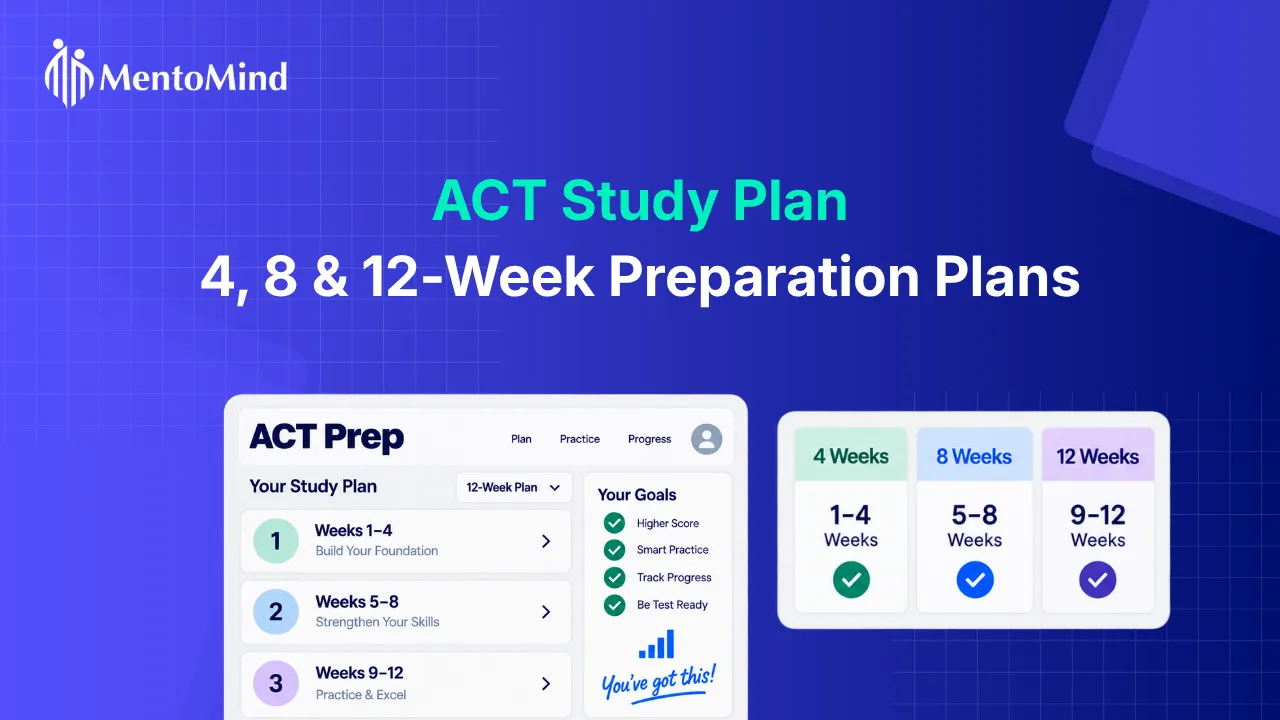
An ACT study plan helps you organize your preparation around your test date, target score, current performance, and available study time. A clear schedule gives you time to review concepts, practice questions, work on weak areas, and take full-length practice tests.
This guide covers 4, 8, and 12-week ACT study plans, how to choose the right preparation timeline, how to structure your study sessions, and practical tips to stay on track.
How Should You Choose an ACT Study Plan?
Choose an ACT study plan based on your test date, current performance, target score, and available study time. Take a practice test first to identify your strengths and the areas that need more work.
Here’s what to consider
- Check your starting score – Take a full-length practice test to understand your current performance.
- Set a target score – Decide what score you want to achieve before building your ACT study schedule.
- Consider your test date – Choose a 4, 8, or 12-week plan based on how much time you have left.
- Identify weak areas – Use your practice results to decide which sections and topics need more attention.
- Set a realistic schedule – Plan study sessions around school, activities, and other commitments.
- Track your progress – Review your practice scores regularly and change your plan when your results show a new priority.
What Is a 4-Week ACT Study Plan?
A 4-week ACT study plan gives you a structured way to prepare when your test date is close. The goal is to identify your biggest gaps early, practice those skills consistently, and use timed tests to check whether your preparation is working. Follow this four-week ACT study schedule
Week 1. Find out where you stand
Take a full-length practice test before starting your main preparation. Analyze your score and mistakes to identify the sections, topics, and question types that need attention. Turn these findings into your study priorities.
Week 2. Target your weakest skills
Spend this week working through your highest-priority topics. Review concepts first, then apply them through practice questions. Keep an error log so you can spot mistakes that occur more than once.
Week 3. Combine practice with timing
Shift towards timed section practice and mixed question sets. Focus on answering accurately without spending too long on individual questions. Continue working on any weak areas that appear in your practice results.
Week 4. Measure your progress
Take another full-length practice test and compare it with your initial result. Review the questions you missed and use the remaining study sessions to address specific gaps. Finish your ACT study schedule with light review rather than intensive new learning.
Also Read -> How to Achieve the Highest ACT Score
What Is an 8-Week ACT Study Plan?
An 8-week ACT study plan gives you enough time to move from basic preparation to timed practice without rushing the process. The first half focuses on understanding your strengths and improving weak areas, while the second half shifts towards applying those skills under test conditions.
Here’s how to divide your ACT study schedule
Weeks 1–2. Take a diagnostic and set your priorities
Start with a full-length practice test to establish your baseline. Review your answers, identify recurring mistakes, and note the topics that need the most attention. Use these results to decide how to divide your study time.
Weeks 3–4. Build your skills
Work through the concepts and question types that caused the most problems in your diagnostic. Combine focused lessons with practice questions so you can apply each concept as you learn it. Keep an error log to track mistakes that come up repeatedly.
Weeks 5–6. Shift to timed practice
Once you have strengthened the main gaps, introduce more timed work. Practice individual sections, mixed question sets, and pacing strategies. Review your score after each session and adjust your ACT prep schedule when a particular skill continues to cause problems.
Weeks 7–8. Simulate the real test
Use full-length practice tests to bring everything together. Take each test under realistic conditions, then spend time analyzing your mistakes and pacing. In the final days, focus on your remaining weak areas and test-day approach rather than trying to cover entirely new topics.
If you’re still stuck on an ACT Math question, try a video solution. MentoMind integrates Think10x.ai to bring AI-generated, step-by-step video solutions to eligible questions. When available, simply click Watch Video Solution next to the Solution heading to watch a short explainer in your preferred language. Video solutions are available for enabled courses and do not appear for passage-based questions.
For SAT and ACT, video solutions are currently limited to Math questions.
What Is a 12-Week ACT Study Plan?
A 12-week ACT study plan suits students who want more time to prepare without studying at the same intensity every week. The extra time lets you build preparation around your school routine, revisit difficult material, and leave the final weeks for test-specific practice.
| Weeks | Main focus | What to do |
|---|---|---|
1–2 |
Get started |
Take a baseline test, set your target score, and get familiar with the ACT format. |
3–4 |
English & Reading |
Work on grammar rules, passage-based questions, main ideas, evidence, and other recurring question types. |
5–6 |
Math |
Review the maths you need for the ACT, practice formulas and problem-solving, and use video solutions when a worked example would help. |
7–8 |
Mixed practice |
Combine sections and question types instead of studying one topic at a time. Start bringing timed work into your routine. |
9–10 |
Test practice |
Take full-length tests and practice following the ACT’s section timings from start to finish. |
11 |
Score improvement |
Compare your recent results with your target score and spend the week on the areas that are still holding your score back. |
12 |
Final preparation |
Keep practice light, review key material, and get your test-day routine and essentials ready. |
The main advantage of a 12-week ACT study schedule is flexibility. You can slow down when a topic takes longer to learn and move ahead when you are ready, instead of trying to fit everything into a short preparation window.
How Many Hours Should You Study for the ACT Each Week?
The right amount of ACT study time depends on your starting score, target score, test date, and other commitments. Instead of following a fixed number of hours, build an ACT study schedule that you can follow consistently and adjust as you see where more practice is needed.
When planning your weekly study time
- Start with your test date – A shorter timeline may require more focused study sessions.
- Consider your weak areas – Give extra time to topics where you consistently make mistakes.
- Work around your routine – Fit ACT practice around school, homework, activities, and other commitments.
- Mix different types of practice – Include concept review, practice questions, timed work, and mistake review.
- Leave time to review – Don’t spend all your study time answering questions. Reviewing mistakes helps you understand what to work on next.
- Adjust as you improve – If your practice results show progress in one area, shift your time towards skills that still need attention.
If you’re wondering how to study for ACT effectively, consistency matters more than trying to fit in long study sessions that are difficult to maintain. An ACT planner can also help you divide your weekly goals into manageable study sessions.
What Are the Best ACT Preparation Tips to Follow?
Good ACT preparation tips go beyond simply doing more practice questions. The way you practice, review your work, and manage your time can make your preparation more effective.
Here are a few habits worth adding to your routine
- Read the question carefully – Make sure you understand what the question is asking before you start solving it.
- Know when to move on – If a question is taking too long, make your best choice and move on. You can return to it if time allows.
- Understand the method – Focus on why an answer is correct instead of memorizing a shortcut that may not work on another question.
- Keep your study materials organized – Keep your practice tests, notes, and error log together so you can easily review them.
- Take regular breaks – Short breaks can help ensure you stay focused during longer study sessions.
- Protect your sleep – Don’t sacrifice sleep for extra late-night study sessions, especially as test day gets closer.
- Keep the final days light – Use the last few days for review rather than trying to learn large amounts of new material.
If you want a more focused way to prepare, start with a free ACT diagnostic in the MentoMind app to find your weak spots. Then use MentoMind’s ACT course to practice with detailed explanations, section-level analytics, progress tracking, and Video Solutions for ACT Math.
How Can an ACT Planner Keep Your Preparation Organized?
An ACT planner helps you see what you need to do, when you need to do it, and how much time you have left before test day. It can make a long ACT study schedule easier to manage without making your preparation feel overwhelming.
Use your planner to
- Set weekly study goals
- Block out specific study sessions
- Record completed practice tests
- Keep track of your test date
- Leave space for missed sessions
- Adjust your ACT prep schedule when your routine changes
The key is to keep your planner realistic. A schedule you can follow consistently is more useful than one packed with tasks you cannot maintain.
What Should You Look for in an ACT Study Guide?
A useful ACT study guide should cover the test content, give you enough realistic practice, and help you understand your mistakes. Use these criteria to choose a resource that fits your preparation
| Feature | What a good ACT study guide should offer |
|---|---|
Current test format |
Content and practice that match the ACT format you will take |
Concept review |
Clear explanations of the skills and concepts tested in each section |
Question practice |
A range of question types and complexity levels |
Detailed solutions |
Step-by-step reasoning that explains why an answer is correct |
Timed practice |
Section-level practice to help you work accurately within the time limit |
Full-length tests |
Complete practice tests that replicate the actual testing experience |
Performance feedback |
Score reports or insights that show how you are performing |
Study flexibility |
Resources you can use alongside your own ACT study schedule |
Before choosing a study guide, make sure you understand the current ACT structure and timing. Read MentoMind’s How Long Is the ACT to see how much time you get for each section and how Science and Writing affect the total test time.
Ready to Put Your ACT Study Plan Into Practice?
Knowing what to study is only the first step. You also need consistent practice to build accuracy, manage your time, and see where you can improve. MentoMind supports your preparation with ACT practice tests, detailed explanations, progress insights, and Video Solutions for ACT Math.
Related reading
ACT vs SAT: How to Help Students Choose
Frequently Asked Questions
You can take the ACT again if you want to improve your score. Your best approach depends on your target score, college deadlines, and how much time you have between test dates. Check each college’s testing and superscoring policy before planning another attempt.
Science is optional on the current ACT, so you may not need to prepare for it if you do not plan to take that section. Check the prerequisites of the colleges you are applying to before leaving Science out of your ACT study plan.
Take a full-length practice test early enough to use the results in your preparation. Starting with a diagnostic gives you a baseline and leaves time to change your ACT study schedule based on what you find.
Not necessarily. Your second or third attempt should reflect what you learned from earlier tests. You may need less time for areas you have already mastered and more focused practice where your score still falls short of your target.
A consistent schedule does not mean studying every day. Plan regular breaks and choose study sessions you can maintain alongside school and other commitments. A realistic ACT study schedule is easier to follow than an overloaded one.