A PSSA score shows how well a student performed against Pennsylvania’s academic standards for their grade and subject. The score report also includes a performance level, which makes it easier to understand whether the student met, exceeded, or fell below the expected standard.
This guide explains PSSA scores, the four performance levels, how to read PSSA test results, and what students and parents should look for in their PSSA results.
What Is a Good PSSA Score?
A Proficient or Advanced PSSA score is generally considered a good result. Proficient means a student met Pennsylvania’s grade-level expectations, while Advanced means the student exceeded them. There is no single PSSA score that counts as good for every student. Pennsylvania sets different performance-level cut scores for each grade and subject.
For example, a student’s PSSA test score should be read alongside the performance level on the score report. A number by itself does not show whether the student met the state standard.
How Are PSSA Performance Levels Explained?
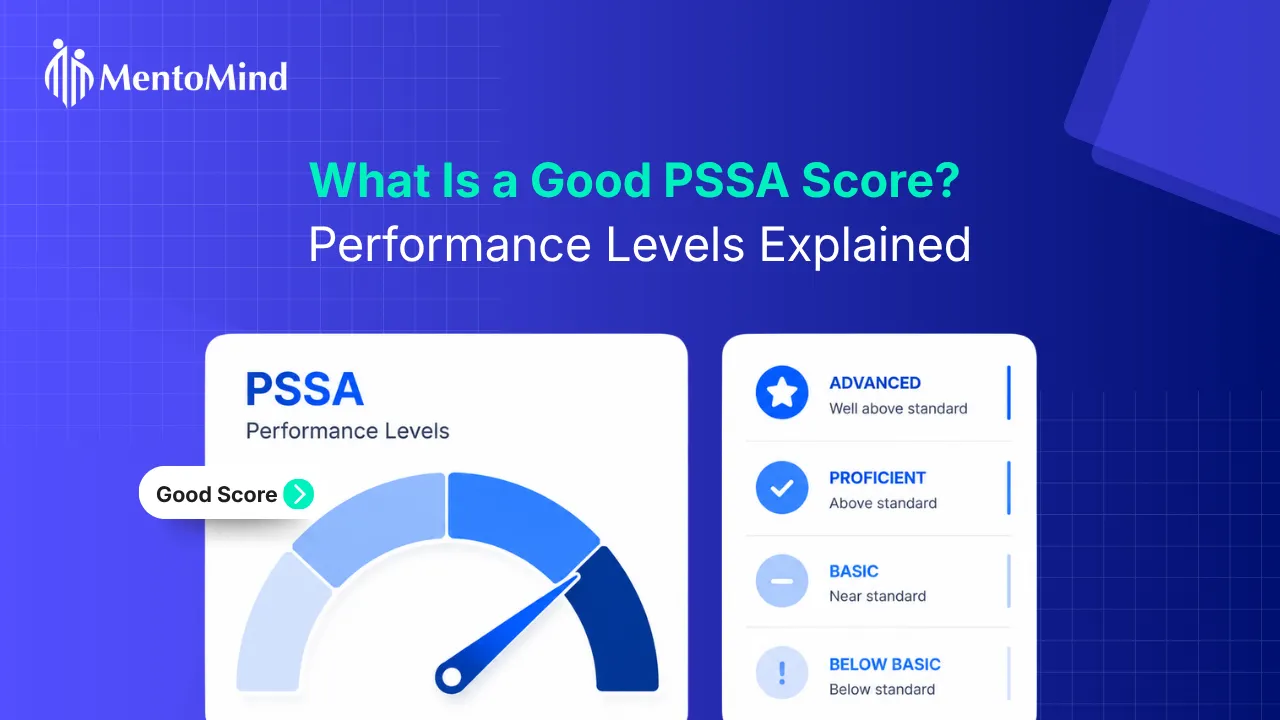
PSSA results place students into four performance levels: Advanced, Proficient, Basic, and Below Basic. These levels show how a student’s performance compares with the achievement standard for the tested grade and subject. Here’s how it differs:
| Performance level | What it means |
|---|---|
Advanced |
Performance above the Proficient level |
Proficient |
Meets the state’s performance standard |
Basic |
Performance below the Proficient level |
Below Basic |
Performance below the Basic level |
How Do PSSA Scores Vary by Grade and Subject?
PSSA exam score ranges differ by grade and subject, so there is no single score that means the same thing across every PSSA assessment. PDE publishes separate performance-level cut scores for each tested grade and subject.
Here’s how to read the differences:
- Grades 3–8: PSSA assesses English Language Arts (ELA) and Mathematics across grades 3 through 8.
- Science: PSSA Science is assessed in grades 5 and 8.
- Different cut scores: The score required for Proficient or Advanced can vary by grade and subject. Use the cut score for the specific assessment rather than comparing numbers across tests.
- 2025 Science results: The 2025 Grade 5 and Grade 8 Science tests were field tests. PDE did not report scaled scores or performance levels for those tests.
- State results: PDE publishes PSSA results by grade and subject, including the percentage of students who reached each performance level.
For an individual student’s PSSA test results, check the grade, subject, scaled score, and performance level together. That gives a more accurate picture than looking at the score alone. Preparing for the PSSA means knowing what students will face on test day. Read MentoMind’s Complete Tutor’s Guide to Digital PSSA 2026 and TEI Questions to understand the digital format, question types, and test-day strategies.
How Should You Read PSSA Results?
Your PSSA test results show your score, performance level, and performance across reporting categories. Read these details together rather than judging your result from the score alone.
Here’s how to read your report:
- Check the subject: Make sure you are looking at the correct ELA, Math, or Science result.
- Find the PSSA score: Your report shows the score for that subject and where it falls within a performance level.
- Check the performance level: Look for Advanced, Proficient, Basic, or Below Basic to understand how your score compares with the applicable standard.
- Review reporting categories: These show how you performed in specific areas of the assessment.
- Check the Strength Profile: This can show areas where you performed more strongly and areas that may need more work.
- Do not compare subjects directly: PDE notes that each subject has its own scale, so a Math PSSA test score should not be compared directly with an ELA score.
How Can Students Improve Their PSSA Scores?
Students can improve their PSSA scores by focusing on the skills they need to strengthen and practicing the same types of questions they will see on the assessment. Pennsylvania Department of Education (PDE) provides official item samplers with sample questions, answer keys, scoring guidelines, and student responses.
Here’s how to use them effectively:
- Find weak areas: Start with previous PSSA results or recent classwork to identify skills that need more practice.
- Use official item samplers: Choose the sampler for the correct grade and subject. PDE provides current ELA and Math samplers for grades 3–8.
- Study the scoring: Check the answer keys, rationales, and scoring guidelines to understand what a strong response requires.
- Practice unfamiliar item types: Work with different question formats instead of focusing only on multiple-choice questions.
- Review mistakes: After each practice set, correct the mistake and explain why the right answer works.
- Get used to the online test: PDE also provides online tools training and tutorials so students can practice using the test platform before test day.
Use the student’s PSSA test results to decide where to spend study time. Targeted practice is more useful than repeating questions the student has already mastered.
Ready to Practice for the PSSA?
Understanding your PSSA test results is only the first step. Targeted practice can help students work on the skills they need to strengthen before the next assessment. If you’re looking for structured practice, see MentoMind’s PSSA program to explore practice questions and full-length tests designed for PSSA preparation.
Frequently Asked Questions
PSSA test results are released after Pennsylvania completes scoring and reporting for the annual assessment. The 2025 PSSA results were released by the Pennsylvania Department of Education on November 14, 2025. Future release dates can vary by testing year.
The PSSA does not have one universal passing score. Pennsylvania sets separate performance-level cut scores for each grade and subject, so the score required for Proficient varies across assessments.
Advanced is the highest PSSA performance level. The four levels are Advanced, Proficient, Basic, and Below Basic. The score range for each level depends on the grade and subject.
Yes. Pennsylvania provides Individual Student Report Guides to help families understand their child’s PSSA report. The report includes the student’s score and performance information for the applicable assessment.
PSSA results are state assessment results, not classroom grades. The PSSA measures how well students have achieved Pennsylvania’s academic standards. Schools and educators can use the results to identify student strengths and areas that need additional support.