SAT Trigonometry is one of the smaller topics on the SAT Math section. Still, it shows up often enough that skipping it can cost you points. The good news is simple. The digital SAT tests trigonometry in a narrow, predictable way. You do not need every identity from class. You need the three core ratios, a few triangle rules, and enough practice to use them fast.
This complete guide to SAT trigonometry covers every concept the SAT tests. You will find the formulas in clear tables. You will also find worked practice problems with full solutions and a short cheat sheet. Everything here matches the current digital SAT Math format. You will not waste time on topics the exam no longer includes.
Is Trigonometry on the SAT?
Yes, trigonometry is on the SAT. It sits in the Geometry and Trigonometry domain of the Math section. The College Board reports that this domain makes up about 15% of all Math questions. Across both Math modules, you can expect a few questions on right triangle ratios, special triangles, or the Pythagorean theorem.
The scope is limited. The SAT focuses on right triangle trigonometry and the links between sine, cosine, and tangent. Deep topics such as the unit circle, trig graphs, and complex identities are rarely tested. You do not need them for a strong score. So spend your study time on a few high-value rules. There is no need to memorize an entire textbook.
The Three Core Ratios: SOHCAHTOA
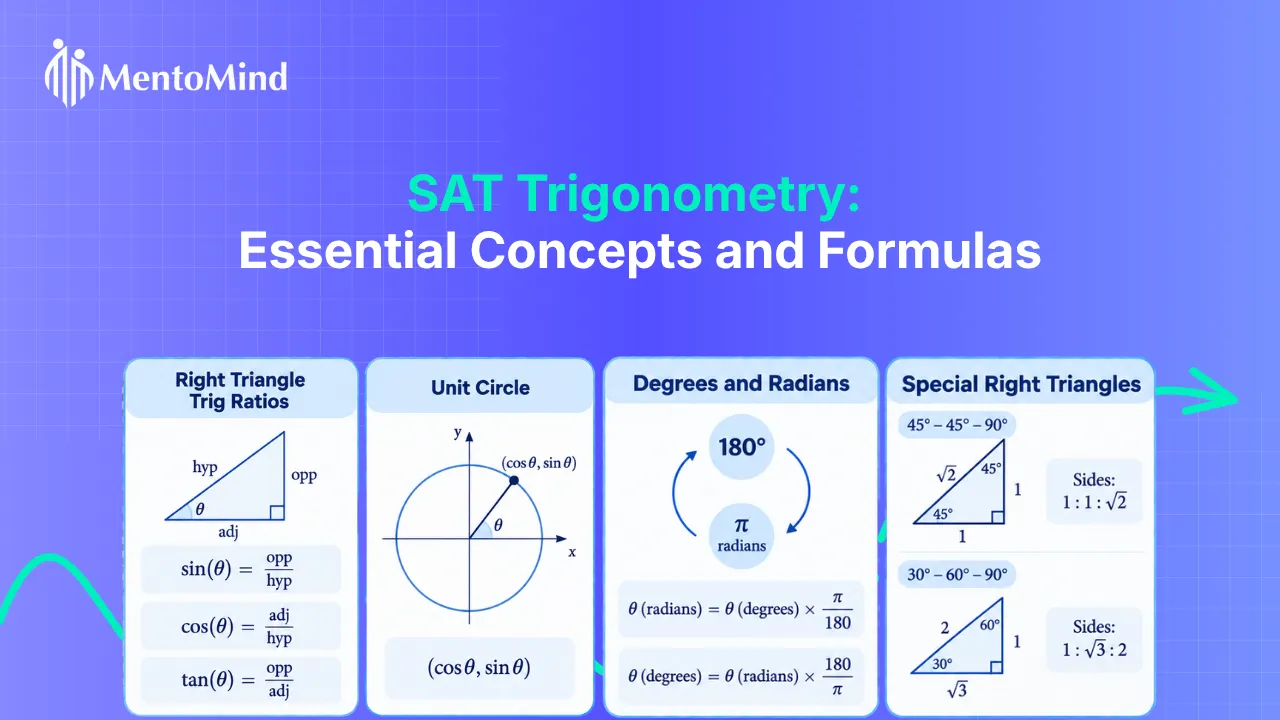
Almost every SAT trigonometry question begins with the three primary ratios. These ratios connect an angle in a right triangle to the lengths of two of its sides. The memory aid SOHCAHTOA keeps them straight.
| Ratio | Formula | Memory Aid |
|---|---|---|
Sine (sin) |
Opposite / Hypotenuse |
SOH |
Cosine (cos) |
Adjacent / Hypotenuse |
CAH |
Tangent (tan) |
Opposite / Adjacent |
TOA |
The three sides are named relative to the angle you use. The opposite side sits across from the angle. The adjacent side is next to the angle but is not the hypotenuse. The hypotenuse is always the longest side. It sits across from the 90-degree angle. Once you label these three sides, the right ratio is easy to pick.
The Pythagorean Theorem and Pythagorean Triples
The Pythagorean theorem is the backbone of right triangle problems. It states that the square of the hypotenuse equals the sum of the squares of the two legs:
a² + b² = c²
where a and b are the legs and c is the hypotenuse
You can save time by learning common Pythagorean triples. These are sets of whole numbers that fit the theorem. When you spot one, you can find a missing side with no arithmetic at all. Memorize the three sets below and their multiples.
| Pythagorean Triple | Example Multiple | How to Spot It |
|---|---|---|
3, 4, 5 |
6, 8, 10 |
Most common on the SAT |
5, 12, 13 |
10, 24, 26 |
Appears in medium questions |
8, 15, 17 |
16, 30, 34 |
Less frequent, still useful |
Special Right Triangles
Two special right triangles appear again and again on the SAT. Their sides follow fixed ratios. Once you know one side, you can solve for any other side. The digital SAT lists these ratios on its reference sheet. Still, knowing them from memory is much faster during the test.
| Triangle | Angles | Side Ratio | Key Rule |
|---|---|---|---|
45-45-90 |
45°, 45°, 90° |
x : x : x√2 |
Both legs equal; hypotenuse is a leg times √2 |
30-60-90 |
30°, 60°, 90° |
x : x√3 : 2x |
Short leg opposite 30°; hypotenuse is twice the short leg |
In the 45-45-90 triangle, both legs are equal. This is because the two non-right angles match. In the 30-60-90 triangle, the shortest side sits opposite the 30-degree angle. The hypotenuse is exactly twice that shortest side. Learn these two patterns well. They remove a lot of the math from geometry questions.
Complementary Angle Relationships
The SAT often tests the link between the sine and cosine of complementary angles. Two angles are complementary when they add up to ninety degrees. In a right triangle, the two non right angles are always complementary. This creates a useful shortcut.
| Relationship | What It Means |
|---|---|
sin(x) = cos(90° − x) |
The sine of an angle equals the cosine of its complement |
cos(x) = sin(90° − x) |
The cosine of an angle equals the sine of its complement |
This rule explains a common question type. A problem may give you sin(x) and then ask for cos of the complementary angle. The answer is the same value. Spot this pattern, and you can answer some questions at once. You do not even need to draw a triangle.
Degrees and Radians
The SAT sometimes asks you to convert between degrees and radians. You do not need deep unit circle knowledge. You only need the two conversion formulas and the common angle values. A full circle equals 360 degrees. This is the same as 2π radians.
| Conversion | Formula |
|---|---|
Degrees to radians |
Multiply the degree value by π / 180 |
Radians to degrees |
Multiply the radian value by 180 / π |
The angle values below cover almost every conversion the SAT will ask for. Keep them in mind so you can convert quickly instead of working the formula each time.
| Degrees | Radians |
|---|---|
30° |
π / 6 |
45° |
π / 4 |
60° |
π / 3 |
90° |
π / 2 |
Worked SAT Trigonometry Practice Problems
The fastest way to build confidence is to work through problems that match the SAT style. Below are three examples with complete solutions. Try each one before reading the answer.
Practice Problem 1: Finding a Missing Side
In a right triangle, one leg measures 6, and the hypotenuse measures 10. What is the length of the other leg?
Solution
Apply the Pythagorean theorem. Set up a² + 6² = 10², which gives a² + 36 = 100. Subtract to get a² = 64, so a = 8.
Shortcut: 6, 8, 10 is simply the 3, 4, 5 triple doubled. Recognizing it lets you skip the arithmetic entirely.
Practice Problem 2: Using a Special Triangle
A right triangle has one acute angle of 30 degrees and a hypotenuse of 12. What is the length of the side opposite the 30-degree angle?
Solution
This is a 30-60-90 triangle. The side opposite the 30 degree angle is the shortest side, and it equals half the hypotenuse. Half of 12 is 6, so the answer is 6.
Knowing the 30-60-90 ratio replaces several steps of trig calculation with one division.
Practice Problem 3: Applying a Ratio
In a right triangle, sin(A) = 3/5. What is the value of cos(A)?
Solution
Since sine equals opposite over hypotenuse, the opposite side is 3 and the hypotenuse is 5. Use the Pythagorean theorem to find the adjacent side: the square root of (25 minus 9) equals 4. Cosine equals adjacent over hypotenuse, so cos(A) = 4/5.
Any time you see a 3 and a 5 in a ratio, check for the 3, 4, 5 triangle before doing the full calculation.
Working through more examples like these is where scores improve. MentoMind offers a large bank of SAT Math practice with step-by-step video solutions. You can see how each trigonometry question is solved. You get the full method, not just a final answer.
Common Trigonometry Mistakes to Avoid
Most lost points in trigonometry come from small setup errors rather than a lack of knowledge. Watch for the mistakes below.
| Common Mistake | How to Avoid It |
|---|---|
Choosing the wrong ratio |
Label the opposite, adjacent, and hypotenuse before you write any formula |
Calculator in the wrong mode |
Confirm whether the question uses degrees or radians and set your calculator to match |
Misreading a special triangle |
Check the given angles before applying a 30-60-90 or 45-45-90 ratio |
Confusing sine with cosine |
Remember that sine uses the opposite side and cosine uses the adjacent side |
Skipping simplification |
Reduce your final answer, since the SAT often lists the simplified form |
SAT Trigonometry Formula Cheat Sheet
Use this section as a quick review before your test. Every formula the SAT expects you to know is gathered here in one place.
Core Ratios
sin = Opposite / Hypotenuse
cos = Adjacent / Hypotenuse
tan = Opposite / Adjacent
Triangles and Theorem
Pythagorean theorem: a² + b² = c²
45-45-90 ratio: x : x : x√2
30-60-90 ratio: x : x√3 : 2x
Common triples: (3, 4, 5), (5, 12, 13), (8, 15, 17)
Angle Rules
sin(x) = cos(90° − x)
Degrees to radians: multiply by π / 180
Radians to degrees: multiply by 180 / π
For the full set of provided formulas across every Math topic, review the complete digital SAT formula sheet. Pair that reference with focused practice. This is the surest way to raise your Math score.
How to Study SAT Trigonometry Efficiently
Trigonometry is a compact topic. A focused plan works better than long study sessions. The steps below build your skills in the right order.
- Master SOHCAHTOA first. These three ratios support almost every trigonometry question on the test.
- Memorize the two special triangles and the common Pythagorean triples so you can recognize them on sight.
- Practice with real SAT-style questions and review every mistake to find the pattern behind it.
- Time yourself. Trigonometry questions should take under a minute once the setup is clear.
A structured study path takes the guesswork out of this. MentoMind builds a personalized SAT prep learning path that targets your weak areas first. You spend your time where it lifts your score the most. You can also check your current level with a free SAT diagnostic test before you start.
Final Thoughts
SAT trigonometry rewards students who focus on a few high value rules. Learn the three core ratios. Commit the special triangles and Pythagorean triples to memory. Practice until the setup feels automatic. The topic is narrow. So a small amount of targeted work can turn trigonometry from a weak spot into steady points.
When you are ready to apply these concepts, explore the MentoMind digital SAT prep course. It blends adaptive practice, video solutions, and progress tracking. It helps you master every Math topic, including trigonometry, at your own pace.
Frequently Asked Questions
Trigonometry is part of the Geometry and Trigonometry domain, which makes up about 15% of the Math section. You can expect a small number of questions, usually involving right triangles, special triangles, or the Pythagorean theorem.
No. The SAT focuses on right triangle trigonometry. You may need to convert between degrees and radians, but deep unit circle knowledge and trigonometric graphs are not required to score well.
The digital SAT includes a reference sheet. It lists the special triangle ratios and several geometry formulas. Still, it helps to know the core ratios from memory. Searching the reference sheet during the test slows you down.
Practice with questions that match the real test. Then review each solution in full. Focused practice on the skills you find hard works faster than random problem sets. You can also review proven SAT math tips to sharpen your overall approach.