What Are Algebra and Functions on the ACT Math Test?
Watch this quick walkthrough to understand the core algebra and function concepts that appear most often on the ACT Math test.
What Algebra and Function Topics Are on the ACT Math Test?
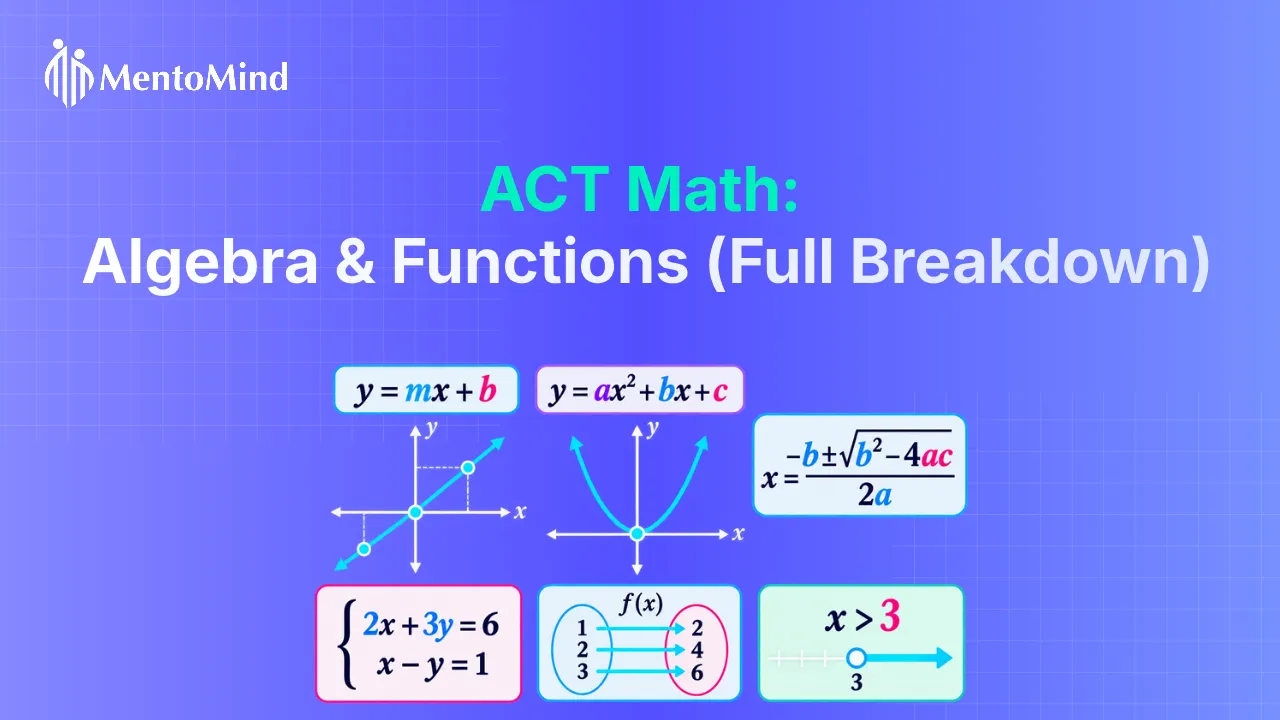
The ACT math section contains 45 questions answered in 50 minutes, and algebra plus functions account for roughly 35 to 40 percent of the total. The tested topics are linear equations, inequalities, absolute value equations, systems of equations, function evaluation, function composition, interpreting graphs, polynomials and factoring, and rational expressions.
| Feature | ACT Math |
|---|---|
Total questions |
45 questions |
Time allowed |
50 minutes |
Calculator |
Allowed throughout |
Algebra and functions share |
Roughly 35 to 40 percent |
Compared to SAT |
More breadth, less depth per item |
ACT Math Algebra and Functions Formula Sheet
The ACT does not hand you a formula sheet on test day, which means the ACT math formulas below need to live in memory before you sit down.
| Topic | Formula | When to use it |
|---|---|---|
Slope |
m = (y₂ − y₁) / (x₂ − x₁) |
Any two points on a line |
Slope-intercept |
y = mx + b |
Graphing or identifying slope and y-intercept |
Standard form |
Ax + By = C |
Systems of equations, finding intercepts |
Quadratic formula |
x = (-b ± √(b² – 4ac)) / 2a |
Solving ax² + bx + c = 0 when factoring fails |
Midpoint |
M = ((x₁ + x₂)/2, (y₁ + y₂)/2) |
Finding the center point between two coordinates |
Distance |
d = √((x2-x1)² + (y2-y1)²) |
Length between two points |
Diff. of squares |
a² – b² = (a+b)(a-b) |
Fast factoring when two perfect squares subtract |
Perfect sq. trin. |
a² + 2ab + b² = (a+b)² |
Recognising and factoring perfect square trinomials |
Exponent product |
xᵃ × xᵇ = xᵃ⁺ᵇ |
Multiplying same-base exponents |
Exponent quotient |
xᵃ / xᵇ = xᵃ⁻ᵇ |
Dividing same-base exponents |
Power rule |
(xᵃ)ᵇ = xᵃᵇ |
Raising a power to another power |
Zero exponent |
x⁰ = 1 (x ≠ 0) |
Any non-zero base raised to zero equals 1 |
Linear Equations, Inequalities, and Absolute Value
1. Linear equations
The goal is always the same: isolate the variable by performing equal operations on both sides.
General process – Distribute parentheses first. Combine like terms on each side. Move variable terms to one side and constants to the other. Divide by the coefficient.
Example- Solve 5(2x – 3) = 3x + 12
Distribute: 10x – 15 = 3x + 12
Subtract 3x from both sides: 7x – 15 = 12
Add 15 – 7x = 27
Divide by – x = 27/7
ACT tip – If your answer does not match a choice, check whether the test wants an exact fraction or a decimal approximation. Both forms appear depending on the question.
Inequalities
Inequalities follow the same rules as equations with one critical difference. When you multiply or divide both sides by a negative number, you must flip the inequality sign.
Example: Solve -4x + 8 > 20
Subtract 8: -4x > 12
Divide by -4 and flip the sign: x < -3
ACT trap – The answer choices often include -3 as a boundary value as well as x < -3 and x > -3. Without the flip, you choose the wrong direction every time.
2. Absolute Value Equations
Absolute value equations create two cases: one positive and one negative.
Example: Solve |3x – 6| = 9
Case 1: 3x – 6 = 9 so 3x = 15 so x = 5
Case 2: 3x – 6 = -9 so 3x = -3 so x = -1
Both x = 5 and x = -1 are solutions. Always check both in the original equation.
3. Systems of Equations
The two methods are substitution (fastest when a variable is already isolated) and elimination (fastest when coefficients line up for cancellation).
- Substitution signal: one equation starts with y = or x =
- Elimination signal: both equations are in standard form with matching or scalable coefficients
Functions: Evaluating, Composing, and Reading Graphs
1. Evaluating functions
Function evaluation questions ask you to find f(a) by substituting a number directly into the function definition.
Example: If f(x) = 3x² – 2x + 1, find f(-2)
Substitute: 3(-2)² – 2(-2) + 1 = 3(4) + 4 + 1 = 12 + 4 + 1 = 17
Tip- Place parentheses around the substituted value before simplifying. Without them, sign errors on squared negatives are almost guaranteed.
2. Composing functions
Composite functions ask you to feed the output of one function into another. The notation f(g(x)) means evaluate g(x) first, then use that result as the input to f.
Example- If f(x) = 2x + 3 and g(x) = x² – 1, find f(g(3))
Start inside- g(3) = 3² – 1 = 9 – 1 = 8
Now apply f- f(8) = 2(8) + 3 = 16 + 3 = 19
ACT trap- Many students reverse the order and compute f(3) first. Always work from the inside out with composition problems.
3. Interpreting Functions From Graphs
The most common question types are finding f(a) from a graph and identifying which x-value produces a given output.
- Zeros are the x-values where the graph crosses the x-axis (where f(x) = 0).
- The domain is the set of all x-values the graph covers left to right.
- The range is the set of all y-values the graph reaches bottom to top.
- A vertical shift moves the entire graph up or down. A horizontal shift moves it left or right.
Polynomials and Factoring
The key operations to know are multiplying polynomials, factoring trinomials, factoring by grouping, and applying special product formulas.
Key Factoring Patterns
Difference of squares: a² – b² = (a + b)(a – b)
Perfect square trinomial: a² + 2ab + b² = (a + b)²
Standard trinomial: x² + bx + c find two numbers that multiply to c and add to b
Example- Factor x² – 7x + 12
Find two numbers that multiply to 12 and add to -7. Those numbers are -3 and -4.
Factored form: (x – 3)(x – 4)
So x = 3 and x = 4 are the solutions.
ACT tip- The ACT often presents a factored expression and asks for the sum or product of the roots. Once factored, the roots are visible directly — no quadratic formula needed.
Rational Expressions: Simplifying and Solving
Rational expressions are fractions with polynomials in the numerator and denominator. The ACT math section tests simplifying these expressions and solving rational equations.
Simplifying Rational Expressions
The process mirrors simplifying numeric fractions: factor the numerator and denominator completely, then cancel any shared factors.
Example: Simplify (x² – 9) / (x² – x – 6)
Factor numerator: (x + 3)(x – 3)
Factor denominator: (x – 3)(x + 2)
Cancel (x – 3): result is (x + 3) / (x + 2), valid for x ≠ 3 and x ≠ -2
Critical rule- The value you cancel (here x = 3) is still excluded from the domain even after cancellation. The ACT tests this directly.
Solving Rational Equations
Multiply both sides by the common denominator to clear all fractions, solve the resulting equation, then check that your solution does not make any denominator equal to zero.
Example- Solve 3/(x – 2) = 6/(x + 1)
Cross-multiply- 3(x + 1) = 6(x – 2)
Distribute- 3x + 3 = 6x – 12
Solve- 3x = 15, so x = 5
Check- x = 5 does not make either denominator zero. Valid.
ACT vs SAT: The Real Difference for Algebra
Both tests cover ACT math formulas and algebra, but the approach is very different.
- ACT math breadth: The ACT tests more topic areas per test. You might see one absolute value question, one rational equation, two polynomial questions, and two function composition questions all in the same 50-minute section.
- SAT math depth: The SAT tends to give fewer unique topics but pushes harder on each one. A single SAT algebra problem might require three steps and a non-obvious setup.
- Calculator access: The ACT allows a calculator for the entire math section. The SAT has a no-calculator portion. This matters for how you handle messy arithmetic.
- Time pressure: The ACT gives you 60 seconds per question on average. The SAT gives slightly more per question. ACT preparation should include heavy timed practice.
Common ACT Algebra Traps
Knowing them before test day is worth several points.
Forgetting to Flip the Inequality Sign
The single most common inequality mistake: dividing or multiplying by a negative number without flipping. Write the word FLIP next to any step where you divide or multiply by a negative, and check it before moving on.
Only Finding One Absolute Value Solution
Absolute value equations always produce two cases. Students who solve only the positive case miss the second solution, which is often one of the answer choices used as a trap.
Reversing Function Composition Order
f(g(x)) means g runs first. Many students compute f(x) first and then apply g, which gives the wrong answer every time. Always read composite notation from the inside out.
Cancelling Terms Instead of Factors in Rational Expressions
(x² + 4) / (x + 2) cannot be simplified to (x + 2) because x² + 4 does not factor as (x + 2)(x + 2). Only factors cancel, never individual terms.
Missing Extraneous Solutions in Rational Equations
After solving a rational equation, always substitute your answer back into the original. If it makes any denominator equal to zero, that solution is extraneous and must be rejected.
ACT Math Practice Questions With Video Solutions
Question 1
Let f(x) = x² + 2x – 8 and g(x) = x + 4. The function h(x) is defined as h(x) = f(x) / g(x) for all x where g(x) ≠ 0. If p(x) = h(x – 1) + 3, what is the value of p(0)?
A. 0 B. 1 C. 2 D. 5
Solution
Simplify h(x) first: Factor f(x) = x² + 2x – 8 = (x + 4)(x – 2)
h(x) = (x + 4)(x – 2) / (x + 4) = x – 2 for x ≠ -4
Now find h(x – 1): Replace x with (x – 1) in h(x) = x – 2
h(x – 1) = (x – 1) – 2 = x – 3
Build p(x): p(x) = h(x – 1) + 3 = (x – 3) + 3 = x
Evaluate at x = 0: p(0) = 0
Answer: A) 0
Key rule – Always simplify rational expressions before composing or substituting. Cancelling shared factors first makes the arithmetic far cleaner and prevents errors at the substitution step.
Why the other choices are wrong
B (1) and C (2) come from substituting x = 0 into unsimplified intermediate steps. D (5) comes from forgetting to subtract the shift and adding instead. Simplifying h(x) to x – 2 first is the key move that unlocks the whole problem.
Think10x.ai Video Explaining Function Composition and Function Evaluation
Question 2
The quadratic function f is defined by f(x) = x² – 6x + 11 and g is a linear function defined by g(x) = mx + 2. If the graphs of f and g are tangent to each other in the xy-plane, which of the following is a possible value of m?
A. 6 B. -6 C. -12 D. 2
Solution
Set the equations equal to find the intersection:
x² – 6x + 11 = mx + 2
Move all terms to one side
x² – (6 + m)x + 9 = 0
Set the discriminant (b² – 4ac) to 0 for exactly one tangent intersection point
(-(6 + m))² – 4(1)(9) = 0
(6 + m)² – 36 = 0
(6 + m)² = 36
Solve for m
6 + m = 6 → m = 0
6 + m = -6 → m = -12
Final Answer – C
Key rule – When a line is tangent to a quadratic curve, setting their equations equal results in a quadratic system with exactly one solution. This requires the discriminant, b² – 4ac, to equal exactly zero.
Why the other choices are wrong
A is a trap for misinterpreting the square root step, where a student might mistakenly solve 6 + m = 12. B incorrectly assumes the x-coefficient term must be zeroed out completely. D represents a sign or factoring error when solving the quadratic expression for the parameter m.
Think10x.ai Video Explaining How to Find the Slope of a Tangent Line to a Parabola
Frequently Asked Questions
The ACT Math section covers linear equations, inequalities, absolute value equations, systems of equations, functions, graph interpretation, polynomials, factoring, and rational expressions. These topics make up roughly 35–40% of the test.
Out of 45 math questions, about 15–18 are based on algebra and functions. Most tests include multiple linear equations, function questions, and polynomial or rational expression problems.
The ACT tests more algebra topics in a single section, while the SAT focuses on fewer but deeper multi-step problems. ACT Math also has heavier time pressure.
You should memorize the slope formula, slope-intercept form, quadratic formula, midpoint formula, distance formula, exponent rules, and common factoring patterns. The ACT does not provide a formula sheet.
Flip the inequality sign whenever you multiply or divide both sides by a negative number. After solving, test a value from your solution set to confirm the direction is correct.
Rational expressions combine factoring with fraction rules. Always factor the numerator and denominator first, cancel shared factors, and check for restricted domain values afterward.
Want a Step-by-Step Video Explanation For Your Own ACT Math Question?
The video explanations above were created using Think10x.ai.
Upload a clear photo of any math problem, including probability, algebra, geometry, or calculus, and our tool will turn it into a narrated, animated explanation in minutes.
👉 Try it at Think10x.ai