Want to estimate your SAT score based on your PSAT results? This guide gives you a full PSAT to SAT conversion chart, explains how accurate the conversion is, and walks you through a preparation strategy to help you close the gap between your PSAT score and your SAT target.
What is the PSAT and How Does It Relate to the SAT?
The PSAT, or Preliminary SAT, is a standardized test administered to high school students by the College Board. It assesses the same core skills as the SAT, including Reading and Writing, and Math, but it is designed to test foundational knowledge rather than the more advanced topics covered on the SAT.
While the SAT is primarily used for college admissions, the PSAT serves two distinct purposes. It acts as a practice test that gives students a realistic preview of what the SAT will feel like, and it also serves as the qualifying exam for the National Merit Scholarship Program. Colleges do not see your PSAT score and it does not affect admissions directly, but a strong performance can open the door to significant scholarship opportunities.
A few key differences between the two tests are worth knowing before you start preparing:
- The PSAT is typically administered in October during school-based testing windows, while the SAT is offered several times throughout the year.
- The PSAT has two sections: Reading and Writing, and Math.
- Neither the PSAT nor the SAT includes an essay.
- The PSAT covers more foundational skills and concepts, while the SAT includes more advanced topics.
- Both tests are developed by the College Board and share the same vertical score scale, which is what makes conversion between the two meaningful.
For students aiming for the National Merit Scholarship, it is important to know that you must take the PSAT/NMSQT during 11th grade to be considered. Selection as a finalist is based on additional criteria beyond your score, including academic records, extracurricular activities, and essays.
PSAT to SAT Score Conversion
Use this score convertor to estimate your SAT score based on your PSAT score:
Enter your PSAT score
Your PSAT score
Oops! Please enter a value in the range of 400 to 1520.
SAT composite equivalent
How Accurate Is PSAT to SAT Score Conversion?
PSAT scores are highly predictive of SAT performance, but they are not an exact match. Several factors affect how closely your SAT score mirrors your PSAT result.
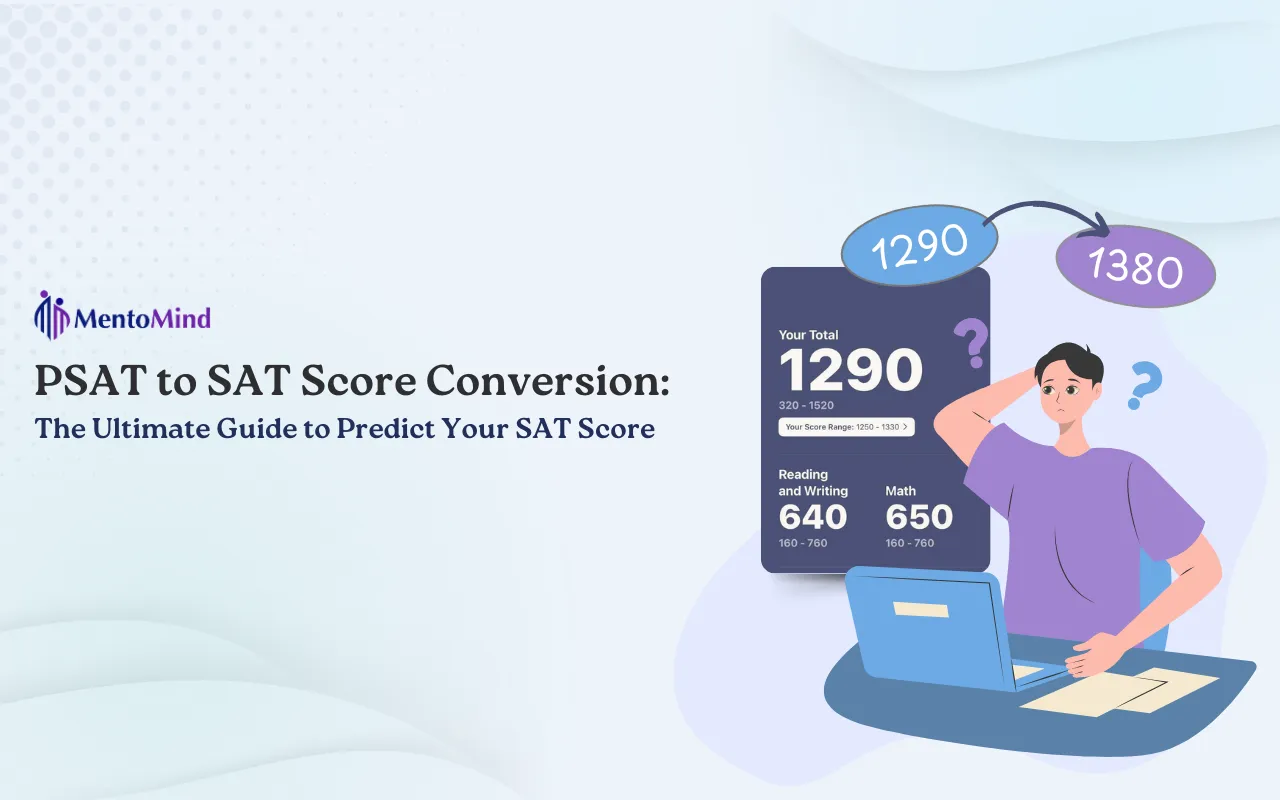
The PSAT is slightly easier than the SAT, so direct comparisons are imperfect by design. To maintain a similar percentile on the SAT, students often need to score higher than their PSAT result. A commonly cited estimate is adding around 100 to 150 points, although there is no official PSAT to SAT conversion formula.
Without any preparation, many students see modest improvements between tests simply due to continued learning and familiarity with the exam. With dedicated SAT preparation, many students improve by 50 to 100 points or more, and focused study can push that improvement even further.
How to Improve Your SAT Score After Taking the PSAT
Your PSAT score is a starting point, not a ceiling. The steps below outline a preparation strategy to help you improve your SAT score.
Step 1. Analyze Your PSAT Score Report
Your PSAT score report breaks down your performance by section and question type. Review it carefully to identify which areas cost you the most points. Look specifically at your weakest content areas within Reading and Writing, and Math. This analysis helps you focus your study plan on the topics that will deliver the biggest score improvement.
Step 2. Build a Structured Study Plan
A structured study plan spread over several months will serve you far better than cramming in the final weeks. A general timeline many students follow:
- 3 to 6 months before the SAT: Take full-length practice tests regularly and review every mistake carefully to understand why the error occurred.
- 1 to 2 months before the test: Shift to targeted practice on your weakest areas, such as linear equations, systems of equations, grammar rules, and evidence-based reading questions.
- Final weeks: Practice under realistic test conditions, including timed sections and minimal distractions.
Step 3. Use the Right Resources
Several free and paid resources can support your preparation at every stage:
- Official Digital SAT practice tests available in the Bluebook app
- Khan Academy personalized SAT practice linked to PSAT scores
- Additional adaptive practice platforms such as MentoMind, which offer full-length Digital SAT practice tests that mirror the real exam format
Step 4. Consider Working With a Tutor
Working with an experienced tutor can help refine your strategy, identify weak areas more quickly, and keep your preparation on track.
Step 5. Take the SAT When You Are Ready
Many students aim to improve around 100 points or more from their PSAT score before sitting the SAT. If your first SAT result is not where you want it to be, a retake is a common strategy. Students often improve on their second attempt after reviewing mistakes and focusing on weaker areas.
Final Thoughts
Your PSAT score provides a realistic starting point for SAT preparation. By using a PSAT to SAT conversion chart to set a target, analysing your score report carefully, and following a structured preparation plan, you give yourself the best possible chance of achieving your SAT goal.
The gap between your PSAT score and your SAT target can be closed. Students who close that gap most effectively are the ones who start early, prepare consistently, and treat every practice test as a learning opportunity rather than just a score check.
Frequently Asked Questions
Without preparation, many students see modest improvements simply from continued learning and familiarity with the exam. With dedicated preparation, many students improve by 50 to 100 points or more, and focused study can lead to even larger gains.
No. Colleges do not see your PSAT score, and it does not affect college admissions. However, a high PSAT score in 11th grade can qualify you for the National Merit Scholarship Program, which carries significant financial and academic recognition.
A common estimate is to add around 100 to 150 points to your PSAT score to predict a possible SAT score. This estimate works because both exams use a similar vertical scoring scale, although there is no official PSAT to SAT conversion formula
A PSAT score around 1300 to 1320 often corresponds to an SAT score near 1400, depending on the test form and percentile differences between the exams.
The PSAT score range is 320 to 1520, while the SAT ranges from 400 to 1600. The lower ceiling exists because the PSAT is designed as a practice and qualifying test, not a full college admissions exam.
You must take the PSAT/NMSQT during the fall of your 11th grade year to be eligible for the National Merit Scholarship Program. Taking it earlier in 9th or 10th grade is useful practice but does not count for scholarship qualification.