
“Can I retake the SAT or ACT?” It’s one of the most common questions students ask after getting their scores back. Retaking a standardized test costs time, money, and mental energy, so making the wrong call can hurt more than help.
The short answer is yes, you can retake the Digital SAT test or the ACT test. But that depends on specific factors like:
- Your target schools
- How close you are to your goal score
- Whether you have time to prepare properly
This guide gives you a clear, no-fluff framework to make the right call.
SAT vs ACT Retake: Quick Comparison
| SAT | ACT | |
|---|---|---|
Test Style |
Reasong and evidence-based |
Content and speed-based |
Pace |
Slower, fewer questions |
Faster, more questions |
Retake Limit |
No official limit |
No official limit |
Average Improvement |
40 points (1600 scale) |
1-2 points (36 scale) |
Superscoring |
Widely accepted |
Increasingly common |
Exam Fee |
$68 |
$68 (without writing) |
What is Your Target SAT or ACT Score?
Long before deciding whether to retake the SAT or ACT, you should have a clear target score in mind. That target should be based entirely on the colleges and programs you plan to apply to, not on what sounds impressive or what others tell you is “good.”
The most reliable way to set this score is by researching each school’s middle 50% SAT or ACT range, which represents the 25th to 75th percentile of admitted students. Aiming toward the upper half of that range helps you stay competitive without overinvesting time in diminishing returns.
Without a defined target, it’s easy to study inefficiently. You may aim too low and miss opportunities, or aim unrealistically high and waste time chasing gains that won’t meaningfully change your admissions outcomes.
If you are unsure how competitive your current score is, you may find it helpful to see how it compares nationally, such as whether Is 1200 a Good SAT Score or Is 1300 a Good SAT Score for college admissions.
4 Clear Signs You Should Retake the SAT or ACT Test
1. You scored well below your practice test average
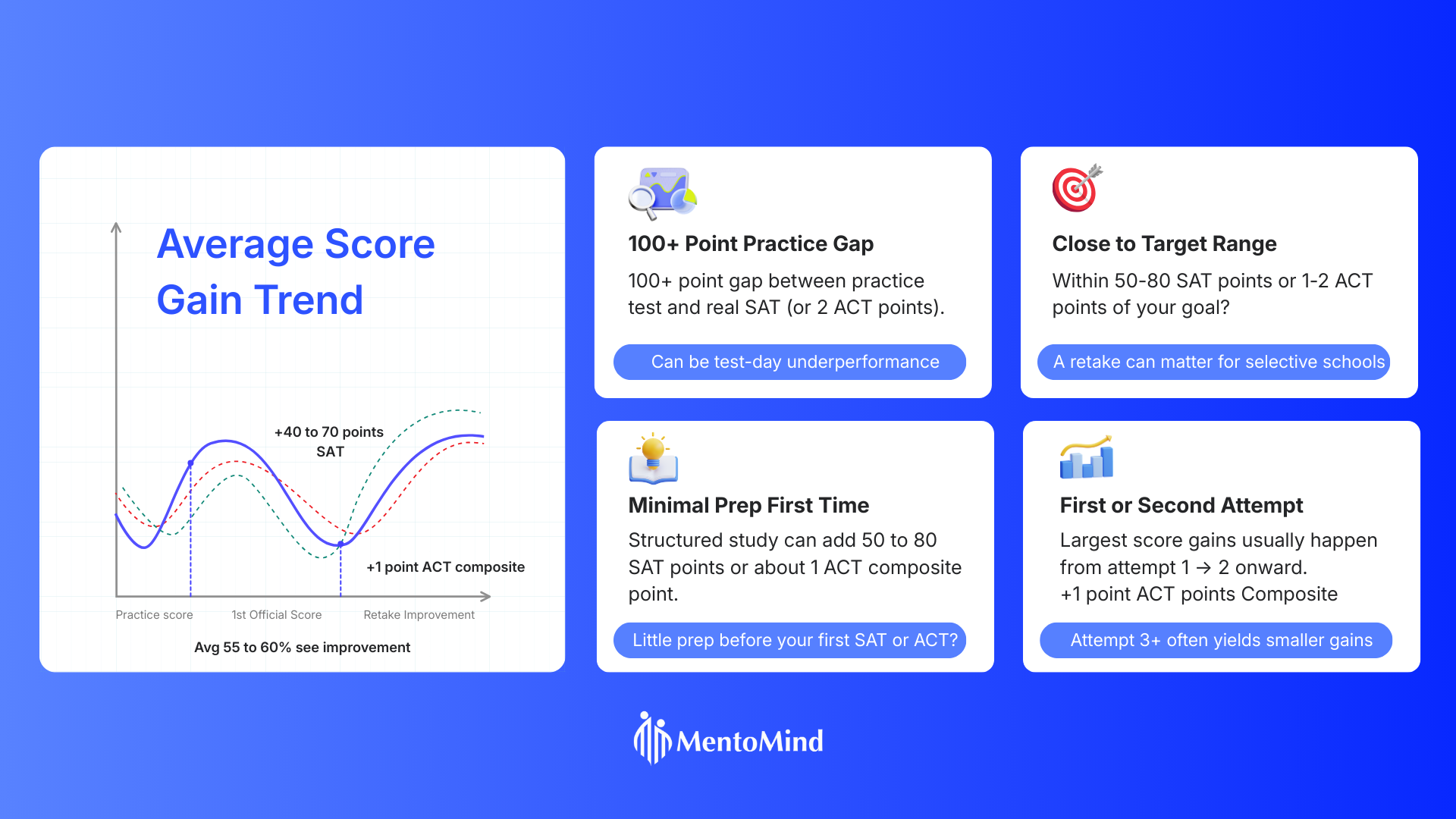
If your actual SAT score came in about 100 points below your consistent practice range, that gap may be recoverable. College Board research shows normal score variation on retakes is typically modest, so large score drops often reflect test-day factors rather than true ability.
2. You’re close, but not quite there
Within 50 to 80 points on the SAT or 1 to 2 composite points on the ACT of your target? That range aligns with typical retake gains. College Board data shows average SAT increases of 40 to 70 points, and ACT reports an average gain of about 1 composite point.
3. You barely prepared the first time
If you prepared minimally the first time, there is meaningful room for improvement. Students who adjust their study approach between attempts often see better results than those who retake the test without a structured plan.
4. This is your first or second attempt
The largest score increases typically occur between the first and second attempts. Gains after a third attempt tend to be smaller, which means if you have only tested once, improvement potential is still realistic with focused preparation.
4 Signs You Should NOT Retake the SAT or ACT
1. You scored 1530 or higher on the SAT or 34 or higher on the ACT
At this level, you are among the top 1-2 percent of test-takers. Further time spent on test preparation is usually better invested in strengthening your essays, extracurricular activities, or academic performance.
2. You have already taken the test three or more times
Score gains tend to diminish after the third attempt. Additional retakes often produce smaller improvements and may offer limited value compared to other parts of your application.
3. You do not have time to prepare meaningfully
Retaking a test without focused preparation rarely leads to meaningful score increases. If you cannot commit sufficient study time before the next test date, a retake is unlikely to be worthwhile.
4. Other parts of your application need more attention
In many cases, a modest score increase matters less than a stronger personal essay, deeper leadership involvement, or improved grades during the academic year.
Before You Retake the SAT or ACT, Ask These 3 Questions
1. Why did I score lower than expected on the SAT or ACT?
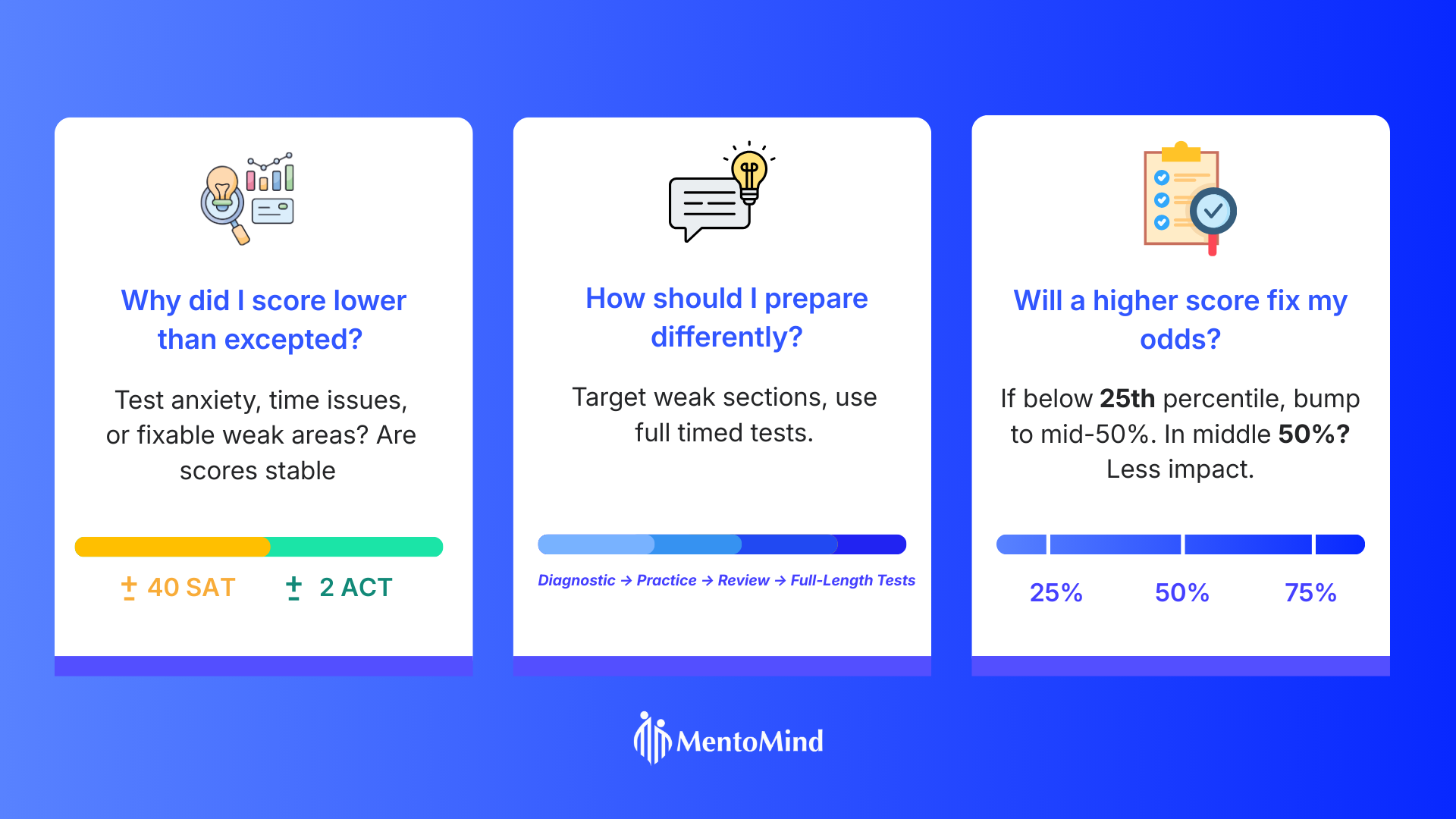
Before retaking, identify what held you back. Test anxiety, poor time management, or weak content areas are often fixable with targeted preparation. If your scores are consistent across multiple official tests, further improvement may be more limited.
2. How should I prepare to retake the SAT or ACT?
An effective prep plan focuses on weak sections, full-length timed practice tests, and tracking measurable progress. Retesting studies consistently show that the largest gains occur between the first and second attempts, especially when students change their preparation strategy rather than simply repeating the test.
3. Will a higher SAT or ACT score improve my chances of admission?
That depends on where your score falls relative to your target schools. Colleges publish score ranges using the 25th to 75th percentile band in their Common Data Set. Moving from below the 25th percentile into the middle 50 percent can meaningfully strengthen your academic profile, while smaller gains within that range often have less impact.
Final Thoughts
Retaking the SAT or ACT makes sense when you underperformed relative to your potential, are close to your target score, and have the time and plan to prepare effectively. When those conditions are not in place, your effort is often better directed toward other parts of your college application.
There is no universal right answer, but this framework should help you make an informed decision based on your goals and circumstances.
Frequently Asked Questions
The average SAT score improvement on a retake is 40 points. Retaking without a structured study plan rarely produces meaningful improvement.
Yes, you can retake the SAT with no official limit set by the College Board. The biggest gains happen between the first and second attempt, with returns diminishing significantly after that.
Retaking the ACT may be worthwhile if your score does not reflect your true ability or if you are close to your target score. Many students see about a one-point improvement on a second attempt, which can meaningfully impact admissions decisions and scholarship eligibility. A retake is especially reasonable if test-day issues, limited preparation, or anxiety affect your performance and you have time to prepare more effectively.
Yes, you can retake the ACT test with no official limit from ACT. Score gains are largest between the first and second attempt, and repeated retakes without improvement can raise flags with admissions officers.
If you’ve plateaued on the SAT after two attempts, switching to the ACT is worth considering. The two tests have different formats. The ACT is more content-based, the SAT more reasoning-focused. Take a full practice ACT first and compare your scores before deciding.
The SAT costs approximately $68. The ACT costs approximately $68 (or $93 with the writing section). Both offer fee waivers for eligible students.
No. Both the SAT and ACT require you to retake the full test. You cannot retake just one section. However, many colleges will superscore across attempts, effectively using your best section scores even if they came from different test dates.