Quick Answer:
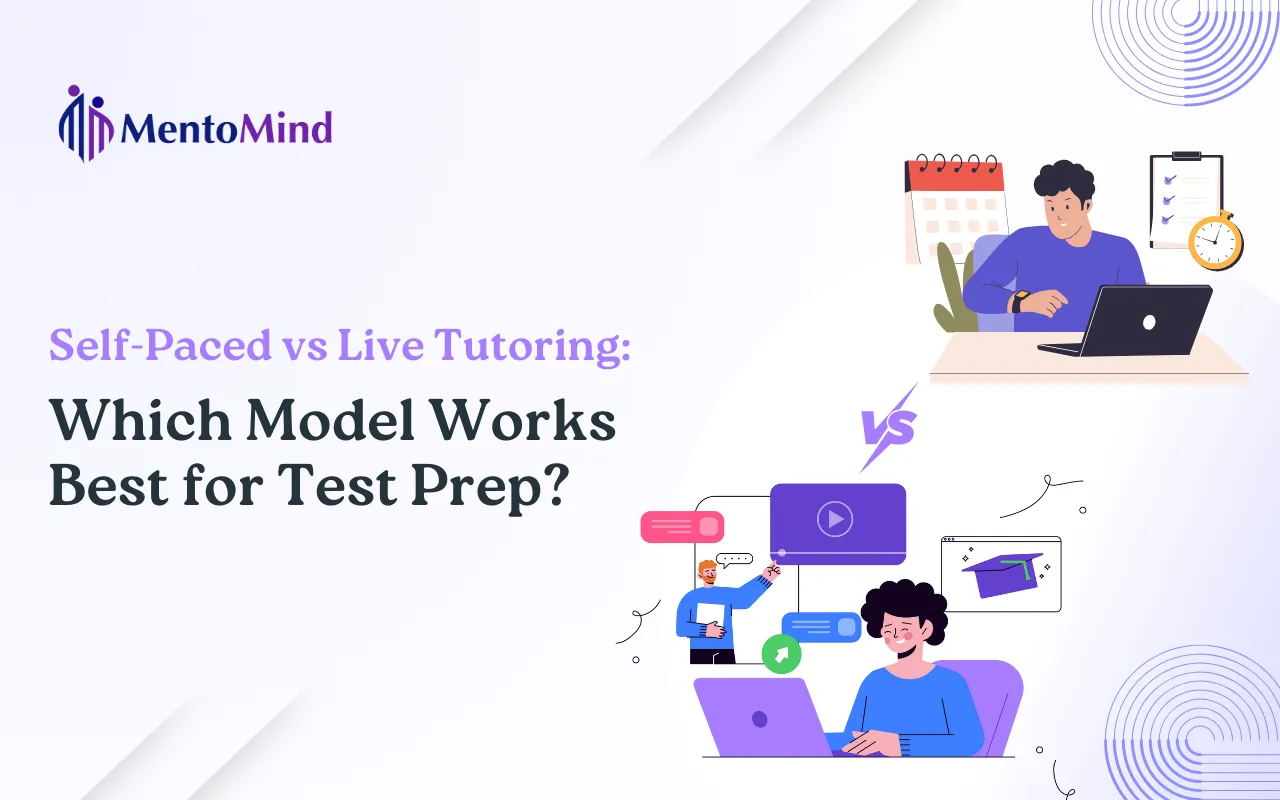
Self-Paced vs Live Tutoring is a foundational choice in test prep.
- Self-Paced programs provide scalable practice, diagnostics, and progress tracking.
- Live Tutoring delivers personalized instruction and strategy.
The most effective test prep outcomes come from a structured hybrid model that combines both.
The Real Question Tutors Should Ask
Most tutors frame this as an either-or decision. That framing misses the real opportunity.
The better question is this: How can self-paced prep help me reach students who would never book live sessions, while freeing my time for the students who truly need direct instruction?
Self-paced and live tutoring solve different problems. When you understand what each does best, you can build a hybrid test prep program that expands your reach, protects your time, and serves both types of learners effectively.
What the Research Actually Shows?
Before diving into practical recommendations, it helps to ground this discussion in what research reveals about how and why students complete or disengage from online learning programs.
- On completion rates: Self-paced online courses (MOOCs) typically see completion rates between 3-15%, according to research from MIT and Harvard. Cohort-based programs with live elements and peer interaction see dramatically higher completion, often 70-96% (Learnopoly).
- On social interaction: A widely-cited study by Muilenburg and Berge (2005) in Distance Education found that lack of social interaction was the single greatest perceived barrier to online learning success.
- Important caveat: Most of this research comes from MOOCs, corporate training, and higher education, not test prep specifically. Test prep differs in key ways: students have fixed deadlines (test dates), high stakes (college admission), often parental oversight, and typically pay meaningful amounts. These factors likely improve completion rates compared to free or low-stakes online courses.
In the context of Self-Paced vs Live Tutoring, the research points to a clear principle for test prep: programs that combine self-paced content with human interaction and accountability consistently outperform purely self-paced models.
What Self-Paced Test Prep Does Well?
Self-paced test prep is most effective for scalable content delivery, high-volume practice, flexible scheduling, and data-driven skill tracking.
- Content mastery at scale: Students learning algebra rules, grammar conventions, or reading strategies don’t need a tutor present. They need practice problems, clear explanations, and immediate feedback. A well-designed self-paced program delivers this without consuming your hours.
- Flexible scheduling: Freshmen, sophomores, and students with packed extracurricular schedules often can’t commit to weekly tutoring. Self-paced prep lets them study at 11 PM after practice or in 20-minute sessions between activities.
- Data collection: Automated practice generates performance data you can’t get from live sessions alone. You see exactly which question types cause problems, how long students spend per question, and whether they’re completing work.
- Lower barrier to entry: Families hesitant to invest $100+ per hour in tutoring will try a $25-50/month self-paced program. This creates a pipeline of engaged students who may convert to live tutoring later.
Self-paced test prep scales instruction efficiently while preserving tutor time for higher-impact teaching.
What Self-Paced Prep Struggles With?
Self-paced test prep is limited when it comes to real-time correction, sustained accountability, and diagnosing the underlying causes of student errors.
- No real-time intervention: When a student misreads a question stem or uses an inefficient approach, self-paced software simply marks the answer wrong and moves on. It cannot step in to correct thinking at the moment.
- Accountability gaps: Students who lack strong self-discipline may disengage from self-paced programs without external deadlines, check-ins, or human follow-up.
- Limited diagnosis: A student missing inference questions may be struggling with comprehension, time management, or test anxiety. Self-paced systems register the wrong answer but cannot identify the root cause.
What Live Tutoring Does Well?
Live tutoring delivers what automation cannot: human judgment, real-time adaptation, and personal connection.
- Immediate intervention: You observe a student’s thinking in real time and catch errors as they happen, correcting inefficient or incorrect approaches before they become habits.
- Strategy customization: Different students require different strategies. One benefits from skipping difficult questions early, while another needs to slow down and read more carefully. Live tutoring allows you to tailor instruction to individual tendencies.
- Accountability and motivation: Scheduled sessions create external structure, and consistent encouragement helps students persist through challenging material.
What Live Tutoring Struggles With?
Live tutoring is constrained by time, cost, and scalability.
- Time ceiling: Your availability is finite. At $100 per hour with 25 weekly sessions, revenue caps at $2,500 per week unless you raise rates or hire additional tutors.
- Inefficient for content delivery: Using live session time to lecture on foundational rules, such as comma usage, underutilizes your expertise. Students can learn this content independently.
- High cost barrier: Many families cannot afford $100-$200 per hour tutoring. Live-only models exclude a large segment of potential students.
Why Hybrid Programs Make Sense?
In the Self-Paced vs Live Tutoring debate, hybrid test prep programs work best because they combine the scalability of self-paced learning with the accountability, diagnosis, and strategic guidance of live instruction.
- Self-paced handles foundations: Content review, vocabulary building, and skill-based practice are completed independently. The platform tracks performance, highlights weak areas, and prepares clear data for intervention.
- Live sessions handle strategy: Tutors diagnose root causes, teach test-taking approaches, and coach students through difficult material. Reviewing practice data before sessions ensures time is spent exactly where it matters most.
- Stronger engagement and outcomes: Research on cohort-based and blended learning shows that combining human accountability with independent practice improves completion and engagement while preserving the efficiency and accessibility of self-paced prep.
How to Structure a Hybrid Program?
A hybrid program works best when diagnostics, self-paced practice, and live instruction are sequenced intentionally over time.
Phase 1: Diagnostic (Week 1)
New students complete a diagnostic assessment to establish a baseline and identify priority skill gaps.
Phase 2: Foundation Building (Weeks 2-8)
Students work through self-paced content focused on weak areas. The platform assigns targeted practice, tracks progress, and flags recurring struggles.
Phase 3: Strategy Sessions (Weeks 4-12)
You schedule live sessions focused on test-taking strategy and addressing persistent problem areas the data reveals.
Phase 4: Practice Tests and Refinement (Weeks 10-16)
Students take full practice tests. You review results in live sessions and adjust strategy.
Revenue Implications
Hybrid programs improve tutor revenue by adding recurring income, expanding the addressable market, and creating a reliable pipeline for higher-value services.
- Recurring revenue: Self-paced subscriptions generate monthly income without consuming your hours. Even modest pricing of $30-$100 per month compounds quickly across dozens of students.
- Expanded market: Hybrid models attract students who would never pay live tutoring rates. Some remain self-paced only, while others upgrade to live sessions after seeing measurable progress.
- Pipeline development: Ongoing engagement with self-paced content builds trust over time, making students natural candidates for intensive live tutoring as deadlines approach.
MentoMind for Hybrid Test Prep
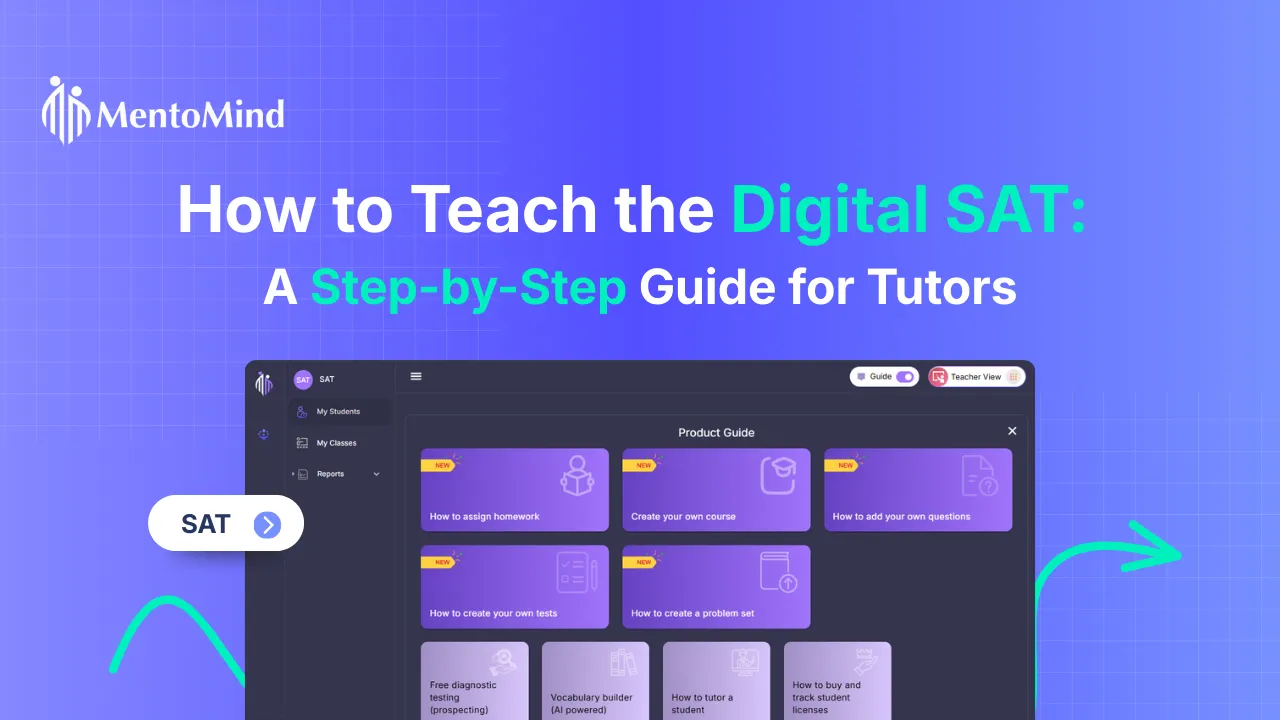
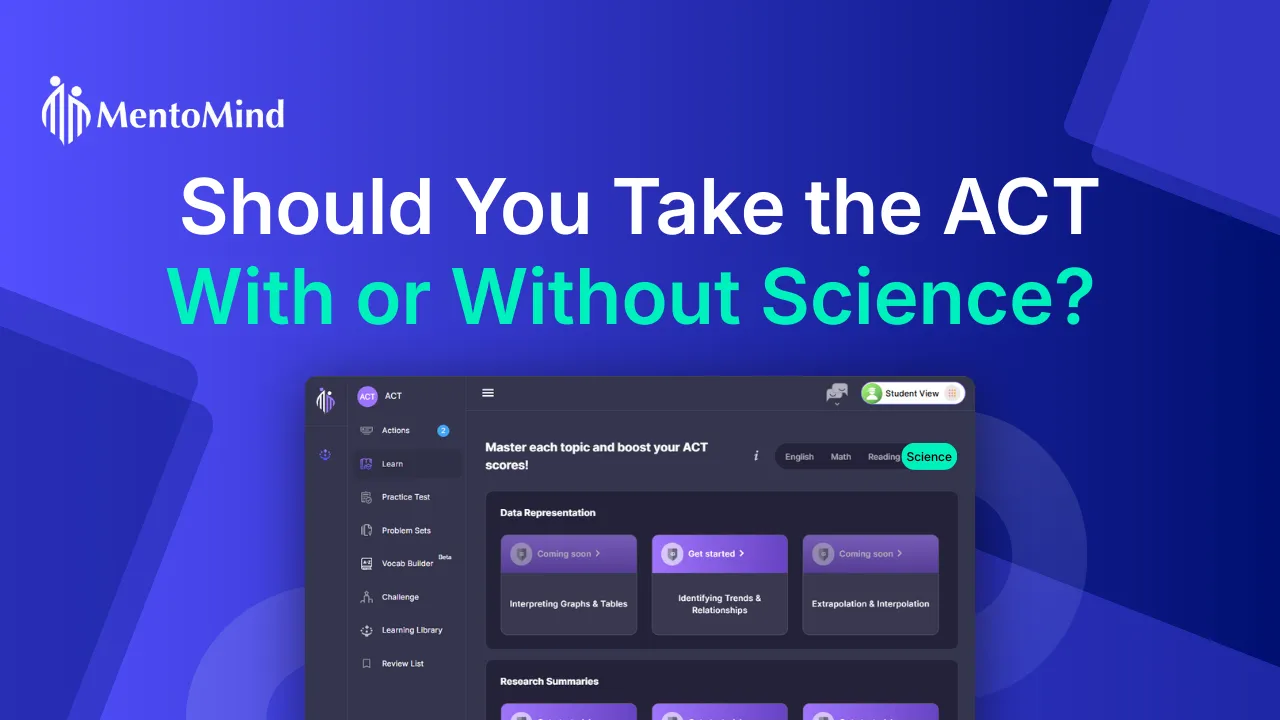
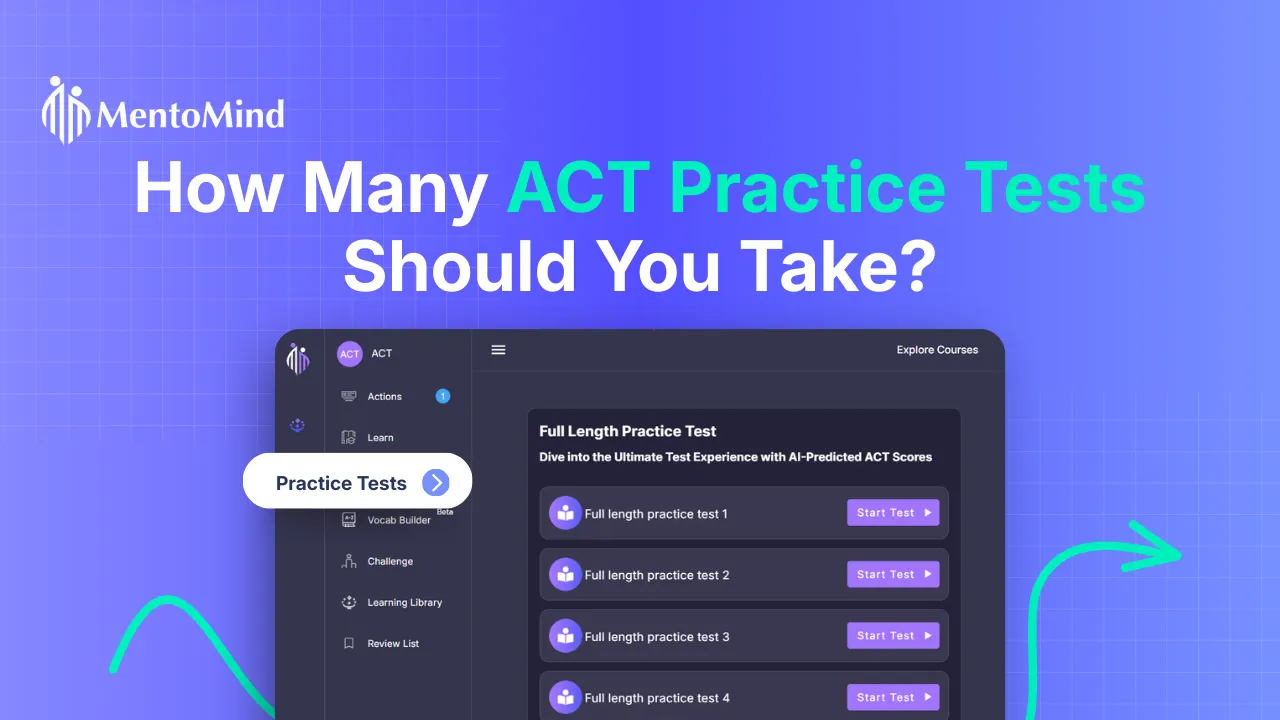
MentoMind provides infrastructure for tutors building hybrid programs for SAT, ACT, and HSPT.
The platform includes 3,500+ practice questions for SAT (with 11 full-length adaptive tests), 1,000+ for ACT, and 1,000+ for HSPT. Students work through content independently while the system tracks skill mastery by topic.
For tutors, the dashboard shows which topics each student struggles with, completion rates, and performance trends. White-label options let you run the platform under your own brand.
The diagnostic test feature works as a lead capture tool: prospective students take a free diagnostic, you see their results, and you can reach out with specific insights about where they need help.
Key Takeaways
- Self-paced prep excels at scalable content delivery, high practice volume, and flexible scheduling.
- Live tutoring excels at strategy coaching, accountability, and diagnosing complex learning issues.
- Research on online learning shows that programs with human interaction and accountability outperform purely self-paced models, a principle that applies directly to test prep.
- Hybrid programs combine the strengths of both approaches, serving more students, generating recurring revenue, and creating a natural pipeline from self-paced learners to live tutoring clients.
Frequently Asked Questions
Yes, for highly motivated students with strong self-discipline. However, research on online learning consistently shows that most students achieve better outcomes when self-paced study is paired with human interaction and accountability.
It depends on the student. Some benefit from weekly sessions, while others succeed with monthly check-ins. Using self-paced performance data to identify who needs more support helps tutors allocate time efficiently.
Yes. Tutors add value through curated content, structured pacing, progress monitoring, and direct access to live support. Many families prefer paying for an organized program with oversight rather than relying on unstructured free materials.
Common tiers include self-paced only ($30-$100 per month), self-paced plus monthly check-ins ($150-$300 per month), and full hybrid programs with weekly live sessions ($400-$800 per month). Tiered pricing lets families choose based on budget and support needs.
By monitoring performance data for clear signals such as stalled progress, incomplete assignments, or repeated struggles with specific topics. Outreach works best when it references specific observations rather than generic sales messages.
Hybrid models work best for standardized tests and structured subjects where content and practice can be automated. They are less effective for subjects that rely heavily on open-ended discussion or creative work.
Final Thoughts
The most effective programs do not choose between self-paced and live tutoring. They design systems where independent practice and human instruction reinforce each other. When structure, data, and guidance work together, programs become easier to manage, scale more smoothly, and align better with how students actually learn.
Related reading: