
How to Solve Quadratic Equations on the SAT
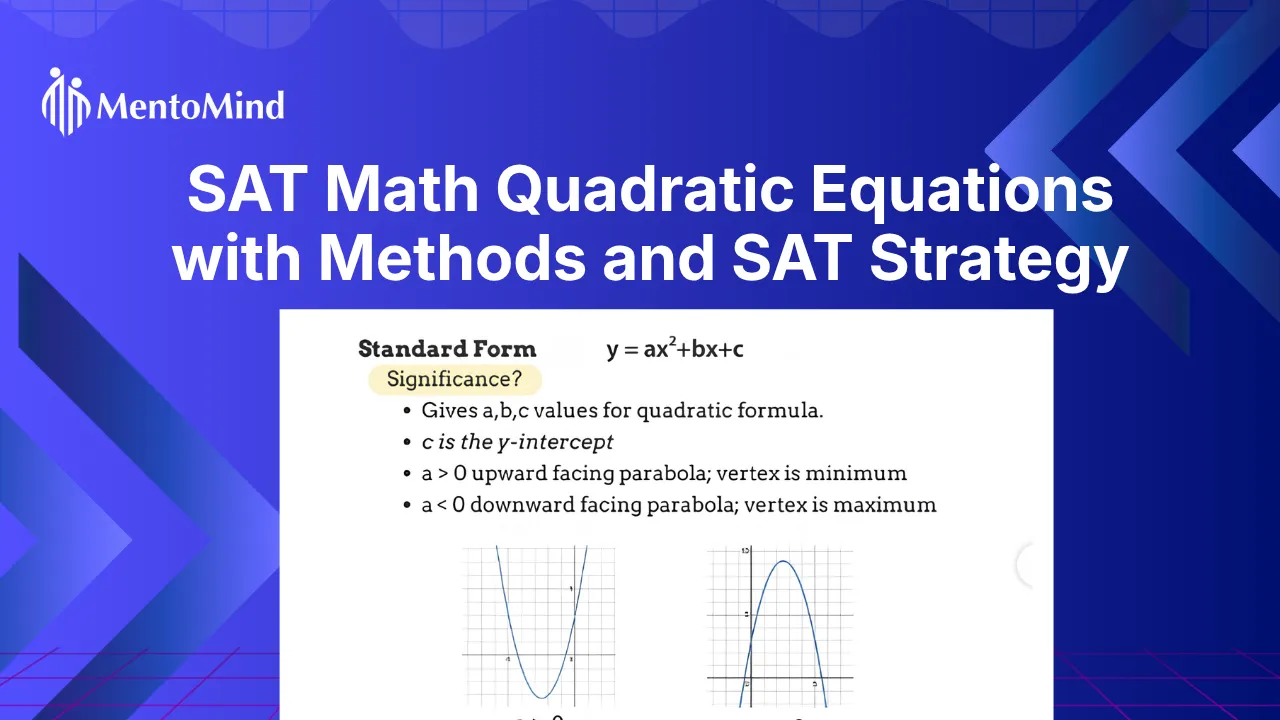
The SAT tests quadratic equations in several forms such as standard form ax² + bx + c = 0, vertex form a(x − h)² + k, and factored form a(x − p)(x − q). To solve them, you choose from three core methods including factoring, the quadratic formula, or completing the square.
Factoring is fastest when the numbers are clean integers. The quadratic formula works on any equation. Completing the square appears mainly in vertex form questions. You also need to read parabola graphs and use the discriminant to answer certain questions without fully solving.
Before we break down each method, watch this quick concept video to understand the full picture.
Factoring Method for Solving Quadratic Equations (Fastest SAT Strategy)
When the SAT gives you a quadratic with clean, small integers, factoring is almost always the quickest path to the answer. The goal is to rewrite ax² + bx + c as a product of two binomials, then set each factor equal to zero.
Standard approach for x² + bx + c = 0
Find two numbers that multiply to c and add to b. Write the equation as (x + p)(x + q) = 0, then solve x = −p and x = −q.
Solve x² − 5x + 6 = 0
- Find two numbers that multiply to 6 and add to −5, those are −2 and −3.
- So (x − 2)(x − 3) = 0, which gives x = 2 or x = 3
Key tip
On the SAT, if the quadratic has a leading coefficient other than 1, look for factoring by grouping or check whether the answer choices are simple fractions. If the roots are messy, switch to the quadratic formula immediately.
When does factoring NOT work? When the discriminant is not a perfect square, the numbers will not factor neatly. That is your signal to move on.
Using the Quadratic Formula to Solve Any Quadratic Equation
The quadratic formula solves any quadratic equation, no matter how messy the numbers are.
x = (−b ± √(b² − 4ac)) / 2a
This applies whenever the equation is in the form ax² + bx + c = 0.
When to use it on the SAT
- Factoring does not produce clean integers within about 20 seconds.
- The problem gives decimal or fractional coefficients.
- You need the exact value of the roots to match an answer choice.
How to avoid arithmetic errors under time pressure
Arithmetic mistakes inside the square root are the most common way students lose points here. Use this three-step process every time.
Step 1 – Write out a, b, and c explicitly before substituting anything.
Step 2 – Calculate b² − 4ac as a separate operation. Write the number down.
Step 3 – Substitute the result into the full formula.
Solve 2x² − 3x − 2 = 0
- a = 2, b = −3, c = −2
- b² − 4ac = (−3)² − 4(2)(−2) = 9 + 16 = 25
- x = (3 ± √25) / 4 = (3 ± 5) / 4 → x = 2 or x = −1/2
Key tip
Always write the sign of b carefully. A negative b means −b becomes positive in the formula. This single step causes more errors than any other part of the calculation.
Completing the Square to Solve Quadratic Equations
Completing the square to solve quadratics appears less often than the other two methods on the SAT. When it does appear, the question is almost always asking about vertex form or the minimum or maximum value of a quadratic.
Convert ax² + bx + c into a(x − h)² + k
Solve x² + 6x + 5 = 0
Step 1 – Move constant
x² + 6x = −5
Step 2 – Add square term
x² + 6x + 9 = 4
Step 3 – Factor
(x + 3)² = 4
Step 4 – Square root
x + 3 = ±2
Step 5 – Solve
x = −1 or x = −5
Key tip
On the SAT, completing the square is most useful when a question asks for the vertex of a parabola or asks “what is the minimum value of f(x)?” Convert to vertex form a(x − h)² + k, and the vertex is (h, k). The minimum value is k when a > 0.
f(x) = a(x − h)² + k → Vertex at (h, k)
Reading Parabola Features from a Graph
Several SAT questions give you a graph and ask about key features. Here is what to look for.
Vertex
The vertex is the highest or lowest point on the parabola. If the parabola opens upward (a > 0), the vertex is the minimum. If it opens downward (a < 0), the vertex is the maximum. In vertex form, h is the x-coordinate and k is the y-coordinate of the vertex.
Axis of Symmetry
x = h or equivalently x = −b / 2a
Key tip
On the SAT, if you know the two x-intercepts (roots) of a parabola, the axis of symmetry is exactly halfway between them – x = (x₁ + x₂) / 2
Roots (x-intercepts)
The roots are the points where the parabola crosses the x-axis. A parabola can have two roots, one root (touching the x-axis), or no real roots. Reading roots from a graph means identifying the x-values where y = 0.
y-intercept
Plug x = 0 into the equation. In standard form ax² + bx + c, the y-intercept is always (0, c).
The Discriminant Formula, Answer Questions Without Solving
The discriminant is the expression inside the square root of the quadratic formula. You do not need to finish the quadratic formula to use it.
Discriminant = b² − 4ac
b² − 4ac > 0 → Two distinct real roots (parabola crosses x-axis at two points)
b² − 4ac = 0 → Exactly one real root (vertex touches the x-axis)
b² − 4ac < 0 → No real roots (parabola does not cross the x-axis)
Key tip
SAT questions often ask “how many times does the graph intersect the x-axis?” or “for what value of k does the equation have exactly one solution?” Both are answered using the discriminant, no full solving required.
Find k for exactly one real solution
For x² − 6x + k = 0 to have exactly one real solution
Set b² − 4ac = 0
(−6)² − 4(1)(k) = 0 → 36 − 4k = 0 → k = 9
Advanced SAT Quadratic Equation Problems (Solved Step-by-Step)
Question 1
The function f is defined by f(x) = ax² + bx + c, where the vertex is (4, −2) and it passes through (2, 10). A second function g is defined by g(x) = f(x − 3) + 5. What is the y-coordinate of the y-intercept of the graph of g?
A. 145 B. 150 C. 153 D. 160
Solution
Step 1 – Build f(x) using vertex form.
Since the vertex is (4, −2)
f(x) = a(x − 4)² − 2
Step 2 – Find a using the point (2, 10).
10 = a(2 − 4)² − 2
12 = a(−2)² = 4a → a = 3
f(x) = 3(x − 4)² − 2
Step 3 – Find g(0) to get the y-intercept of g.
g(0) = f(0 − 3) + 5 = f(−3) + 5
Step 4 – Evaluate f(−3).
f(−3) = 3(−3 − 4)² − 2 = 3(−7)² − 2 = 3(49) − 2 = 147 − 2 = 145
Step 5 – Final answer.
g(0) = 145 + 5 = 150
Answer – B. 150
Key rule
For complex transformations, first find the specific equation of the base function using the vertex and a given point. Then, to find the y-intercept of any transformed function, always substitute x = 0 into the new expression.
Why the other choices are wrong
A (145) is the value of f(−3) but forgets to add the vertical shift of +5. C (153) results from a sign error when squaring the negative number inside the bracket. D (160) results from incorrectly applying the horizontal shift inside the square.
Think10x.ai video explaining vertex form and function transformations (Finding y-intercept)
Question 2
The equation x² + bx + 16 = 0 has two real solutions. The equation x² + bx + 30 = 0 has no real solutions. Which of the following could be the value of b?
A. 7 B. 10 C. 11 D. 13
Solution
Apply the discriminant formula to each equation separately.
Condition 1 – x² + bx + 16 = 0 has two real solutions → b² − 4ac > 0
b² − 4(1)(16) > 0 → b² > 64 → b > 8 (taking b > 0)
Condition 2 – x² + bx + 30 = 0 has no real solutions → b² − 4ac < 0
b² − 4(1)(30) < 0 → b² < 120 → b < √120 ≈ 10.95
Combine both conditions
b > 8 AND b < √120 → 8 < b < 10.95
Check each option
- A (7) – 7² = 49 < 64. Fails condition 1 — the first equation would have no real solutions.
- B (10) – 10² = 100 > 64 ✓ and 100 < 120 ✓. Both conditions pass.
- C (11) – 11² = 121 > 120. Fails condition 2 — the second equation would have real solutions.
- D (13) – 13² = 169 > 120. Fails condition 2 for the same reason as C.
Answer is B
Key rule
When an SAT question sets up two conditions with the discriminant, write both inequalities separately, solve each for b, then find the overlap. Test every answer choice against both conditions, only one will survive.
Why the other choices are wrong
A (7) fails condition 1 because 49 < 64, so the first equation would have no real solutions. C (11) fails condition 2 because 121 > 120, meaning the second equation would actually have real solutions. D (13) fails for the same reason as C since 169 > 120.
Think10x.ai video explaining multiple conditions with the discriminant (Finding b)
Frequently Asked Questions
The SAT tests three methods. Use factoring first whenever the coefficients are small integers and the roots feel like they should be whole numbers. If factoring is not working within about 20 seconds, switch to the quadratic formula x = (−b ± √(b² − 4ac)) / 2a, which always works. Completing the square comes up mainly when a question asks for the vertex or minimum value, and converting to vertex form a(x − h)² + k is the fastest path.
Use the quadratic formula when the equation has a leading coefficient greater than 1 with no clean factor pairs, when the coefficients include fractions or decimals, or when you have spent more than 20 seconds trying to factor without success. The formula never fails, so if you are under time pressure, go straight to it.
The discriminant b² − 4ac tells you how many real solutions a quadratic has without you needing to solve it. A positive discriminant means two real roots. A discriminant of zero means one repeated root where the vertex touches the x-axis. A negative discriminant means no real roots and the parabola floats entirely above or below the x-axis.
Yes. The vertex form f(x) = a(x − h)² + k appears directly in SAT questions. The vertex is at (h, k), the axis of symmetry is x = h, and k is the minimum value when a > 0 or the maximum value when a < 0. Knowing this form saves significant time compared to re-deriving it by completing the square during the test.
The axis of symmetry is the vertical line that cuts the parabola in half. Use x = −b / 2a when the equation is in standard form. If the two roots are given or visible on a graph, the axis of symmetry is the average of the two roots x = (x₁ + x₂) / 2. Either approach gives the same result.
The most frequent error is a sign mistake inside the quadratic formula, specifically mishandling a negative b. When b is negative, −b becomes positive, and students often forget to carry that sign change through. Write a, b, and c explicitly before substituting, and calculate b² − 4ac separately before plugging it into the formula. That two-second pause prevents the most costly mistakes.
Want a Step-by-Step Video Explanation For Your Own SAT Math Question?
The video explanations above were created using Think10x.ai.
Upload a clear photo of any math problem, including probability, algebra, geometry, or calculus, and our tool will turn it into a narrated, animated explanation in minutes.
👉 Try it at Think10x.ai