If you want to improve your Digital SAT Reading and Writing score, understanding each question type is where it starts. The sections test different skills, from finding key evidence and understanding word meanings to analyzing an author’s choices and applying grammar rules. Knowing what kinds of questions are on the sat, recognizing rhetorical techniques, improving sentence flow, and identifying grammar patterns can help you solve questions faster and with more accuracy.
This guide breaks down every Digital SAT Reading and Writing question type, what each one tests, and the strategies you need to solve them effectively.
What Type of Questions Are on the Digital SAT Reading and Writing Section?
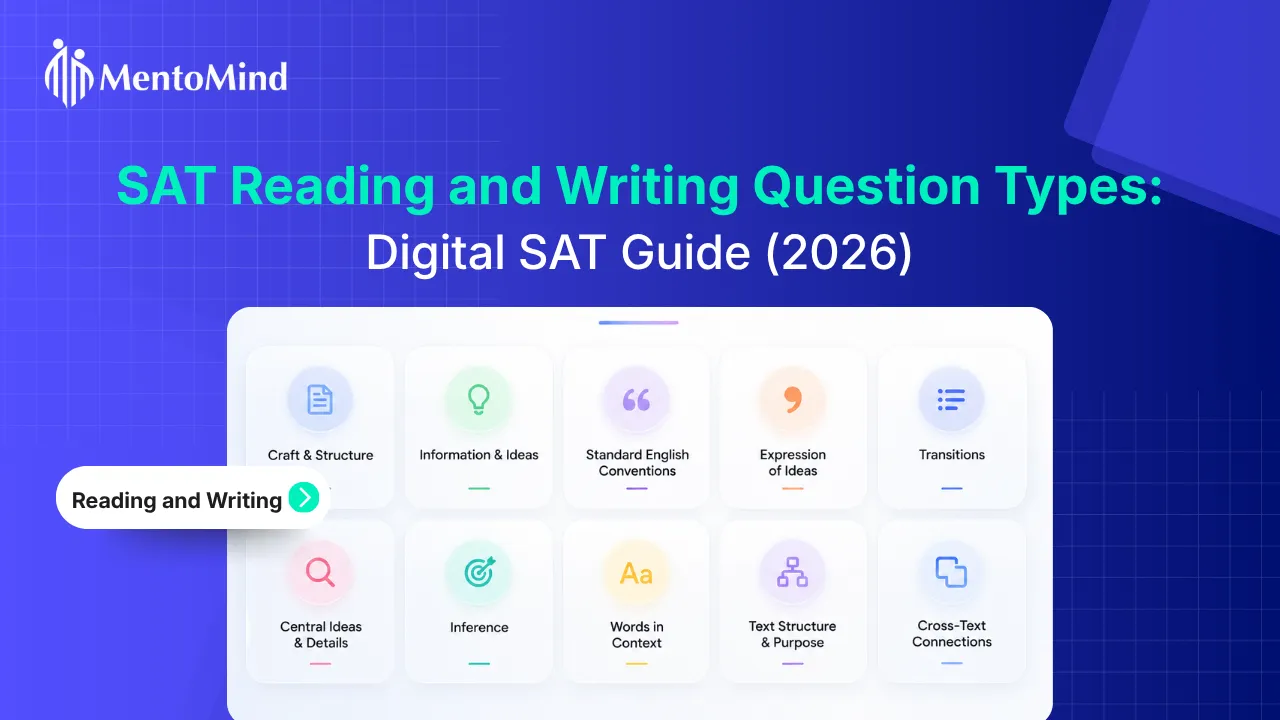
The Digital SAT Reading and Writing section has four question types: Information and Ideas, Expression of Ideas, Craft and Structure, and Standard English Conventions. Here are the type of questions you will see and the skills each one tests.
1. Information and Ideas questions
Information and Ideas questions test your ability to find key details, identify the main idea, and support answers with evidence from the passage.
- Central Ideas and Details: Identify the main point or important information from the text.
- Inferences: Draw conclusions using evidence from the passage.
- Command of Evidence: Choose the evidence that best supports an answer.
- Data Interpretation: Analyze charts, tables, or graphs linked to the passage.
2. Craft and Structure questions
Craft and Structure questions test how well you understand word meanings, text structure, and the author’s purpose. These question types ask you to analyze how an author uses language and organizes ideas to communicate a message.
- Words in Context: Define the meaning of a word or phrase based on how it is used in the passage.
- Text Structure and Purpose: Identify how the passage is organized and why the author presents ideas in a specific way.
- Cross-Text Connections: Compare ideas or viewpoints from two related passages.
3. Expression of Ideas questions
Expression of Ideas questions test how well you recognize the clarity, organization, and flow of a passage. These questions focus on how ideas connect and how effectively a writer communicates information.
- Transitions: Choose the transition that creates the correct relationship between ideas.
- Rhetorical Synthesis: Select the option that best uses notes to achieve a specific writing goal.
- Organization and Development: Improve the structure, focus, or effectiveness of the passage.
4. Standard English Conventions questions
Standard English Conventions questions test your knowledge of grammar, punctuation, and sentence structure. These types of reading questions ask you to identify and fix errors that affect how clearly a sentence communicates its meaning.
- Sentence Boundaries: Fix errors related to run-on sentences, fragments, and punctuation.
- Form, Structure, and Sense: Apply rules for verb tense, subject-verb agreement, and sentence construction.
- Conventions of Usage: Identify correct grammar choices, including pronouns, modifiers, and word usage.
How Many Questions Are on the Digital SAT Reading and Writing Section?
The Digital SAT Reading and Writing section has 54 questions across two modules. You get 64 minutes total, with each module lasting 32 minutes. The table below displays section breakdown:
| Feature | Digital SAT Reading and Writing Section |
|---|---|
Total Questions |
54 questions |
Modules |
2 adaptive modules |
Time Limit |
64 minutes total |
Time per Module |
32 minutes |
Question Types |
Information and Ideas, Expression of Ideas, Craft and Structure, Standard English Conventions |
What Are the Hardest Digital SAT Reading and Writing Question Types?
The hardest Digital SAT Reading and Writing questions are usually Inference, Words in Context, Rhetorical Synthesis, and Grammar questions because they require careful analysis instead of simple recall.
The following are the question types students often find challenging:
- Inference Questions: Require you to draw conclusions using only the information provided in the passage.
- Words in Context Questions: Test whether you can identify the meaning of a word based on how it is used.
- Rhetorical Synthesis Questions: Ask you to select the choice that best supports a specific writing goal.
- Grammar Questions: Test your ability to apply rules for sentence structure, punctuation, and usage.
How to Approach Different Digital SAT Reading and Writing Question Types
The Digital SAT Reading and Writing section has four question categories, and each requires a different solving strategy. Identify the question type first, then apply the right method to reach the answer faster.
| Question Type | Best Strategy |
|---|---|
Information and Ideas |
Find the main point, key details, and evidence that supports the answer. |
Craft and Structure |
Use context to understand word meanings, purpose, and author choices. |
Expression of Ideas |
Check how each option improves clarity, flow, and organization. |
Standard English Conventions |
Apply grammar and punctuation rules to identify the correct choice. |
4 Common Mistakes Students Make on Digital SAT Reading and Writing Questions
Students often miss Digital SAT Reading and Writing questions because they rush, overthink, or choose answers that feel correct without checking the passage. Avoid these mistakes:
- Picking an answer that sounds right: The SAT rewards evidence, not assumptions. Always connect your choice to the passage.
- Ignoring small details: A single word or phrase can change the context of an answer choice.
- Reading answer choices too quickly: Check what each option changes before selecting one.
- Spending too long on one question: If a question feels confusing, eliminate obvious wrong answers and move ahead.
Reading and Writing is only one part of the Digital SAT. If you’re also preparing for SAT Math, Think10X.ai provides step-by-step video explanations that help you understand the logic behind each solution and apply the same approach to similar questions.
How to Practice Digital SAT Reading and Writing Question Types Effectively
Practice one SAT Reading and Writing question type at a time, review every mistake, and focus on the skills where you lose points. Learning why an answer is correct helps you improve faster than simply checking your score. Here are the steps to follow:
1. Practice by question type
Start with an SAT study plan for one category, such as Information and Ideas or Standard English Conventions. Learn the patterns behind each question type before moving to mixed practice.
2. Review why you missed a question
A wrong answer shows what you need to improve. Check the reasoning behind the correct choice, understand where your approach went wrong, and apply that lesson to similar questions.
3. Track weak areas and improve
Keep track of question types where you make repeated mistakes. Use this data to focus your SAT practice test and spend more time on skills that need improvement.
4. Practice under test conditions
After building confidence with individual question types, move to timed practice. This helps you apply your strategies while managing the pace of the Digital SAT.
Ready to Practice Every SAT Reading and Writing Question Type?
MentoMind’s Digital SAT course includes 3,500+ SAT Reading, Writing, and Math questions, 11 full-length adaptive practice tests, detailed performance analytics, and section-wise practice to help you master every Digital SAT question type.
Frequently Asked Questions
Yes. Every scored question contributes equally to your section score. The College Board does not assign extra weight to specific SAT Reading and Writing question types.
Start with the question types you miss most often. If you’re just beginning, focus on Information and Ideas and Craft and Structure questions because they make up a large portion of the Digital SAT Reading and Writing section.
No. The core SAT question types remain consistent, but the passages, topics, and individual questions differ from one test to the next. The College Board may change the exam over time, but the tested skills remain the same.
The tested skills are similar, but the Digital SAT uses shorter passages with one question per passage. This changes how students approach SAT Reading question types compared with the previous paper-based exam.
Yes. Full-length adaptive practice tests expose you to a mix of SAT Reading and Writing question types under timed conditions. They also help you identify which question types need the most improvement.