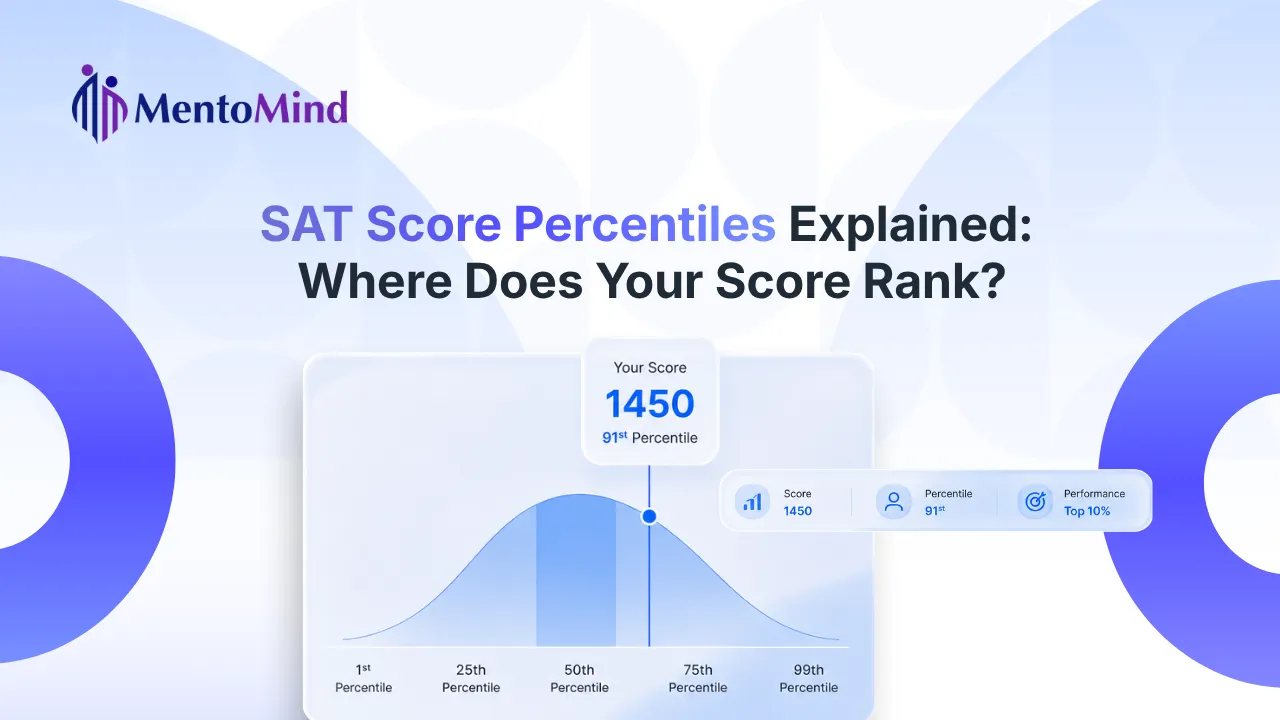
If you’re trying to understand your SAT score ranking, an SAT score percentile shows where your score stands compared with other students. Instead of looking at your SAT score alone, you can use your percentile to understand how your performance compares with the relevant comparison group.
This guide explains how SAT percentiles work, how to read an SAT score chart, and how to use your percentile when evaluating a Good SAT score, the Average SAT score, and your target score.
What Is an SAT Score Percentile?
An SAT score percentile shows how your score ranks compared with other students in the relevant comparison group. It tells you how many students you scored higher than, rather than how many SAT questions you answered correctly.
For example, if your score falls in the 90th percentile, you scored as well as or better than about 90% of students in that comparison group. A score in the 75th percentile means you performed better than about 75% of students.
How do SAT percentiles work?
SAT percentiles depend on how your score compares with the scores in a specific reference group. College Board uses that comparison to assign your percentile. Here’s how it works:
- Your score: A higher SAT score generally places you higher in the percentile rankings.
- Reference group: The percentile can vary based on the group used for comparison.
- Score distribution: Percentile changes are not equal across the full SAT score range. The same score increase can move you a different number of percentile points at different score levels.
What Is the Average SAT Score?
The average SAT score is 1029 for the class of 2025, according to the College Board. This figure gives you a national benchmark, but it does not tell you whether your score is competitive for a specific college.
Use the average SAT score as a starting point:
- Below 1029: Your score falls below the reported average.
- Around 1029: Your score is close to the reported average.
- Above 1029: Your score is above the reported average.
Your SAT score percentile adds more context by showing how your score ranks among other students. For college planning, also compare your score with the SAT scores reported by your target schools.
What Is a Good SAT Score?
A good SAT score is generally 1200 or higher, while a score of 1400 or above is considered strong for many competitive colleges. However, the right target depends on the colleges you want to attend.
Use your score and college list to judge where you stand:
- 1200+: Above the reported national average and a solid score for many colleges.
- 1400+: A strong score that can make you competitive at more selective colleges.
- 1500+: A highly competitive score for many selective schools.
- College-specific target: Check the SAT scores of students at your target colleges before deciding whether you need to improve.
Use the current College Board percentile table when checking your SAT score ranking so you compare your result with the correct reference group.
How Do You Read an SAT Score Chart?
An SAT score chart helps you find the percentile associated with your total score. Use your official SAT result to locate the score, then check the corresponding percentile in the current College Board data.
- Find your total score: Start with your score on your SAT results.
- Check the percentile: Match your score with the corresponding SAT score percentile.
- Read the ranking: A higher percentile means your score ranks higher within the comparison group.
- Check the reference group: Make sure the chart uses the correct College Board comparison group before interpreting your SAT score ranking.
What Is the SAT Score Range?
The SAT score range is 400–1600, with separate scores for Reading and Writing and Math.Your SAT score percentile then shows how that total score ranks compared with other students. Here are the details of the score range for each section:
| SAT section | Score range |
|---|---|
Reading and Writing |
200–800 |
Math |
200–800 |
Total SAT score |
400–1600 |
What Should You Do After Getting Your SAT Results?
After receiving your SAT results, compare your score with your target colleges and decide whether you need to retake the test. Review your section scores first, then use that information to plan your next step. Here’s how you can do it:
1. Check your section scores
Compare your Reading and Writing, and Math scores. A clear difference between them can show which section needs more practice.
2. Review your score report
Check the details of your results to identify where you lost points. Use your performance to find the areas that need more attention.
3. Compare your target colleges
Look at the SAT scores reported by the colleges on your list. A score that meets one school’s typical range may fall short at another.
4. Decide whether to retake
Consider retaking the SAT if your score falls below your target and you have enough time to improve. If your score already meets your goals, another test may not be necessary.
5. Set your next target
If you retake the SAT, choose a specific score to work toward. Base it on your target colleges and the areas you need to improve.
Think10X.ai provides step-by-step video explanations for SAT Math questions, so you can understand why an answer is correct instead of simply checking the final answer. You can follow the method, understand the logic, and apply it to similar questions.
How Does an SAT Score Calculator Work?
An SAT score calculator adds your Reading and Writing and Math section scores to estimate your total SAT score. The SAT uses a 400–1600 total score range, with each section scored from 200–800.
Here’s how an SAT score calculator works:
- Enter your section scores: Add your Reading and Writing score and your Math score from your SAT score report.
- Calculate your total: The two section scores make up your total SAT score. For example, a 650 Reading and Writing score and a 700 Math score give you a 1350 total.
- Check your official result: Use your College Board score report to confirm the calculated total. College Board reports the total score and both section scores on your official report.
- Don’t use it to estimate percentiles: An SAT score calculator gives you the total score, but your SAT score percentile comes from College Board’s percentile data. College Board provides separate percentile tables based on different comparison groups.
- Don’t confuse it with raw-score conversion: The SAT converts the number of questions you answer correctly into section scores. The conversion accounts for differences in test difficulty, so a simple calculator cannot reliably turn a number of correct answers into an official SAT score.
If you already have your official SAT results, you usually don’t need a calculator to find your total score. The calculator is more useful for checking the relationship between your two section scores or estimating a target total during practice.
Should You Retake the SAT?
Retake the SAT if your current score falls below your target and you have a realistic chance of improving it. If your score already meets the range you need for your target colleges, another attempt may not be necessary.
Before you register for another test:
- Check your score gap: Compare your current score with your target score.
- Review your practice tests: Look for consistent weak areas, not one unusually low score.
- Estimate your improvement: Make sure you can gain enough points to justify another test.
- Check your timeline: Give yourself enough time to prepare before the next test date.
- Set a clear goal: Know exactly what score you want to reach before you retake.
A retake works best when you know why your score needs to improve and what you will change in your preparation.
What Can You Do to Level Up Your SAT Score Ranking?
Improving your SAT score ranking starts with improving the score behind it. The fastest way to do that is to find where you’re losing points, practice those areas, and track whether your scores improve.
Focus on these five areas:
1. Review your mistakes
Go through your practice tests and look for mistakes that keep coming up. A repeated error tells you more than a question you missed once.
2. Strengthen weak skills
Spend more time on the Math, Reading and Writing topics where you consistently lose points. Targeted practice is more useful than reviewing every topic equally.
3. Practice under time limits
Work on accuracy and pacing together. Timed practice helps you find whether rushing, spending too long on one question, or running out of time affects your score.
4. Track your scores
Record your practice-test results and compare them over time. Look for a consistent upward trend instead of judging your progress from one test.
5. Change what isn’t working
If the same question type or timing problem keeps costing you points, change your approach. Try a different solving method, review the underlying skill, or adjust how you manage your time.
As your SAT score improves, your SAT score percentile may also increase. Set your target based on the score you need for your college list, not on percentile alone.
Ready to Reach Your Target SAT Score?
Knowing your SAT score percentile shows where you stand. The next step is knowing what to work on. MentoMind helps you find your weak areas, practice with adaptive tests, and track your progress as you prepare for a higher SAT score.
Frequently Asked Questions
No. Your SAT score percentile compares your score with other students. It does not show the percentage of questions you answered correctly.
College Board uses different comparison groups for SAT percentiles. Your reported percentile can change depending on which group the table uses. Check the comparison group before interpreting your ranking.
They can if you compare them using different percentile tables or comparison groups. The same score receives the same percentile when you use the same comparison group and College Board data.
Colleges primarily consider your SAT score, not your percentile ranking. Check the SAT scores reported by each target college to understand how your score fits its applicant pool.
No. An SAT score calculator can calculate your total score from your two section scores. It cannot provide your official percentile. Use current College Board percentile data to check your ranking.