This guide covers absolute value equations, absolute value inequalities SAT questions, graphing on a number line and coordinate plane, and systems of inequalities SAT questions, all of which are common Advanced Algebra topics on the Digital SAT.
What Are Absolute Value Equations, Absolute Value Inequalities, and Systems of Inequalities?
Before diving into the rules, watch this short concept video to understand absolute value equations, absolute value inequalities, and systems of inequalities. It introduces the core ideas you’ll use to solve the SAT-style questions throughout this guide.
Solving absolute value equations
Absolute value measures the distance a number sits from zero, so it is always positive or zero. This one fact is the key to solving absolute value equations correctly.
When you see an equation like |x – 3| = 5, you are really being told that the expression inside the bars is either 5 units from zero in the positive direction or 5 units from zero in the negative direction. That gives you two separate cases to solve.
Case one sets the inside expression equal to the positive value. Case two sets it equal to the negative version of that value. For the example above, case one gives x – 3 = 5, so x = 8. Case two gives x – 3 = -5, so x = -2.
SAT tip
Isolate the absolute value expression on one side of the equation before you do anything else. Skipping this step is where most students lose points on absolute value equations SAT questions.
The no solution trap
Not every absolute value equation has an answer. Since absolute value can never be negative, an equation like |x + 2| = -3 has no solution at all.
SAT tip
Before splitting into two cases, check the isolated absolute value expression. If it’s already set equal to a negative number, stop. The answer is no solution.
Absolute Value Inequalities SAT Compound Inequality vs. OR
Absolute value inequalities SAT questions follow a similar setup to absolute value equations, but the direction of the inequality symbol changes how you write the final answer.
When the absolute value is less than a positive number, you get a compound inequality. |x| < a means -a < x < a. For example, |x| < 4 gives -4 < x < 4. Every value in that range works.
When the absolute value is greater than a positive number, the solution splits into two separate pieces joined by OR. |x| > a means x < -a or x > a. For example, |x| > 4 gives x < -4 or x > 4. These two pieces never overlap, which is why OR is used instead of a compound statement. Less than gives one connected range in the middle, while greater than gives two separate rays pointing outward.
SAT tip
Less than (<) uses a compound AND statement. Greater than (>) uses a separate OR statement. Mixing these up is one of the most common mistakes on absolute value inequalities SAT problems.
What an absolute value graph looks like
An absolute value graph always forms a V shape, with the point of the V sitting at the value that makes the inside expression equal to zero. For y = |x – 3|, the V shifts to sit at x = 3 instead of the origin.
Seeing this shape can help you sanity check whether your solutions to an absolute value equation or inequality make sense. If you solve for two answers, they should sit the same distance from the vertex.
Digital SAT (Desmos) Tip
The Digital SAT gives every student access to a built-in Desmos calculator. Type an absolute value equation directly into Desmos using abs(x) notation, for example, abs(x-3) = 5, to see the V-shaped graph and confirm where it crosses your target value. You can do the same with inequalities by graphing both sides and checking where one graph sits above or below the other. Use Desmos to double-check your algebra, not to replace it. The SAT still expects you to show the reasoning behind how to solve absolute value inequalities by hand.
Graphing linear inequalities
Linear inequalities can be graphed two different ways on the Digital SAT Math section. You can graph them on a simple number line or on the full coordinate plane. The same care you use when solving absolute value inequalities carries over here, since both topics depend on reading the inequality symbol correctly.
Number line graphs
Use an open circle for strict inequalities (< or >), since the boundary value itself is not included. Use a closed circle for ≤ or ≥, since the boundary value is included. After placing the circle, shade or draw an arrow in the direction the inequality points.
Coordinate plane graphs
On the coordinate plane, a linear inequality is graphed by first drawing the boundary line as if it were an equation. Use a dashed line for strict inequalities and a solid line when the inequality includes “equal to.” A dashed boundary line means the line itself is not part of the solution.
Systems of Inequalities SAT Questions Shading the Correct Region
A system of inequalities asks you to graph two or more inequalities on the same coordinate plane at once. This is one of the more visual Advanced Algebra SAT questions, and it rewards careful, step-by-step graphing over guessing.
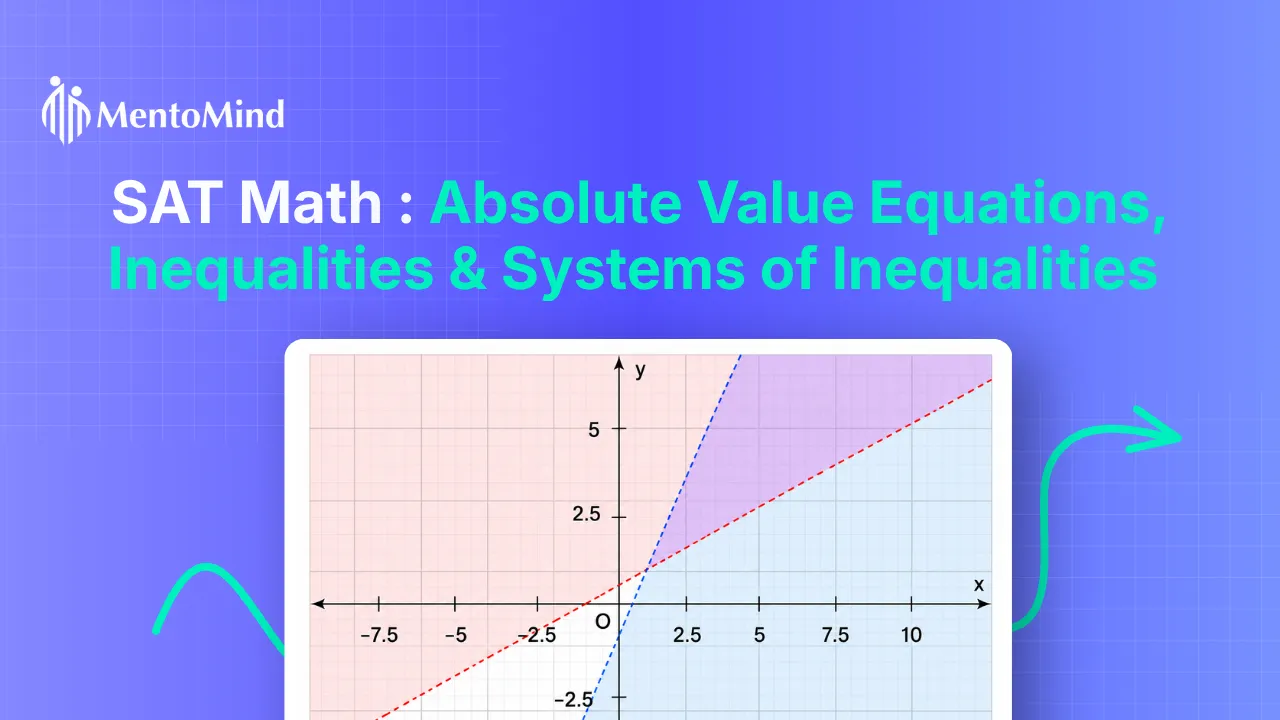
Graph each inequality separately first, using dashed or solid lines and shading each one on its own. The solution to the whole system is only the region where all the individual shaded areas overlap. Every point in that region must make every inequality in the system true at the same time.
This overlapping region is sometimes shaped like a triangle, a rectangle, or another polygon, depending on how many inequalities are in the system. On the SAT, you’ll often be asked to identify a point that lies in this region, or to find the boundary lines that form its corners.
Common mistake
Shading each inequality correctly on its own doesn’t automatically give the right final answer. Always go back and check that the region you’ve marked satisfies every inequality in the system, not just one or two of them.
Example reading a system of inequalities
Consider the system x ≥ 0, y ≥ 0, y ≤ 4, and x + y ≤ 6. Which of the following points lies in the solution region (5, 3), (1, 2), or (0, 5)?
Check each point against all four inequalities. For (5, 3), x + y = 8, which fails x + y ≤ 6. For (0, 5), y ≤ 4 is not satisfied. For (1, 2), x ≥ 0 ✓, y ≥ 0 ✓, y ≤ 4 ✓, and x + y = 3 ≤ 6 ✓. Every condition holds.
Answer
(1, 2) is the only point that satisfies every inequality in the system.
Practice question
Which system of inequalities describes only the shaded region bounded by the x-axis, the y-axis, and the line x + y = 5, including all three boundaries?
A) x ≥ 0, y ≥ 0, x + y ≤ 5 B) x > 0, y > 0, x + y < 5 C) x ≥ 0, y ≥ 0, x + y ≥ 5 D) x ≤ 0, y ≤ 0, x + y ≤ 5
Solution
The region sits in the first quadrant, bounded by the x-axis and y-axis, so both x and y must be non-negative. Therefore, x ≥ 0 and y ≥ 0.
Since the boundaries themselves are included, each inequality needs ≥ or ≤ rather than a strict inequality.
The line x + y = 5 forms the third boundary. The triangular region between the origin and that line, not beyond it, is where x + y ≤ 5.
Key rule
To translate a shaded region into a system of inequalities, check each boundary line separately. Determine which side of the line is shaded and whether the boundary itself is included (≥ / ≤) or excluded (> / <).
Why the other choices are wrong
B uses strict inequalities, which would exclude the boundary lines even though the problem states they’re included. C shades the far side of x + y = 5 instead of the triangle near the origin. D restricts x and y to negative values, placing the region in the wrong quadrant entirely.
Additional Advanced Topic Linear Programming
Linear programming is not a major focus on the current Digital SAT, but it’s worth knowing the core idea in case it appears. Once you graph a system of inequalities and find the overlapping feasible region, an objective function (an expression to maximize or minimize, like profit or cost) always reaches its maximum or minimum at one of the corner points of that region, never in the middle of the shaded area. To solve this kind of problem, find each corner point where two boundary lines intersect, then plug every corner point into the objective function and compare the results.
The SAT’s Favorite Absolute Value Trap
The most common mistake students make with absolute value equations is assuming every absolute value equation automatically produces two answers.
That assumption breaks down in two situations. The first is the no solution case, where the absolute value is set equal to a negative number. The second is when the two cases happen to produce the same answer, which means the equation really only has one solution instead of two.
A related trap shows up with absolute value inequalities SAT questions. Students sometimes forget to flip the compound inequality correctly, or they mix up when to use AND versus OR.
Common mistake
Don’t assume an absolute value equation has exactly two solutions. Always isolate the absolute value first, identify which case you’re in, and solve each piece carefully instead of relying on a shortcut.
Key takeaways
- Always isolate the absolute value expression first, before doing anything else.
- A positive constant on the other side leads to two cases; a negative constant means no solution.
- “<” (less than) uses AND, giving one compound inequality; “>” (greater than) uses OR, giving two separate pieces.
- An absolute value graph is a V-shape whose vertex sits where the inside expression equals zero.
- On the coordinate plane, dashed lines mean strict inequalities; solid lines mean “equal to” is included.
- The solution to a system of inequalities is only the region where every individual shaded area overlaps.
- Use the Digital SAT’s built-in Desmos calculator to check your graph, not to replace your algebra.
SAT-Style Practice Questions with Video Solutions
Practice SAT-style systems of inequalities questions designed to test your understanding of solution regions, boundary lines, and inequality constraints. Work through each problem first, then watch the step-by-step video solutions to understand the reasoning behind every answer and improve your Digital SAT Advanced Algebra skills.
Question 1.
The equation 2|x + 3| – 7 = 2x – 1 has how many solutions?
A) 0 B) 1 C) 2 D) Infinitely many
Solution
Isolate the absolute value expression. Add 7 to both sides to get 2|x + 3| = 2x + 6, then divide by 2 to get |x + 3| = x + 3.
This splits into two cases. Case one assumes the inside expression is already positive or zero. x + 3 = x + 3, which is true for every value of x, but only where x + 3 ≥ 0, meaning x ≥ -3.
Case two assumes the inside expression is negative. −(x + 3) = x + 3, which gives −x − 3 = x + 3, so −2x = 6, so x = −3. This case only applies where x + 3 < 0, meaning x < −3, but x = −3 does not satisfy that condition, so case two contributes nothing.
Since case one holds for every value of x in its domain, the solution set is x ≥ −3, which contains infinitely many values.
Key rule
Whenever both sides of an isolated absolute value equation simplify to the exact same expression, check the domain restriction on each case carefully instead of assuming two clean answers. Some absolute value equations have zero, one, two, or infinitely many solutions.
Why the other choices are wrong
A assumes no value works, but plugging in x = 0 or x = 5 both satisfy the original equation. B and C assume the equation behaves like a typical absolute value equation with one or two isolated answers, missing that an entire range of values works here.
Think10x.ai video explaining an infinite geometric series with exponents (Step-by-step)
Question 2.
What are all solutions to |2x – 3| = |x + 9|?
A) x = 12 only B) x = -2 only C) x = 12 or x = -2 D) x = 12 or x = 2
Solution
When two absolute value expressions are set equal to each other, there are two cases. Either the expressions inside are equal, or they are opposites of each other.
Case one
2x − 3 = x + 9. Subtracting x from both sides gives x − 3 = 9, so x = 12.
Case two
2x − 3 = −(x + 9). Distributing gives 2x − 3 = −x − 9. Adding x to both sides gives 3x − 3 = −9, so 3x = −6, so x = −2.
Check both in the original equation. At x = 12, |2(12) − 3| = |21| = 21, and |12 + 9| = |21| = 21 ✓. At x = −2, |2(−2) − 3| = |−7| = 7, and |−2 + 9| = |7| = 7 ✓. Both solutions check out.
Key rule
When one absolute value expression equals another, split into two cases. The expressions are either equal or opposites. Always verify each solution in the original equation, since this equation type can occasionally introduce an extraneous answer.
Why the other choices are wrong
A and B each capture only one of the two valid cases. D changes the sign of the second solution. Substituting x = 2 into the original equation gives |1| = 1 on the left but |11| = 11 on the right, so it does not work.
Think10x.ai video explaining how to solve absolute value equations (Step-by-step)
Frequently Asked Questions
The Digital SAT Math section tests absolute value equations, absolute value inequalities SAT questions, graphing linear inequalities, and systems of inequalities SAT questions as part of the Advanced Algebra domain. Learning how to solve absolute value inequalities alongside absolute value equations covers most of what shows up, since the two topics use the same core skills. These questions often include the no solution trap or a case where students assume an answer without checking it carefully.
Start by isolating the absolute value expression on one side of the equation. Then split into two cases just like usual, but check each solution in the original equation afterward, since equations with variables on both sides can sometimes produce an extra solution that doesn’t actually work.
Isolate the absolute value expression first, exactly like you would for an equation. Once it’s alone on one side, decide whether the inequality is less than or greater than, then write either a compound inequality or an OR statement using the same reference value on both sides.
An absolute value graph is shaped like a V, and it can help confirm whether your algebra is correct. If you solve an absolute value equation and get two answers, those two answers should sit the same distance from the point where the V touches its lowest point.
Yes. The Digital SAT includes a built-in Desmos graphing calculator you can use on Math questions. It’s useful for confirming a graph’s shape or checking a solution, but you still need to know how to solve absolute value inequalities by hand, since not every question gives you a clean graph to read from.
Want a Step-by-Step Video for Your Own SAT Math Question?
The video explanations above were created using Think10x.ai.
Upload a clear photo of any math problem, including probability, algebra, geometry, or calculus, and our tool will turn it into a narrated, animated explanation in minutes.
👉Try it at Think10x.ai