The HSPT Verbal section trips up more 8th graders than any other part of the exam, and not because they lack ability. It is because verbal reasoning is rarely taught in middle school. Students who ace English class can still struggle with HSPT analogies and synonym questions because those skills require specific, deliberate training.
This guide covers what the HSPT exam tests in its Verbal section, where students get stuck, and the instructional methods that consistently move scores, whether you are running a structured HSPT exam prep program or working one-on-one.
What Is the HSPT Verbal Section?
The HSPT entrance exam (High School Placement Test) is the primary admissions exam for Catholic high schools across the United States. Unlike the ISEE or SSAT, including the ISEE Upper Level, which students can take multiple times, the HSPT is typically a one-attempt exam. Most dioceses do not permit meaningful retakes, and some schools that allow a second attempt count the lower score. That single-attempt structure shapes everything about how you prepare students for it.
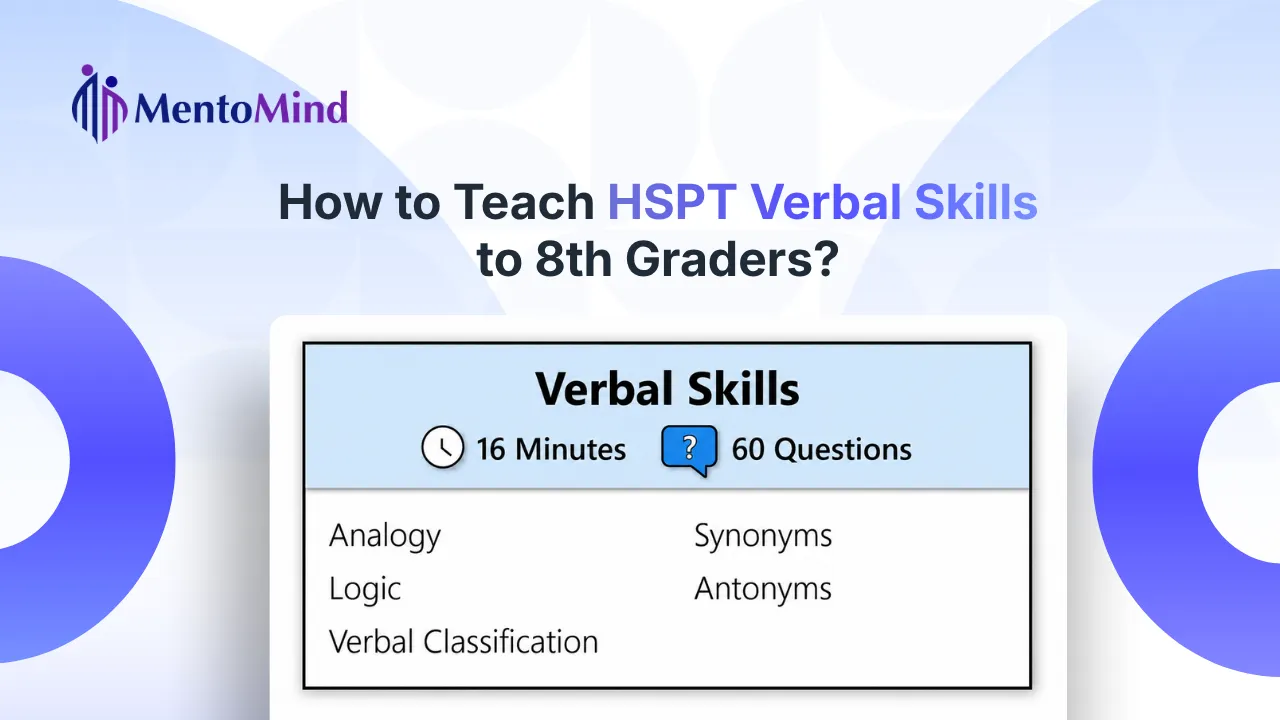
The Verbal section contains 60 questions in 16 minutes, roughly 16 seconds per question, making it the most time-pressured section on the exam. Understanding how long the HSPT test is overall, approximately 2 hours and 21 minutes of active testing, helps tutors explain to families why early preparation through a structured HSPT prep course matters so much.
The verbal question types
- Synonyms and Antonyms – Choose the word closest in meaning, or the word most opposite in meaning. These vocabulary questions appear throughout the section and are often grouped together in prep materials, though they test slightly different recall skills.
- Analogies – Identify the relationship between two words and apply it to a second pair.
- Verbal Classification – Identify which word in a group does not belong.
- Verbal Logic and Reasoning – Determine whether a conclusion is true, false, or uncertain.
Many tutors treat all of these as vocabulary problems and assign word lists. That works for synonyms and antonyms but does almost nothing for analogies or logic. Each question type needs its own method, which is why an HSPT diagnostic test at the start of any HSPT preparation is essential; it shows you exactly where each student needs to focus.
Why 8th Graders Struggle
The vocabulary gap. Most 8th graders have strong recognition vocabulary: words they understand when they read them. The HSPT tests recall vocabulary; words they can define and differentiate under time pressure. Words like fastidious, indolent, and tenacious appear regularly on the HSPT but rarely in 8th-grade coursework.
Analogy reasoning is a taught skill. Students who have never practiced analogies pick answers by feel. That fails above the basic level. In practice, two to three hours of structured framework instruction tends to outperform far more time spent on unguided HSPT practice questions.
Pacing is a physical shock. Run this drill with every new student – 10 Verbal questions, 2 minutes and 40 seconds on the clock. Almost every student either rushes through or freezes. Identify this issue in week one, not on test day. From the start, teach the skip-and-return protocol: if a question has no clear direction within 15 to 20 seconds, circle it, move on, and return only if time permits. Since there is no guessing penalty, no question should ever be left blank.
Teaching Synonyms and Antonyms
Use tier 2 vocabulary in context, not lists
Words learned through contextual exposure stick significantly better than words memorized from lists. Present each target word in 2 to 3 different sentences instead of pairing it with a single definition.
Instead of – Reticent, adj. not revealing one’s thoughts readily.
Use “She was reticent about sharing her scores. Her quiet, reticent manner made her seem distant. Even when pressed, she said nothing.”
Build 10 to 12 new words per week via context sentences. Review prior weeks’ words with fill-in-the-blank sentences, which force students to process meaning rather than just recognize a word. This approach makes vocabulary acquisition far more effective than any HSPT practice worksheets that rely on rote matching alone.
Core vocabulary groups to target – personality and character (taciturn, gregarious, fastidious, affable); degree and intensity (negligible, profound, paltry); clarity (lucid, ambiguous, cryptic); action words (placate, antagonize, bolster, corroborate).
Practice – Synonyms and antonyms
These questions are realistic HSPT-style examples. Students can work through them independently or tutors can use them as in-session drills.
Q1. TENACIOUS most nearly means
(A) fragile
(B) persistent
(C) generous
(D) careless
Answer is (B). Tenacious means holding firm, not giving up.
Q2. The opposite of RETICENT is
(A) outspoken
(B) quiet
(C) nervous
(D) stubborn
Answer is (A). Reticent means reserved; outspoken is its opposite.
Q3. PLACATE most nearly means
(A) irritate
(B) confuse
(C) calm
(D) strengthen
Answer is (C). To placate is to make someone less angry or upset.
Teaching Analogies – The Relationship-First Method
Name the relationship before looking at answers
When a student sees DOCTOR : STETHOSCOPE ::, the first step is naming the relationship aloud. “A doctor uses a stethoscope. This is a professional-to-tool relationship.” Then they find the answer choice matching that same type. This eliminates guessing because students are testing a hypothesis, not scanning every option.
Teach students to reject choices whose relationship type does not match, even when the words seem related. PAINTER : CANVAS looks close, but a painter works on a canvas, which is a person-to-surface relationship, not person-to-tool.
Relationship types to drill
The eight relationship types that appear most on the HSPT: Part to Whole (petal : flower), Tool to Function (thermometer : temperature), Cause to Effect (drought : famine), Degree (warm : scorching), Antonym pair (bold : timid), Member to Category (sparrow : bird), Creator to Creation (author : novel), and Location (surgery : hospital).
Start with single-relationship-type sets. Move to mixed sets only after students name each type without hesitation.
Practice – Analogies
Q4. AUTHOR is to NOVEL as COMPOSER is to
(A) instrument
(B) symphony
(C) lyrics
(D) conductor
Relationship is Creator to Creation.
Answer is (B)
Q5. DROUGHT is to FAMINE as FLOOD is to
(A) rainfall
(B) destruction
(C) river
(D) crops
Relationship is Cause to Effect.
Answer is (B)
Q6. SURGEON is to HOSPITAL as PILOT is to
(A) airplane
(B) runway
(C) cockpit
(D) airport
Relationship is Professional to workplace.
Answer is (D)
Teaching Verbal Classification
Classification questions ask students to find the word that does not belong. The key is the most specific shared property among the other words, not just any surface connection.
Example
January, March, May, Monday, July
Monday is the answer, because it is not a month. Students miss this when they stop at “all are time-related” instead of the precise category (all are months). Teach students to ask, “What is the single most specific property the others share?” before answering.
Practice – Verbal classification
Q7. Which word does NOT belong?
(A) Eagle
(B) Hawk
(C) Penguin
(D) Falcon
Answer is (C). Eagle, hawk, falcon, and osprey are birds of prey. A penguin is not.
Q8. Which word does NOT belong?
(A) Inch
(B) Meter
(C) Pound
(D) Yard
Answer is (C). All others measure length. Pound measures weight.
Teaching Verbal Logic and Reasoning
This subtype surprises students most because it requires formal logical thinking that middle school English rarely covers. The HSPT tests whether a conclusion is definitely true, definitely false, or uncertain given two or three statements.
The “Some” trap
“All dogs are mammals. Some mammals are brown. Therefore, all dogs are brown.”
If the first two statements are true, the third is
(A) True
(B) False
(C) Uncertain
Most students pick (A). The answer is (C). “Some mammals are brown” does not say which ones. Those brown mammals may not include any dogs. The word “some” breaks the chain.
Teach students to circle “some,” “most,” “all,” and “none” in every logic question. These quantifiers control what can actually be proven.
Practice – Verbal logic
Q9. All squares are rectangles. Some rectangles are blue. Therefore, some squares are blue.
(A) True
(B) False
(C) Uncertain
Answer is (C). “Some rectangles are blue” does not confirm any of those blue rectangles are squares.
Q10. No fish can breathe air. A salmon is a fish. Therefore, a salmon cannot breathe air.
(A) True
(B) False
(C) Uncertain
Answer is (A). Valid. All fish are excluded from air-breathing, and a salmon is a fish.
Weekly Practice Routine
A three-session-per-week structure works well for 8th graders with 6 to 10 weeks before the exam. Use MentoMind’s HSPT adaptive assignments to handle between-session HSPT online practice automatically, so students are building on each session without requiring tutors to manually assign every drill.
Session 1 (30 min)
Vocabulary Introduce 10 to 12 new Tier 2 words via context sentences. Review prior weeks’ words with fill-in-the-blank. Close with 10 rapid synonym questions.
Session 2 (35 min)
Analogies and Classification Five relationship-naming warm-ups with no answer choices shown. Then 20 analogy questions sorted by type, plus 10 verbal classification questions. Review every error by identifying the correct relationship or category.
Session 3 (30 to 40 min)
Timed Mixed Practice A full timed HSPT practice exam (60 questions, 16 minutes) or a timed half-section. Track error patterns by subtype. Students who miss the same type repeatedly need targeted drilling, not more mixed practice.
For students below the 40th percentile on Verbal, use MentoMind’s tutor dashboard to run a structured HSPT diagnostic test and pinpoint which subtype is driving the most errors, then isolate that skill for two weeks before returning to mixed practice.
Frequently Asked Questions
Most 8th graders see measurable improvement in 6 to 8 weeks with three focused sessions per week. Students starting 10 or more weeks out have a meaningful advantage, particularly for vocabulary acquisition.
No. Students should answer every question. Teach the skip-and-return protocol so no question gets left blank because time ran out.
The HSPT Verbal section is significantly more time-pressured than either the ISEE Upper Level or SSAT, and it includes verbal classification and formal logic (syllogism) questions that do not appear on those exams. The SSAT also applies a 0.25-point penalty for wrong answers, while the HSPT does not. See the HSPT vs ISEE vs SSAT breakdown for a full comparison.
Most tutors recommend starting 8 to 12 weeks before the test date. For the most common January test window, that means beginning in September or October. Vocabulary acquisition is the longest-lead skill. It needs consistent weekly exposure over time, not a last-minute sprint. Earlier is meaningfully better for students with weak word knowledge.
The section mixes all five question types (synonyms, antonyms, analogies, verbal classification, and logic) without grouping them. Students cannot build a rhythm by type the way they might in a section that clusters similar questions. This is one reason timed mixed practice in Session 3 is important: students need to shift mental modes quickly question to question, not just perform each type in isolation.
The Verbal Skills section contains 60 questions with a 16-minute time limit, roughly 16 seconds per question. Across all five sections, the HSPT has 298 questions total, but for verbal prep purposes the 60-question, 16-minute Verbal section is the focus.
Yes. HSPT test scores include section-level breakdowns, and HSPT scoring on the Verbal section is reported on the same 200 to 800 scale as other sections. The HSPT score chart and HSPT score calculator can help tutors interpret where a student sits nationally.
How MentoMind Supports HSPT Verbal Prep
MentoMind offers a full HSPT prep course covering all five exam sections. It includes 1,000+ HSPT practice questions, 3 full-length HSPT practice exams, a downloadable HSPT verbal skills practice test PDF, and printable HSPT sample test PDFs, all in a single subscription that also covers SAT, ACT, AP Math, and PSSA. Tutors running HSPT prep classes, an HSPT online prep course, or individual HSPT tutoring sessions use MentoMind to replace the manual work of sourcing questions and tracking progress.
For tutors, MentoMind includes adaptive question assignment by subtype, a companion with step-by-step hints, a topic-level dashboard showing which verbal subtypes each student misses, and automated weekly parent reports under your brand. Starting at $24.99 per month per student, with a free HSPT diagnostic test at sign-up.